JavaScript is disabled in your browser. Please enable JavaScript to view this website.
AB66501

Anti-HCN4 antibody

Be the first to review this product! Submit a review

|

(5 Publications )
Rabbit Polyclonal HCN4 antibody. Suitable for IHC-P and reacts with Human samples. Cited in 5 publications. Immunogen corresponding to Synthetic Peptide within Human HCN4.
1 Images
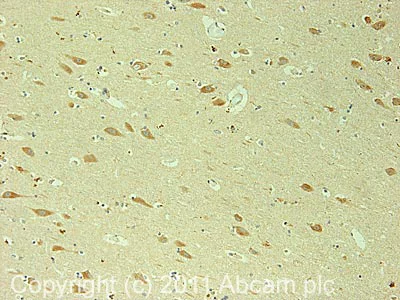
Immunohistochemistry (Formalin/PFA-fixed paraffin-embedded sections) - Anti-HCN4 antibody (AB66501)
  • IHC-P

Unknown

Immunohistochemistry (Formalin/PFA-fixed paraffin-embedded sections) - Anti-HCN4 antibody (AB66501)

IHC image of ab66501 staining in human hippocampus formalin fixed paraffin embedded tissue section, performed on a Leica BondTM system using the standard protocol F. The section was pre-treated using heat mediated antigen retrieval with sodium citrate buffer (pH6, epitope retrieval solution 1) for 20 mins. The section was then incubated with ab66501, 5µg/ml, for 15 mins at room temperature and detected using an HRP conjugated compact polymer system. DAB was used as the chromogen. The section was then counterstained with haematoxylin and mounted with DPX.

For other IHC staining systems (automated and non-automated) customers should optimize variable parameters such as antigen retrieval conditions, primary antibody concentration and antibody incubation times.

Key facts

Host species

Rabbit

Clonality

Polyclonal

Isotype

IgG

Carrier free

No

Reacts with

Human

Applications

IHC-P

applications

Immunogen

Synthetic Peptide within Human HCN4. The exact immunogen used to generate this antibody is proprietary information.

Q9Y3Q4

Reactivity data

{ "title": "Reactivity Data", "filters": { "stats": ["", "Species", "Dilution Info", "Notes"], "tabs": { "all-applications": {"fullname" : "All Applications", "shortname": "All Applications"}, "IHCP" : {"fullname" : "Immunohistochemistry (Formalin/PFA-fixed paraffin-embedded sections)", "shortname":"IHC-P"} }, "product-promise": { "all": "all", "testedAndGuaranteed": "tested", "guaranteed": "expected", "predicted": "predicted", "notRecommended": "not-recommended" } }, "values": { "Human": { "IHCP-species-checked": "testedAndGuaranteed", "IHCP-species-dilution-info": "", "IHCP-species-notes": "<p></p>" }, "Mouse": { "IHCP-species-checked": "predicted", "IHCP-species-dilution-info": "", "IHCP-species-notes": "" }, "Rat": { "IHCP-species-checked": "predicted", "IHCP-species-dilution-info": "", "IHCP-species-notes": "" } } }

Properties and storage information

Form
Lyophilized
Reconstitution
reconstitute with water at 200µL
Purification technique
Affinity purification Protein A
Storage buffer
Constituents: PBS
Shipped at conditions
Blue Ice
Appropriate short-term storage conditions
+4°C
Appropriate long-term storage conditions
-20°C
Aliquoting information
Upon delivery aliquot
Storage information
Avoid freeze / thaw cycle

Supplementary information

This supplementary information is collated from multiple sources and compiled automatically.

HCN4 also known as hyperpolarization-activated cyclic nucleotide-gated channel 4 is a protein that functions mechanically as an ion channel. It aids in carrying the hyperpolarization-activated non-selective cation current also called I_f or funny current. HCN4 has a molecular mass of about 136 kDa. The channel is expressed prominently in heart tissues particularly in the sinoatrial node which plays an important role in pacemaker activity to regulate heart rate. HCN4 also appears in some regions of the central nervous system and contributes to neural activity.
Biological function summary

Hyperpolarization-activated ion currents mediated by HCN4 contribute to the pacing of cardiac cells. They allow controlled influx of Na^+ and K^+ ions therefore facilitating rhythmic cardiac activity. Although it does not form part of a larger complex HCN4 interacts with auxiliary subunits and regulator proteins that can modulate its activity. It can be influenced by internal cyclic AMP levels leading to changes in its kinetics and voltage dependency.

Pathways

The involvement of HCN4 mostly figures into cardiac conduction and neuronal signaling pathways. Within the cardiac conduction system it plays a pivotal role in maintaining coordinated heart rhythms. HCN4's function relates to proteins like HCN1 HCN2 and HCN3 which together form a family responsible for various rhythmic activities in the heart and brain. It also assists in stabilizing neuronal firing patterns influenced by neurotransmitter-mediated effects but has less direct interaction with these related proteins.

Mutations or dysfunctions in HCN4 can lead to cardiac arrhythmias like bradycardia. Abnormalities in the function of this protein can also contribute to sick sinus syndrome a condition characterized by problems with the sinoatrial node that affects heart rhythm. In these scenarios HCN4's interaction with other channel proteins and regulatory molecules becomes important as interventions might target these associated pathways for treatment.

Product protocols

For this product, it's our understanding that no specific protocols are required. You can visit:

Target data

Hyperpolarization-activated ion channel that are permeable to Na(+) and K(+) ions with very slow activation and inactivation (PubMed : 10228147, PubMed : 10430953, PubMed : 20829353). Exhibits higher selectivity for K(+) over Na(+) ions (PubMed : 10228147). Contributes to the native pacemaker currents in heart (If) that regulate the rhythm of heart beat (Probable) (PubMed : 10228147, PubMed : 16407510, PubMed : 19165230). Contributes to the native pacemaker currents in neurons (Ih) (Probable). May mediate responses to sour stimuli (By similarity).
See full target information HCN4

Alternative Names

Potassium/sodium hyperpolarization-activated cyclic nucleotide-gated channel 4, HCN4

Publications (5)

Recent publications for all applications. Explore the full listand refine your search

iScience 28:112005 PubMed40092609

2025

Spatiotemporal profiling of protein kinase A activity in spontaneously beating hiPSC-derived cardiac organoids.

Applications

Unspecified application

Species

Unspecified reactive species

Ido Weiser-Bitoun,Savyon Mazgaoker,Rami Eid,Inbar Brosh,Yael Yaniv

JCI insight 7: PubMed36509290

2022

Adenylyl cyclase isoform 1 contributes to sinoatrial node automaticity via functional microdomains.

Applications

Unspecified application

Species

Unspecified reactive species

Lu Ren,Phung N Thai,Raghavender Reddy Gopireddy,Valeriy Timofeyev,Hannah A Ledford,Ryan L Woltz,Seojin Park,Jose L Puglisi,Claudia M Moreno,Luis Fernando Santana,Alana C Conti,Michael I Kotlikoff,Yang Kevin Xiang,Vladimir Yarov-Yarovoy,Manuela Zaccolo,Xiao-Dong Zhang,Ebenezer N Yamoah,Manuel F Navedo,Nipavan Chiamvimonvat

Cells 10: PubMed34685588

2021

A Human 3D Cardiomyocyte Risk Model to Study the Cardiotoxic Influence of X-rays and Other Noxae in Adults.

Applications

Unspecified application

Species

Unspecified reactive species

Timo Smit,Esther Schickel,Omid Azimzadeh,Christine von Toerne,Oliver Rauh,Sylvia Ritter,Marco Durante,Insa S Schroeder

BioMed research international 2018:7487324 PubMed30581867

2018

Development of a Rat Model of Sick Sinus Syndrome Using Pinpoint Press Permeation.

Applications

Unspecified application

Species

Unspecified reactive species

Hong-Bin Zhong,Ting-Jun Wang,Gui-Li Lian,Chang-Sheng Xu,Hua-Jun Wang,Liang-di Xie

Biology open 6:1445-1457 PubMed28818840

2017

HCN4 ion channel function is required for early events that regulate anatomical left-right patterning in a nodal and lefty asymmetric gene expression-independent manner.

Applications

Unspecified application

Species

Unspecified reactive species

Vaibhav P Pai,Valerie Willocq,Emily J Pitcairn,Joan M Lemire,Jean-François Paré,Nian-Qing Shi,Kelly A McLaughlin,Michael Levin
View all publications

Product promise

We are committed to supporting your work with high-quality reagents, and we're here for you every step of the way. In the unlikely event that one of our products does not perform as expected, you're protected by our Product Promise.
For full details, please see our Terms & Conditions

Please note: All products are 'FOR RESEARCH USE ONLY. NOT FOR USE IN DIAGNOSTIC OR THERAPEUTIC PROCEDURES'.

For licensing inquiries, please contact partnerships@abcam.com