Anti-HEF1/NEDD-9 antibody [2G9]
Be the first to review this product! Submit a review
|
(0 Publication)
- WB
Supplier Data
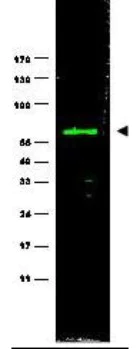
Western blot - Anti-HEF1/NEDD-9 antibody [2G9] (AB288750)
Western blot using ab288750 monoclonal anti-HEF1 antibody (clone 2G9) antibody shows detection of a ~92 kDa band corresponding to HEF1 in MCF7 lysate [arrowhead]. Approximately 35 μg of lysate was loaded for SDS-PAGE followed by transfer onto nitrocellulose and reaction with a 1 : 1,000 dilution of anti-HEF1 antibody. Detection occurred using a 1 : 5,000 dilution of IRDye®800 conjugated Sh-a-Mouse IgG [H&L] for 45 min at room temperature (800 nm channel, green). Molecular weight estimation was made by comparison to prestained MW markers (indicated at left). IRDye®800 fluorescence image was captured using the Odyssey® Infrared Imaging System developed by LI-COR. IRDye is a trademark of LI-COR, Inc. Other detection systems will yield similar results.
All lanes:
Western blot - Anti-HEF1/NEDD-9 antibody [2G9] (ab288750) at 1/1000 dilution
All lanes:
MCF7 lysate
Secondary
All lanes:
IRDye®800 conjugated Sh-a-Mouse IgG [H&L] at 1/5000 dilution
Predicted band size: 92 kDa
false
Complementary Products

Primary Antibodies
AB125031
20ul selling size|RabMAb|Recombinant|Trial Size

- 4
- 2
Primary Antibodies
AB81298
Anti-FAK (phospho Y397) antibody [EP2160Y]
20ul selling size|RabMAb|Recombinant

- 4
- 2
Primary Antibodies
AB40855
20ul selling size|RabMAb|Advanced Validation|Recombinant|KO Validated

- 5
- 4
Reactivity data
Properties and storage information
Form
Purification technique
Purification notes
Storage buffer
Shipped at conditions
Appropriate short-term storage duration
Appropriate short-term storage conditions
Appropriate long-term storage conditions
Aliquoting information
Storage information
Supplementary information
This supplementary information is collated from multiple sources and compiled automatically.
Biological function summary
HEF1 functions as a scaffolding protein involved in various cellular processes including cell adhesion migration and proliferation. It interacts with several other proteins and forms part of complexes such as focal adhesion complexes. It regulates the dynamics of these complexes by modulating signaling pathways linked to cellular adhesion and migration. In neuronal cells it influences axonal and dendritic branching.
Pathways
HEF1 plays a significant role in both the integrin signaling pathway and cell cycle regulation. Through these pathways HEF1 interacts with various key proteins including focal adhesion kinase (FAK) and Src kinase. It positions itself strategically within these pathways and facilitates cross-talk between signaling molecules enabling the coordination of structural and replicative functions in cells.
Product protocols
- Visit the General protocols
- Visit the Troubleshooting
Target data
Alternative Names
Product promise
Please note: All products are 'FOR RESEARCH USE ONLY. NOT FOR USE IN DIAGNOSTIC OR THERAPEUTIC PROCEDURES'.
For licensing inquiries, please contact partnerships@abcam.com