Anti-HERPUD1 antibody [EPR9649]
- RabMAb
- Recombinant
- KO Validated
- What is this?
Be the first to review this product! Submit a review
|
(11 Publications )
- Flow Cyt (Intra)
Unknown
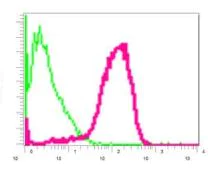
Flow Cytometry (Intracellular) - Anti-HERPUD1 antibody [EPR9649] (AB150424)
Intracellular flow cytometric analysis of permeabilized HepG2 cells labelling HERPUD1 with ab150424 at 1/10 dilution (red) or a rabbit IgG (negative).
- ICC/IF
Unknown
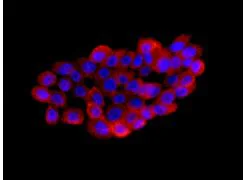
Immunocytochemistry/ Immunofluorescence - Anti-HERPUD1 antibody [EPR9649] (AB150424)
Immunofluorescent analysis of BxPC-3 cells labelling HERPUD1 with ab150424 at 1/100 dilution.
- WB
Unknown
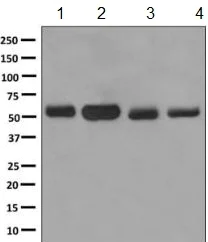
Western blot - Anti-HERPUD1 antibody [EPR9649] (AB150424)
All lanes:
Western blot - Anti-HERPUD1 antibody [EPR9649] (ab150424) at 1/1000 dilution
Lane 1:
BxPC-3 cell lysate at 10 µg
Lane 2:
HepG2 cell lysate at 10 µg
Lane 3:
SH-SY5Y cell lysate at 10 µg
Lane 4:
293T (Human embryonic kidney epithelial cell) cell lysate at 10 µg
Predicted band size: 44 kDa
false
- WB
Lab
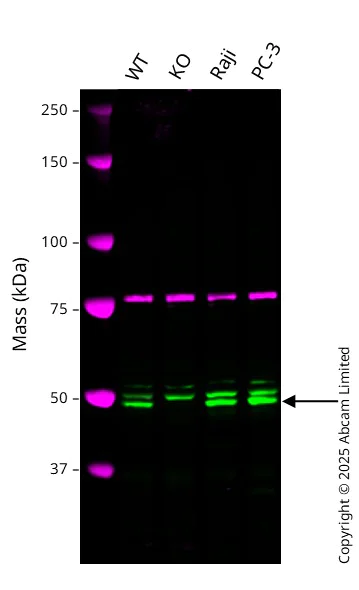
Western blot - Anti-HERPUD1 antibody [EPR9649] (AB150424)
Western blot : Anti-HERPUD1 antibody [EPR9649] ab150424 staining at 1/1000 dilution, shown in green; Mouse anti-CANX (ab238078) loading control staining at 1/20,000 dilution, shown in magenta. A band was observed at 49 kDa in Wild-type A549 cell lysates with no signal observed at this size in HERPUD1 knockout A549 cell line. To generate this image, samples were run on an SDS-PAGE gel then transferred onto a nitrocellulose membrane. Membranes were blocked in 5pc Milk in TBS-0.1 % Tween® 20 (TBS-T) before incubation with primary antibodies overnight at 4 °C. Blots were washed four times in TBS-T, incubated with secondary antibodies for 1 h at room temperature, washed again four times then imaged. Secondary antibodies used were Goat anti-Rabbit 800CW & Goat anti-Mouse 680RD at 1/20,000 dilution.
All lanes:
Western blot - Anti-HERPUD1 antibody [EPR9649] (ab150424) at 1/1000 dilution
Lane 1:
Wild-type A549 at 20 µg
Lane 2:
HERPUD1 knockout A549 at 20 µg
Lane 3:
Raji at 20 µg
Lane 4:
PC-3 at 20 µg
Secondary
Lanes 1 - 4:
Goat anti-Rabbit 800CW at 1/20000 dilution
Lanes 1 - 4:
Goat anti-Mouse 680RD at 1/20000 dilution
Predicted band size: 44 kDa
Observed band size: 49 kDa,76 kDa
false
Related conjugates and formulations (1)
-
Anti-HERPUD1 antibody [EPR9649] - BSA and Azide free
Complementary Products

Primary Antibodies
AB108615
Anti-GRP78 BiP antibody [EPR4041(2)]
20ul selling size|RabMAb|Recombinant

- 5
- 3


Reactivity data
Product details
Patented technology
Our RabMAb® technology is a patented hybridoma-based technology for making rabbit monoclonal antibodies. For details on our patents, please refer to RabMAb® patents.
What are the advantages of a recombinant monoclonal antibody?
This product is a recombinant monoclonal antibody, which offers several advantages including:
- - High batch-to-batch consistency and reproducibility
- - Improved sensitivity and specificity
- - Long-term security of supply
- - Animal-free batch production
For more information, read more on recombinant antibodies.
Properties and storage information
Form
Purification technique
Storage buffer
Shipped at conditions
Appropriate short-term storage conditions
Appropriate long-term storage conditions
Supplementary information
This supplementary information is collated from multiple sources and compiled automatically.
Biological function summary
HERPUD1 helps maintain cellular homeostasis during periods of ER stress by facilitating the degradation of misfolded proteins. It forms part of a larger complex in the ER-associated degradation (ERAD) pathway which targets these proteins for retrotranslocation and subsequent destruction by the proteasome. HERPUD1 therefore plays a vital role in mitigating the buildup of potentially harmful proteins within the cell.
Pathways
HERPUD1 is integral to the unfolded protein response (UPR) and the ERAD pathway. In the UPR HERPUD1 is involved in signaling mechanisms that help restore normal ER function. It interacts with other proteins such as SEL1L and DERLIN-1 within the ERAD pathway to ensure the proper disposal of misfolded proteins preventing cellular damage.
Product protocols
- Visit the General protocols
- Visit the Troubleshooting
Target data
Alternative Names
Publications (11)
Recent publications for all applications. Explore the full listand refine your search
Nature communications 15:1440 PubMed38365914
2024
Applications
Unspecified application
Species
Unspecified reactive species
Cell biology and toxicology 39:2665-2684 PubMed36746840
2023
Applications
Unspecified application
Species
Unspecified reactive species
Cell death discovery 8:376 PubMed36038536
2022
Applications
Unspecified application
Species
Unspecified reactive species
Frontiers in cell and developmental biology 10:743287 PubMed35309917
2022
Applications
Unspecified application
Species
Unspecified reactive species
PLoS pathogens 17:e1009644 PubMed34138976
2021
Applications
Unspecified application
Species
Unspecified reactive species
Journal of cellular and molecular medicine 25:6709-6720 PubMed34057287
2021
Applications
Unspecified application
Species
Unspecified reactive species
eLife 9: PubMed32614325
2020
Applications
Unspecified application
Species
Unspecified reactive species
International journal of cardiology 269:242-249 PubMed30017525
2018
Applications
Unspecified application
Species
Unspecified reactive species
Scientific reports 8:3902 PubMed29500363
2018
Applications
Unspecified application
Species
Unspecified reactive species
Medical science monitor : international medical jo 23:5774-5782 PubMed29206808
2017
Applications
Unspecified application
Species
Unspecified reactive species
Product promise
Please note: All products are 'FOR RESEARCH USE ONLY. NOT FOR USE IN DIAGNOSTIC OR THERAPEUTIC PROCEDURES'.
For licensing inquiries, please contact partnerships@abcam.com