Anti-Histone H3 (asymmetric di methyl R17) antibody
4
(17 Reviews)
|
(68 Publications )
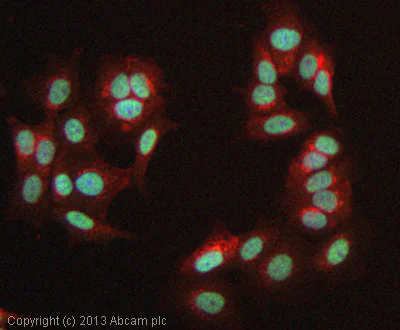
- ICC/IF
Unknown
Immunocytochemistry/ Immunofluorescence - Anti-Histone H3 (asymmetric di methyl R17) antibody (AB8284)
ICC/IF image of ab8284 stained MCF7 cells. The cells were 100% methanol fixed (5 min) and then incubated in 1%BSA / 10% normal goat serum / 0.3M glycine in 0.1% PBS-Tween for 1h to permeabilise the cells and block non-specific protein-protein interactions. The cells were then incubated with the antibody (ab8284, 0.1µg/ml) overnight at +4°C. The secondary antibody (green) was ab96899, DyLight® 488 goat anti-rabbit IgG (H+L) used at a 1/250 dilution for 1h. Alexa Fluor® 594 WGA was used to label plasma membranes (red) at a 1/200 dilution for 1h. DAPI was used to stain the cell nuclei (blue) at a concentration of 1.43µM.
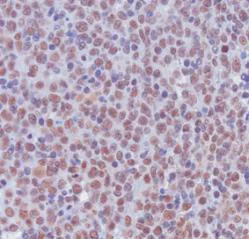
- IHC-P
Unknown
Immunohistochemistry (Formalin/PFA-fixed paraffin-embedded sections) - Anti-Histone H3 (asymmetric di methyl R17) antibody (AB8284)
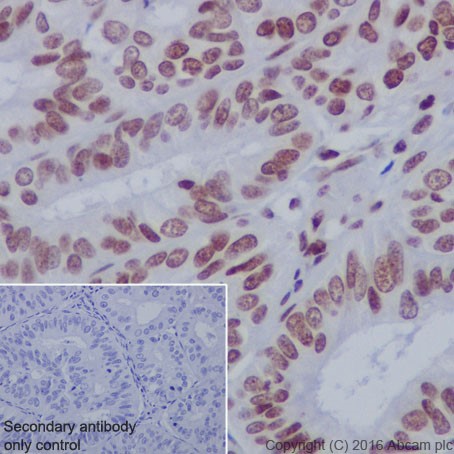
ab8284 was used in immunohistochemistry with paraffin embedded sections of human tonsil, using DAB as a chromogen (brown). Counterstaining of nuclei was performed with haemotoxylin (blue).
Staining is seen confined to the nucleus.
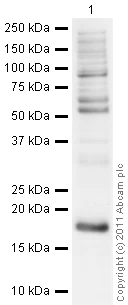
- WB
Unknown
Western blot - Anti-Histone H3 (asymmetric di methyl R17) antibody (AB8284)
All lanes:
Western blot - Anti-Histone H3 (asymmetric di methyl R17) antibody (ab8284) at 1 µg/mL
All lanes:
HeLa Histone Preparation Nuclear Lysate at 2.5 µg/mL
Secondary
All lanes:
Western blot - Goat Anti-Rabbit IgG H&L (HRP) preadsorbed (<a href='/en-us/products/secondary-antibodies/goat-rabbit-igg-h-l-hrp-preadsorbed-ab97080'>ab97080</a>) at 1/5000 dilution
Predicted band size: 15 kDa
Observed band size: 17 kDa,55 kDa,60 kDa,90 kDa
true
Exposure time: 2min
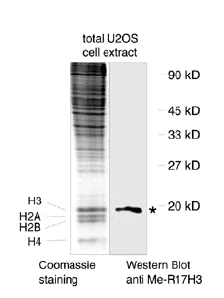
- WB
PubMed
Western blot - Anti-Histone H3 (asymmetric di methyl R17) antibody (AB8284)
Total U2OS cell extract was western blotted using the anti-Me-R17H3 antibody. The asterisk indicates methylated histone H3. The left panel shows presence of core histones (indicated on the left) by Coomassie Blue staining. Molecular weights are indicated on the right.
All lanes:
Western blot - Anti-Histone H3 (asymmetric di methyl R17) antibody (ab8284)
All lanes:
Total U2OS cell extract
Predicted band size: 15 kDa
false
Taken from Bauer et al, (2001).
- PepArr
Unknown
Peptide Array - Anti-Histone H3 (asymmetric di methyl R17) antibody (AB8284)
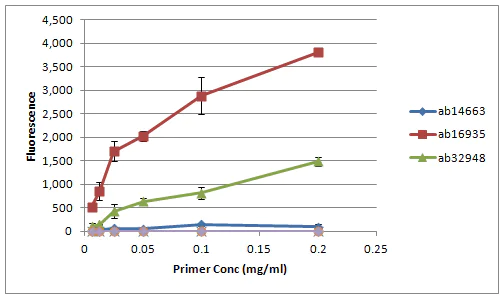
All batches of ab8284 are tested in Peptide Array against peptides to different Histone H3 modifications. Six dilutions of each peptide are printed on to the Peptide Array in triplicate and results are averaged before being plotted on to a graph. Results show strong binding to Histone H3 - asymmetric di methyl R17 peptide (ab16935), indicating that this antibody specifically recognises the Histone H3 - asymmetric di methyl R17 modification.
- Dot
Unknown
Dot Blot - Anti-Histone H3 (asymmetric di methyl R17) antibody (AB8284)
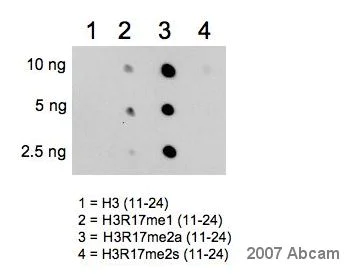
A dot blot was performed using unmodified peptide (lane 1), Histone H3 mono methyl R17 peptide (lane 2), Histone H3 asymmetric di methyl R17 peptide (lane 3) and Histone H3 symmetric di methyl R17 peptide (lane 4). The dot blot indicates that ab8284 is specific to Histone H3 asymmetric di methyl R17.
- WB
CiteAb
Western blot - Anti-Histone H3 (asymmetric di methyl R17) antibody (AB8284)
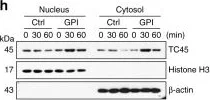
Western Blotting using Anti-Histone H3 (asymmetric di methyl R17) antibody, ab8284. Publication image from Ma, J. et al., 2020, Nat Commun, 32286295. Legend direct from paper.
UDPG-P2Y14 pathway regulates STAT1 phosphorylation.a, b BMDMs were pretreated with GPI (20 or 50 µM) for 30 min or pretransfected with Pygl siRNA for 24 h prior to stimulation with IFN-γ/LPS, followed by western blot analysis of STAT1 and its phosphorylation from 15 to 120 min after stimulation. c, dPygl siRNA transfected BMDMs were treated with IFN-γ/LPS ± UDPG, STAT1 and its phosphorylation was analyzed by two-photon confocal microscope, scale bar, 10 µm (c) and western blot (d). e BMDMs were pretransfected with Pygl siRNA for 24 h prior to stimulation with IFN-γ/LPS, followed by western blot analysis of JAK1 and JAK2 from 15 to 120 min after stimulation. f, g BMDMs were pretreated with GPI alone or combined with MG132 (f) or Na3VO4 (g) for 30 min prior to stimulation with IFN-γ/LPS, followed by western blot analysis of STAT1, JAK1, and JAK2 from 15 to 120 min after stimulation. h BMDMs were pretreated with GPI for 30 min prior to stimulation with IFN-γ/LPS, the cytoplasmic and nuclear protein fractions were blotted for TC45, β-actin (cytoplasmic marker) and Histone H3 (nuclear marker). iPtpn2 siRNA transfected BMDMs were stimulated with IFN-γ/LPS, STAT1, JAK1, JAK2, and TC45 were analyzed by western blot. jPygl siRNA transfected BMDMs were stimulated with IFN-γ/LPS ± UDPG, ERK, JNK, P38, JAK1, JAK2, and TC45 were analyzed from 15 to 120 min after stimulation by western blot. k, l IFN-γ/LPS stimulated BMDMs were treated with UDPG alone or combined with U0126, SP600125 or SB203580 for 1 and 3 h, JAK1, JAK2, STAT1, and TC45 were analyzed by western blot (k). Nos2, Tnf, Il6, and Il1b expression was determined by real-time PCR (l). Data are presented as mean ± SEM of n = 3 biologically independent experiments. P values were calculated using one-way ANOVA.
false
Alternative Products
Primary Antibodies
AB176916
Anti-Histone H3 (tri methyl K9) antibody [EPR16601] - ChIP Grade
20ul selling size|RabMAb|Advanced Validation|Recombinant

- 4
- 14
Primary Antibodies
AB32356
Anti-Histone H3 (di methyl K4) antibody [Y47] - ChIP Grade
20ul selling size|RabMAb|Advanced Validation|Recombinant

- 5
- 14
Primary Antibodies
AB52946
Anti-Histone H3 (acetyl K14) antibody [EP964Y] - ChIP Grade
20ul selling size|BOND RX™ Validated|RabMAb|Recombinant|Advanced Validation
- 5
- 12
Primary Antibodies
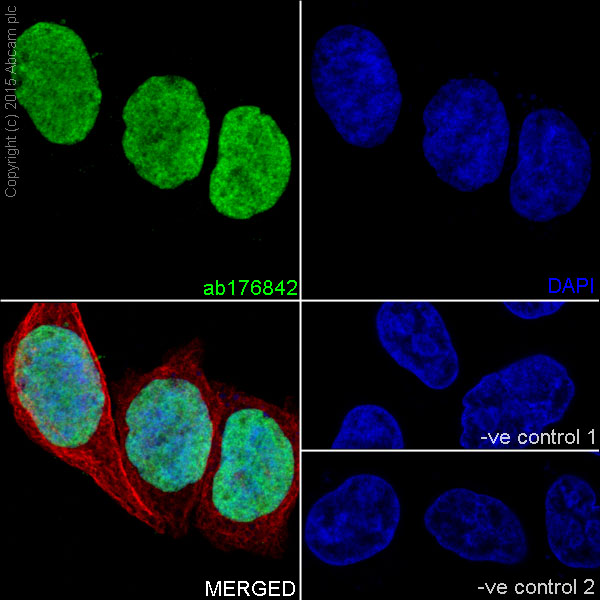
AB176842
Anti-Histone H3 antibody [EPR16987] - Nuclear Marker and ChIP Grade
20ul selling size|RabMAb|Recombinant|Lab Essentials|Advanced Validation
- 5
- 15
Primary Antibodies
AB176843
Anti-Histone H3 (citrulline R2) antibody [EPR17703]
20ul selling size|RabMAb|Advanced Validation|Recombinant

- 5
- 1
Primary Antibodies
AB219407
Anti-Histone H3 (citrulline R17) antibody [EPR20358-120]
RabMAb|Recombinant|20ul selling size

- 5
- 1
Primary Antibodies
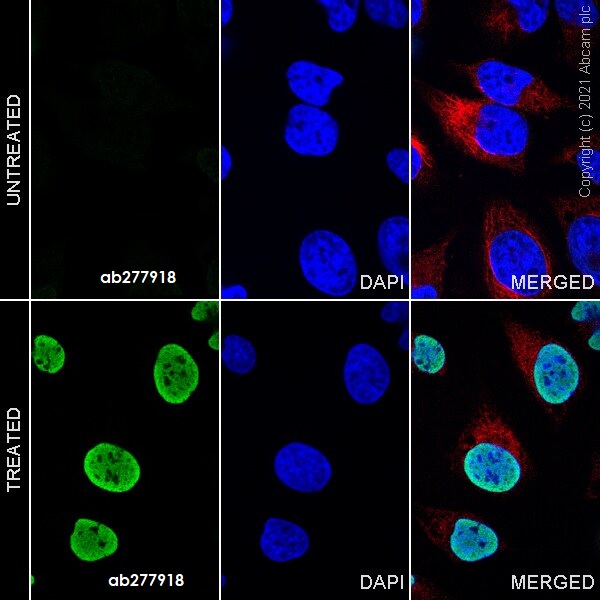
AB277918
Alexa Fluor® 488 Anti-Histone H3 (acetyl K14) antibody [EP964Y]
RabMAb|Recombinant
- 0
- 0
Primary Antibodies
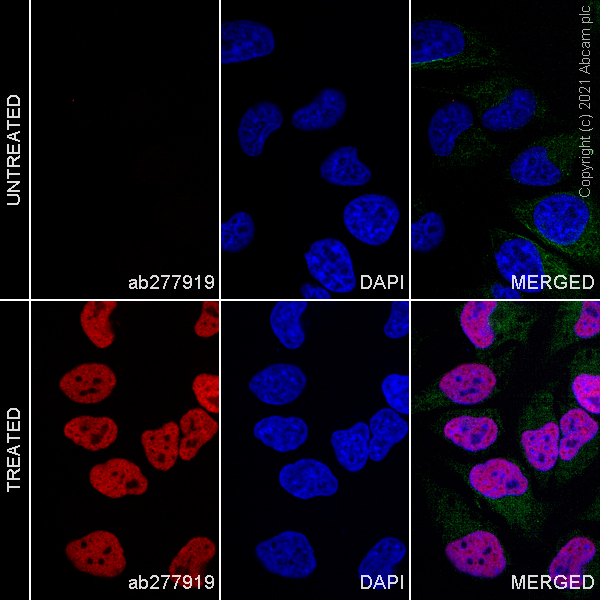
AB277919
Alexa Fluor® 647 Anti-Histone H3 (acetyl K14) antibody [EP964Y]
RabMAb|Recombinant
- 0
- 0
Primary Antibodies
AB192985
Anti-Histone H3 (tri methyl K27) antibody [EPR18607] - ChIP Grade
20ul selling size|RabMAb|Advanced Validation|Recombinant

- 4
- 14
Complementary Products
Primary Antibodies
AB8580
Anti-Histone H3 (tri methyl K4) antibody - ChIP Grade
BOND RX™ Validated

- 5
- 90
Primary Antibodies
AB4729
Anti-Histone H3 (acetyl K27) antibody - ChIP Grade
BOND RX™ Validated

- 5
- 85
Primary Antibodies
AB8895
Anti-Histone H3 (mono methyl K4) antibody - ChIP Grade
BOND RX™ Validated

- 4
- 59

Reactivity data
Product details
Properties and storage information
Form
Purification technique
Storage buffer
Shipped at conditions
Appropriate short-term storage duration
Appropriate short-term storage conditions
Appropriate long-term storage conditions
Aliquoting information
Storage information
Product protocols
- Visit the General protocols
- Visit the Troubleshooting
Target data
Alternative Names
Publications (68)
Recent publications for all applications. Explore the full listand refine your search
The Journal of biological chemistry 301:108271 PubMed39922487
2025
Applications
Unspecified application
Species
Unspecified reactive species
Cell death & disease 15:670 PubMed39266534
2024
Applications
Unspecified application
Species
Unspecified reactive species
Genes 15: PubMed38927636
2024
Applications
Unspecified application
Species
Unspecified reactive species
Nature communications 15:3336 PubMed38637528
2024
Applications
Unspecified application
Species
Unspecified reactive species
Cell reports 42:113468 PubMed37995178
2023
Applications
Unspecified application
Species
Unspecified reactive species
Cancer research communications 3:1067-1077 PubMed37377614
2023
Applications
Unspecified application
Species
Unspecified reactive species
Cells 12: PubMed37408241
2023
Applications
Unspecified application
Species
Unspecified reactive species
Frontiers in molecular biosciences 8:688973 PubMed34557518
2021
Applications
Unspecified application
Species
Unspecified reactive species
Nature communications 12:5321 PubMed34493732
2021
Applications
Unspecified application
Species
Unspecified reactive species
International journal of molecular sciences 22: PubMed34360791
2021
Applications
Unspecified application
Species
Unspecified reactive species
Product promise
Please note: All products are 'FOR RESEARCH USE ONLY. NOT FOR USE IN DIAGNOSTIC OR THERAPEUTIC PROCEDURES'.
For licensing inquiries, please contact partnerships@abcam.com