HRP Anti-ATPB antibody [3D5] - Mitochondrial Marker
Be the first to review this product! Submit a review
|
(1 Publication)
- WB
Lab
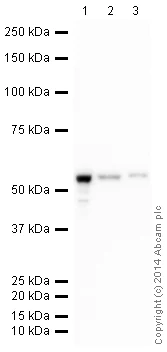
Western blot - HRP Anti-ATPB antibody [3D5] - Mitochondrial Marker (AB197905)
This blot was produced using a 4-12% Bis-tris gel under the MOPS buffer system. The gel was run at 200V for 50 minutes before being transferred onto a Nitrocellulose membrane at 30V for 70 minutes. The membrane was then blocked for an hour using 2% Bovine Serum Albumin before being incubated with ab197905 overnight at 4°C. Antibody binding was visualised using ECL development solution ab133406.
All lanes:
Western blot - HRP Anti-ATPB antibody [3D5] - Mitochondrial Marker (ab197905) at 1/5000 dilution
Lane 1:
Human heart tissue lysate - mitochondrial extract (<a href='/en-us/products/unavailable/human-heart-tissue-lysate-mitochondrial-extract-ab110337'>ab110337</a>) at 5 µg
Lane 2:
Western blot - HeLa whole cell lysate (<a href='/en-us/products/cell-lysates/hela-whole-cell-lysate-ab150035'>ab150035</a>) at 10 µg
Lane 3:
HepG2 (Human hepatocellular liver carcinoma cell line) Whole Cell Lysate at 10 µg
Predicted band size: 56 kDa
Observed band size: 52 kDa
true
Exposure time: 2s
Related conjugates and formulations (3)
-
Anti-ATPB antibody [3D5] - Mitochondrial Marker
-
519 Alexa Fluor® 488
Alexa Fluor® 488 Anti-ATPB antibody [3D5] - Mitochondrial Marker
-
665 Alexa Fluor® 647
Alexa Fluor® 647 Anti-ATPB antibody [3D5] - Mitochondrial Marker
Alternative Products
Primary Antibodies
AB170948
Anti-ATPB antibody [EPR11991] - Mitochondrial Marker
RabMAb|Recombinant
- 0
- 1
Primary Antibodies
AB223436
Alexa Fluor® 647 Anti-ATPB antibody [EPR11990] - Mitochondrial Marker
RabMAb|Recombinant

- 0
- 0
Complementary Products
Primary Antibodies
AB14748
Anti-ATP5A antibody [15H4C4] - Mitochondrial Marker
BOND RX™ Validated|Lab Essentials
- 5
- 27
Primary Antibodies
AB209606
Alexa Fluor® 647 Anti-TOMM20 antibody [EPR15581-54] - Mitochondrial Marker
RabMAb|Recombinant

- 5
- 2
Primary Antibodies
AB203832
Anti-UQCRC2 antibody [EPR13051]
RabMAb|Recombinant|20ul selling size

- 5
- 1
Primary Antibodies
AB14744
Anti-COX IV antibody [20E8C12] - Mitochondrial Marker
Lab Essentials

- 5
- 23
Reactivity data
Properties and storage information
Form
Purification technique
Purification notes
Storage buffer
Shipped at conditions
Appropriate short-term storage duration
Appropriate short-term storage conditions
Appropriate long-term storage conditions
Aliquoting information
Storage information
Supplementary information
This supplementary information is collated from multiple sources and compiled automatically.
Biological function summary
ATPB functions as part of the mitochondrial ATP synthase complex which is also known as complex V of the electron transport chain. This complex is important for maintaining cellular energy homeostasis through ATP production. ATPB contributes to the catalytic activity necessary for ATP synthesis therefore supporting various cellular processes that require energy input such as muscle contraction and active transport. The protein also plays a role in coupling the proton motive force to ATP synthesis a function critical for mitochondrial efficiency and metabolic health.
Pathways
ATPB involves itself significantly in the oxidative phosphorylation and glycolysis pathways. It partners with other proteins in the ATP synthase complex such as ATP synthase subunit alpha (ATP5A1) to effectuate the conversion of energy. In the broader scope of energy metabolism ATPB integrates with glycolysis where glycolytic end-products feed into oxidative phosphorylation sustaining the cell’s energy currency. Both pathways are important for cells especially in tissues with high energy demands like the heart and skeletal muscles.
Product protocols
- Visit the General protocols
- Visit the Troubleshooting
Target data
Alternative Names
Publications (1)
Recent publications for all applications. Explore the full listand refine your search
Scientific reports 10:7795 PubMed32385361
2020
Applications
Unspecified application
Species
Unspecified reactive species
Product promise
Please note: All products are 'FOR RESEARCH USE ONLY. NOT FOR USE IN DIAGNOSTIC OR THERAPEUTIC PROCEDURES'.
For licensing inquiries, please contact partnerships@abcam.com