JavaScript is disabled in your browser. Please enable JavaScript to view this website.
AB323661

HRP Anti-PCSK9 antibody [EPR7627(2)]

Be the first to review this product! Submit a review

|

(0 Publication)
Rabbit Recombinant Monoclonal PCSK9 antibody - conjugated to HRP. Suitable for WB and reacts with Human samples.
1 Images
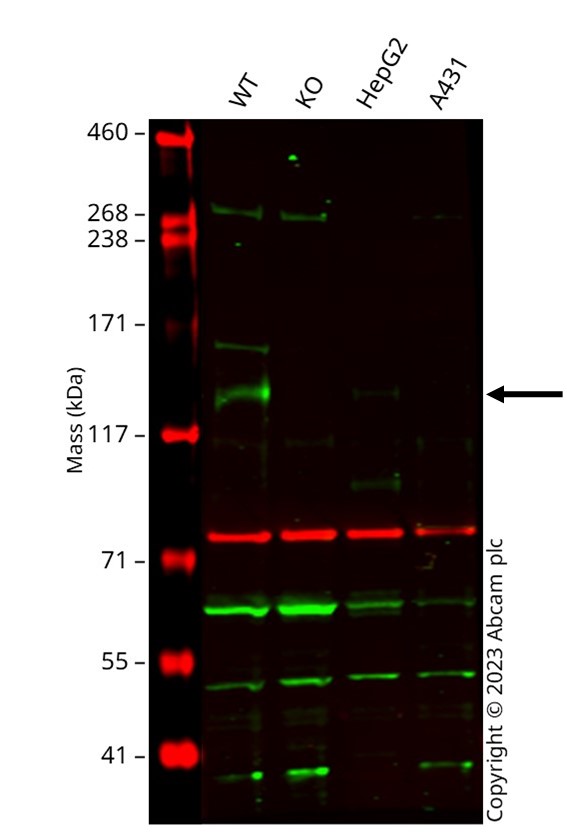
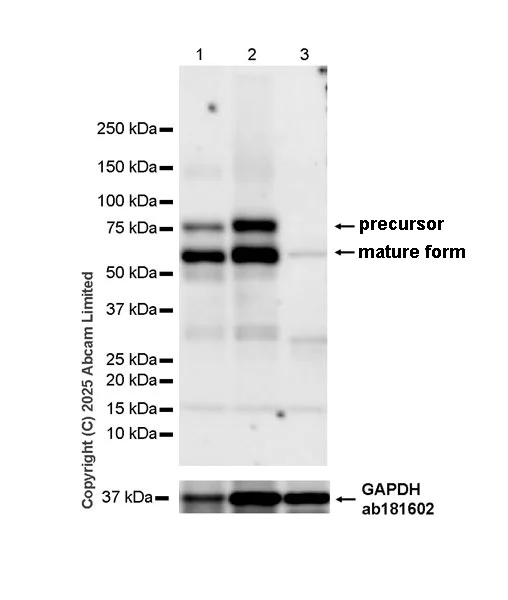
Western blot - HRP Anti-PCSK9 antibody [EPR7627(2)] (AB323661)
  • WB

Supplier Data

Western blot - HRP Anti-PCSK9 antibody [EPR7627(2)] (AB323661)

Blocking and diluting buffer and concentration : 5% NFDM/TBST.

Low expression : T-47D.

Precursor and mature forms : The band around 78 kDa is the precursor form and 62 kDa the mature form.

In Western blot, Anti-GAPDH antibody [EPR16891] - Loading Control (ab181602) staining at 1/200000 dilution.

All lanes:

Western blot - HRP Anti-PCSK9 antibody [EPR7627(2)] (ab323661) at 1/1000 dilution

Lane 1:

A431 (human epidermoid carcinoma epithelial cell) whole cell lysate at 20 µg

Lane 2:

BxPC-3 (human pancreas adenocarcinoma epithelial cell) whole cell lysate at 20 µg

Lane 3:

T-47D (human ductal breast epithelial tumor epithelial cell) whole cell lysate at 20 µg

Observed band size: 62 kDa,78 kDa,36 kDa

false

Exposure time: 37s

Key facts

Host species

Rabbit

Clonality

Monoclonal

Clone number

EPR7627(2)

Isotype

IgG

Conjugation

HRP

Excitation/Emission
Carrier free

No

Reacts with

Human

Applications

WB

applications

Immunogen

The exact immunogen used to generate this antibody is proprietary information.

Reactivity data

{ "title": "Reactivity Data", "filters": { "stats": ["", "Species", "Dilution Info", "Notes"], "tabs": { "all-applications": {"fullname" : "All Applications", "shortname": "All Applications"}, "WB" : {"fullname" : "Western blot", "shortname":"WB"} }, "product-promise": { "all": "all", "testedAndGuaranteed": "tested", "guaranteed": "expected", "predicted": "predicted", "notRecommended": "not-recommended" } }, "values": { "Human": { "WB-species-checked": "testedAndGuaranteed", "WB-species-dilution-info": "1/1000", "WB-species-notes": "<p></p>" } } }

Product details

Patented technology
Our RabMAb® technology is a patented hybridoma-based technology for making rabbit monoclonal antibodies. For details on our patents, please refer to RabMAb® patents.

What are the advantages of a recombinant monoclonal antibody?
This product is a recombinant monoclonal antibody, which offers several advantages including:

  • - High batch-to-batch consistency and reproducibility
  • - Improved sensitivity and specificity
  • - Long-term security of supply
  • - Animal-free batch production

For more information, read more on recombinant antibodies.

Properties and storage information

Form
Liquid
Purification technique
Affinity purification Protein A
Storage buffer
pH: 7.4 Preservative: 0.1% Proclin 300 Solution Constituents: PBS, 30% Glycerol (glycerin, glycerine), 1% BSA
Shipped at conditions
Blue Ice
Appropriate short-term storage duration
1-2 weeks
Appropriate short-term storage conditions
+4°C
Appropriate long-term storage conditions
-20°C
Aliquoting information
Upon delivery aliquot
Storage information
Avoid freeze / thaw cycle|Store in the dark

Supplementary information

This supplementary information is collated from multiple sources and compiled automatically.

Proprotein convertase subtilisin/kexin type 9 (PCSK9) is a protein responsible for the regulation of cholesterol levels by binding to low-density lipoprotein receptors (LDLR) on hepatocytes. This interaction marks the LDLRs for degradation reducing the liver's ability to clear LDL cholesterol from the blood. PCSK9 has a molecular weight of approximately 74 kDa. The protein is mainly expressed in the liver but is also found in the intestine and kidneys. PCSK9 is referred to as NARC-1 standing for neural apoptosis-regulated convertase 1 highlighting its role in the liver's cholesterol management system.
Biological function summary

PCSK9 influences cholesterol homeostasis by its important role in degrading LDL receptors. It functions independently rather than as part of larger protein complexes. PCSK9 gains particular interest in therapeutic contexts where its inhibition can lead to increased LDLR levels and enhanced clearance of LDL cholesterol. Biotinylated PCSK9 and mouse PCSK9 variants provide significant tools for experimental study. Kits such as the PCSK9 ELISA kit enable detailed measurement of PCSK9 levels in blood samples providing insights into cholesterol metabolism dynamics.

Pathways

PCSK9 operates within the lipid metabolism pathway and the cholesterol biosynthesis pathway. The protein's activity affects the fate of LDL cholesterol within these pathways. It interacts with proteins such as apolipoprotein B (ApoB) which plays a central role in the structural component of LDL particles. The modulation of these pathways by PCSK9 highlights the significance of its function in maintaining cardiovascular health and managing cholesterol levels.

PCSK9 is closely linked to hypercholesterolemia and coronary artery disease. Mutations in PCSK9 can lead to autosomal dominant hypercholesterolemia due to its effect on LDL receptor degradation. Other proteins such as ApoB and LDLR are involved in these conditions tightly interacting with PCSK9's regulatory function. A better understanding of PCSK9's role offers potential therapeutic targets for cardiovascular disease interventions especially through the development of PCSK9 antibodies and PCSK9 assays that adjust cholesterol levels.

Product protocols

For this product, it's our understanding that no specific protocols are required. You can visit:

Target data

Crucial player in the regulation of plasma cholesterol homeostasis. Binds to low-density lipid receptor family members : low density lipoprotein receptor (LDLR), very low density lipoprotein receptor (VLDLR), apolipoprotein E receptor (LRP1/APOER) and apolipoprotein receptor 2 (LRP8/APOER2), and promotes their degradation in intracellular acidic compartments (PubMed : 18039658). Acts via a non-proteolytic mechanism to enhance the degradation of the hepatic LDLR through a clathrin LDLRAP1/ARH-mediated pathway. May prevent the recycling of LDLR from endosomes to the cell surface or direct it to lysosomes for degradation. Can induce ubiquitination of LDLR leading to its subsequent degradation (PubMed : 17461796, PubMed : 18197702, PubMed : 18799458, PubMed : 22074827). Inhibits intracellular degradation of APOB via the autophagosome/lysosome pathway in a LDLR-independent manner. Involved in the disposal of non-acetylated intermediates of BACE1 in the early secretory pathway (PubMed : 18660751). Inhibits epithelial Na(+) channel (ENaC)-mediated Na(+) absorption by reducing ENaC surface expression primarily by increasing its proteasomal degradation. Regulates neuronal apoptosis via modulation of LRP8/APOER2 levels and related anti-apoptotic signaling pathways.
See full target information PCSK9

Alternative Names

NARC1, PSEC0052, PCSK9, Proprotein convertase subtilisin/kexin type 9, Neural apoptosis-regulated convertase 1, Proprotein convertase 9, Subtilisin/kexin-like protease PC9, NARC-1, PC9

Product promise

We are committed to supporting your work with high-quality reagents, and we're here for you every step of the way. In the unlikely event that one of our products does not perform as expected, you're protected by our Product Promise.
For full details, please see our Terms & Conditions

Please note: All products are 'FOR RESEARCH USE ONLY. NOT FOR USE IN DIAGNOSTIC OR THERAPEUTIC PROCEDURES'.

For licensing inquiries, please contact partnerships@abcam.com