Anti-Hsp105/HSP110 antibody [EPR4577]
- RabMAb
- Recombinant
- What is this?
Be the first to review this product! Submit a review
|
(4 Publications )
- Flow Cyt (Intra)
Unknown
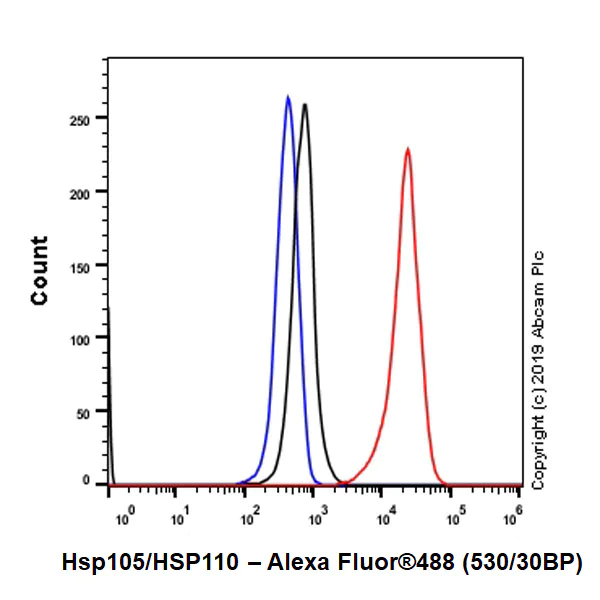
Flow Cytometry (Intracellular) - Anti-Hsp105/HSP110 antibody [EPR4577] (AB108625)
Intracellular Flow Cytometry analysis of HepG2 (Human hepatocellular carcinoma epithelial cell) cells, labeling Hsp105/HSP110 with Purified ab108625 at 1/20 dilution (10μg/ml) (Red). Cells were fixed with 4% Paraformaldehyde and permeabilised with 90% Methanol. A Goat anti rabbit IgG (Alexa Fluorr® 488, ab150077) secondary antibody was used at 1/2000. Isotype control - Rabbit monoclonal IgG (Black). Unlabeled control - Cell without incubation with primary antibody and secondary antibody (Blue).
- ICC/IF
Unknown
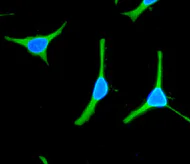
Immunocytochemistry/ Immunofluorescence - Anti-Hsp105/HSP110 antibody [EPR4577] (AB108625)
ab108625, unpurifed, at 1/100 dilution staining Hsp105/HSP110 in HeLa cells by Immunofluorescence.
- ICC/IF
Unknown
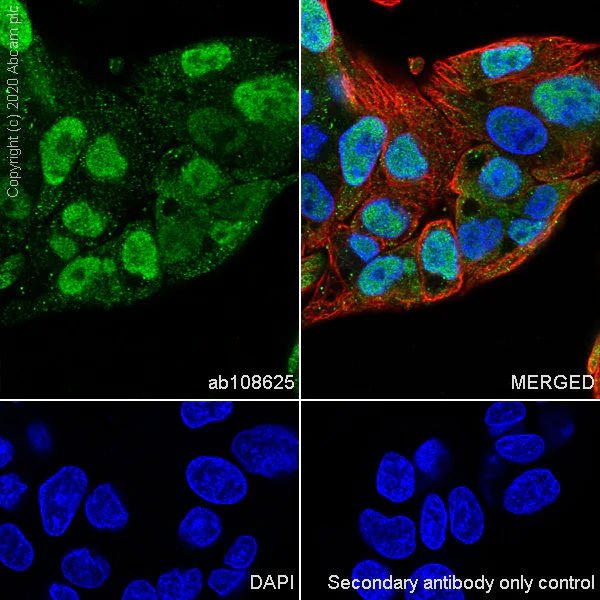
Immunocytochemistry/ Immunofluorescence - Anti-Hsp105/HSP110 antibody [EPR4577] (AB108625)
Immunocytochemistry/Immunofluorescence analysis of HepG2 (Human hepatocellular carcinoma epithelial cell) cells labeling Hsp105/HSP110 with Purified ab108625 at 1 : 50 dilution (2.7 μg/ml). Cells were fixed in 4% Paraformaldehyde and permeabilized with 0.1% tritonX-100. Cells were counterstained with ab195889 Anti-alpha Tubulin antibody [DM1A] - Microtubule Marker (Alexa Fluor® 594) 1 : 200 (2.5 μg/ml). Goat anti rabbit IgG (Alexa Fluor® 488, ab150077) was used as the secondary antibody at 1 : 1000 (2 μg/ml) dilution. DAPI (blue) was used as nuclear counterstain. PBS instead of the primary antibody was used as the secondary antibody only control.
- IP
Unknown
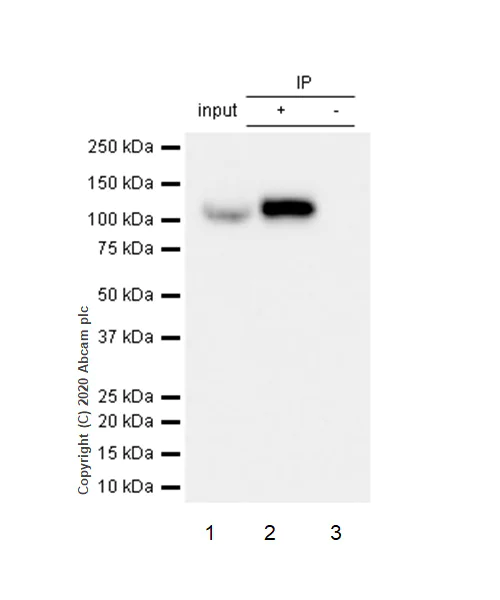
Immunoprecipitation - Anti-Hsp105/HSP110 antibody [EPR4577] (AB108625)
Purified ab108625 at 1 : 20 dilution (0.6μg) immunoprecipitating Hsp105/HSP110 in HeLa whole cell lysate.
Lane 1 (input) : HeLa (Human cervix adenocarcinoma epithelial cell) whole cell lysate 10μg
Lane 2 (+) : ab108625 + HeLa whole cell lysate.
Lane 3 (-) : Rabbit monoclonal IgG (ab172730) instead of ab108625 in HeLa whole cell lysate.
Blocking Buffer and concentration : 5% NFDM/TBST.
Diluting buffer and concentration : 5% NFDM/TBST.
Observed band size : 105 kDa
All lanes:
Immunoprecipitation - Anti-Hsp105/HSP110 antibody [EPR4577] (ab108625)
Predicted band size: 96 kDa
false
- WB
Unknown
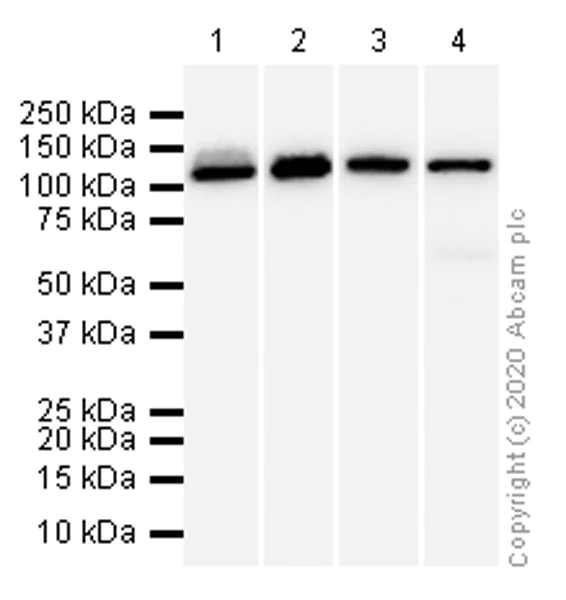
Western blot - Anti-Hsp105/HSP110 antibody [EPR4577] (AB108625)
Blocking/Diluting buffer : 5% NFDM/TBST
All lanes:
Western blot - Anti-Hsp105/HSP110 antibody [EPR4577] (ab108625) at 1/1000 dilution
Lane 1:
HeLa (Human cervix adenocarcinoma epithelial cell) whole cell lysate at 20 µg
Lane 2:
HepG2 (Human hepatocellular carcinoma epithelial cell) whole cell lysate at 20 µg
Lane 3:
Caco-2 (Human colorectal adenocarcinoma epithelial cell) whole cell lysate at 20 µg
Lane 4:
Human lung lysate at 20 µg
Secondary
All lanes:
Goat Anti-Rabbit IgG (HRP) with minimal cross-reactivity with human IgG at 1/2000 dilution
Predicted band size: 96 kDa
Observed band size: 105 kDa
false
Related conjugates and formulations (1)
-
Anti-Hsp105/HSP110 antibody [EPR4577] - BSA and Azide free
Alternative Products

Complementary Products
Primary Antibodies
AB182844
Anti-Hsp70 antibody [EPR17677]
20ul selling size|RabMAb|Recombinant|Lab Essentials
- 0
- 0
Primary Antibodies
AB51052
RabMAb|Recombinant|KO Validated|20ul selling size
- 4
- 2
Primary Antibodies
AB207305
Anti-SQSTM1 / p62 antibody [EPR18351] - Autophagosome Marker
20ul selling size|KO Validated|RabMAb|Recombinant|Lab Essentials|Trial Size

- 5
- 3
Reactivity data
Product details
Species reactivity
Mouse, Rat: We have preliminary internal testing data to indicate this antibody may not react with these species.
Please contact us for more information.
Patented technology
Our RabMAb® technology is a patented hybridoma-based technology for making rabbit monoclonal antibodies. For details on our patents, please refer to RabMAb® patents.
What are the advantages of a recombinant monoclonal antibody?
This product is a recombinant monoclonal antibody, which offers several advantages including:
- - High batch-to-batch consistency and reproducibility
- - Improved sensitivity and specificity
- - Long-term security of supply
- - Animal-free batch production
For more information, read more on recombinant antibodies.
Properties and storage information
Form
Purification technique
Storage buffer
Shipped at conditions
Appropriate short-term storage duration
Appropriate short-term storage conditions
Appropriate long-term storage conditions
Aliquoting information
Storage information
Supplementary information
This supplementary information is collated from multiple sources and compiled automatically.
Biological function summary
Hsp105 plays an essential role in protein folding and stress responses. It forms part of a cellular complex that includes other chaperones like Hsp70 and Hsp40. This interaction is critical in refolding denatured proteins and preventing the accumulation of misfolded proteins. In the cell the chaperone activity of Hsp105 helps in managing protein quality control particularly during heat shock and other stress conditions.
Pathways
This protein integrates within signaling cascades associated with stress responses and apoptosis. It is an important player in the HSF1-mediated heat shock response pathway which regulates the expression of various heat shock proteins. Additionally Hsp105 interacts with proteins like Hsp70 within this pathway coordinating cellular mechanisms that protect against protein-damaging conditions. Another pathway in which Hsp105 is involved might be the ubiquitin-proteasome pathway facilitating the degradation of damaged proteins.
Product protocols
- Visit the General protocols
- Visit the Troubleshooting
Target data
Alternative Names
Publications (4)
Recent publications for all applications. Explore the full listand refine your search
Cancers 15: PubMed37444524
2023
Applications
Unspecified application
Species
Unspecified reactive species
PLoS genetics 17:e1009539 PubMed33914734
2021
Applications
Unspecified application
Species
Unspecified reactive species
Oncoimmunology 6:e1362527 PubMed29209566
2017
Applications
Unspecified application
Species
Unspecified reactive species
Molecular and cellular biology 35:1390-400 PubMed25645927
2015
Applications
Unspecified application
Species
Unspecified reactive species
Product promise
Please note: All products are 'FOR RESEARCH USE ONLY. NOT FOR USE IN DIAGNOSTIC OR THERAPEUTIC PROCEDURES'.
For licensing inquiries, please contact partnerships@abcam.com