JavaScript is disabled in your browser. Please enable JavaScript to view this website.
AB58522

Anti-Hsp20 (phospho S16) antibody

Be the first to review this product! Submit a review

|

(12 Publications )
Rabbit Polyclonal Hsp20 phospho S16 antibody. Suitable for IHC-P and reacts with Human samples. Cited in 12 publications. Immunogen corresponding to Synthetic Peptide within Human HSPB6 pS16 aa 1-100.
1 Images
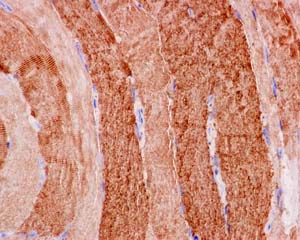
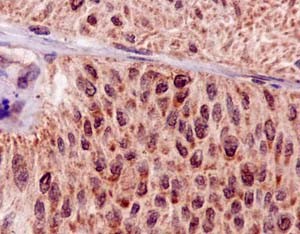
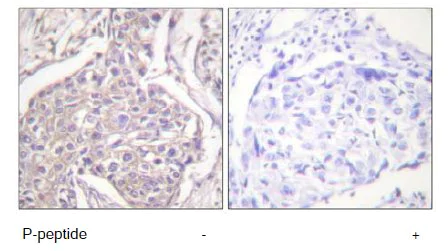
Immunohistochemistry (Formalin/PFA-fixed paraffin-embedded sections) - Anti-Hsp20 (phospho S16) antibody (AB58522)
  • IHC-P

Unknown

Immunohistochemistry (Formalin/PFA-fixed paraffin-embedded sections) - Anti-Hsp20 (phospho S16) antibody (AB58522)

Immunohistochemistry analysis of paraffin-embedded human breast carcinoma.

Key facts

Host species

Rabbit

Clonality

Polyclonal

Isotype

IgG

Carrier free

No

Reacts with

Human

Applications

IHC-P

applications

Immunogen

Synthetic Peptide within Human HSPB6 pS16 aa 1-100. The exact immunogen used to generate this antibody is proprietary information.

O14558

Reactivity data

{ "title": "Reactivity Data", "filters": { "stats": ["", "Species", "Dilution Info", "Notes"], "tabs": { "all-applications": {"fullname" : "All Applications", "shortname": "All Applications"}, "IHCP" : {"fullname" : "Immunohistochemistry (Formalin/PFA-fixed paraffin-embedded sections)", "shortname":"IHC-P"} }, "product-promise": { "all": "all", "testedAndGuaranteed": "tested", "guaranteed": "expected", "predicted": "predicted", "notRecommended": "not-recommended" } }, "values": { "Human": { "IHCP-species-checked": "testedAndGuaranteed", "IHCP-species-dilution-info": "", "IHCP-species-notes": "<p></p>" } } }

Properties and storage information

Form
Liquid
Purification technique
Affinity purification Immunogen
Purification notes
The antibody against non-phosphopeptide was removed by chromatographyusing non-phosphopeptide corresponding to the phosphorylation site.
Storage buffer
pH: 7.4 Preservative: 0.02% Sodium azide Constituents: PBS, 50% Glycerol (glycerin, glycerine), 0.87% Sodium chloride
Shipped at conditions
Blue Ice
Appropriate short-term storage conditions
+4°C
Appropriate long-term storage conditions
-20°C
Storage information
Stable for 12 months at -20°C

Supplementary information

This supplementary information is collated from multiple sources and compiled automatically.

Hsp20 also known as Heat Shock Protein 20 or HspB6 is a small heat shock protein with a molecular weight of approximately 20 kDa. It functions by binding to partially unfolded proteins preventing them from aggregating and assisting in their proper folding. Hsp20 achieves this through its chaperone activity similar to other small heat shock proteins. This protein is expressed ubiquitously with high levels found in cardiac and skeletal muscles as well as in the brain and placenta.
Biological function summary

The small heat shock protein family which includes Hsp20 plays a critical role in maintaining cellular proteostasis under stress conditions. Hsp20 does not typically form large complexes though it may oligomerize under certain conditions to exert its protective functions. It interacts with cellular structures and proteins to maintain cell integrity and function. Hsp20 can modulate actin filament dynamics influencing cellular motility and smooth muscle relaxation.

Pathways

The Hsp20 protein is actively involved in several key regulatory pathways. It plays a role in the stress response pathway and is engaged in the cardiomyocyte signaling network. Hsp20 interacts closely with proteins such as Akt and PKA which are involved in the signaling cascades that govern cell survival and response to stress. Phosphorylation of Hsp20 by PKA contributes to its protective functions especially in cardiac tissues.

Alterations in Hsp20 expression or function can impact the development of cardiac diseases and neurodegenerative disorders. The protein is associated with cardiomyopathies where its protective role is important in managing stress in cardiac cells. Furthermore changes in Hsp20 have implications for Alzheimer's disease due to its interactions with tau protein. Enhanced understanding of Hsp20's mechanisms might lead to better therapeutic strategies for these diseases.

Product protocols

For this product, it's our understanding that no specific protocols are required. You can visit:

Target data

Small heat shock protein which functions as a molecular chaperone probably maintaining denatured proteins in a folding-competent state. Seems to have versatile functions in various biological processes. Plays a role in regulating muscle function such as smooth muscle vasorelaxation and cardiac myocyte contractility. May regulate myocardial angiogenesis implicating KDR. Overexpression mediates cardioprotection and angiogenesis after induced damage. Stabilizes monomeric YWHAZ thereby supporting YWHAZ chaperone-like activity.
See full target information HSPB6 pS16

Alternative Names

Heat shock protein beta-6, HspB6, Heat shock 20 kDa-like protein p20, Heat shock protein family B member 6, HSPB6

Publications (12)

Recent publications for all applications. Explore the full listand refine your search

Cell & bioscience 10:120 PubMed33088476

2020

Inducible expression of heat shock protein 20 protects airway epithelial cells against oxidative injury involving the Nrf2-NQO-1 pathway.

Applications

Unspecified application

Species

Unspecified reactive species

Aihua Bao,Aying Ma,Hui Zhang,Lihua Qiao,Suqin Ben,Xin Zhou,Min Zhang

FEBS open bio 7:64-73 PubMed28097089

2017

Selective inhibition of phosphodiesterases 4, 5 and 9 induces HSP20 phosphorylation and attenuates amyloid beta 1-42-mediated cytotoxicity.

Applications

Unspecified application

Species

Unspecified reactive species

Ryan T Cameron,Ellanor Whiteley,Jon P Day,Anna I Parachikova,George S Baillie

The Journal of physiology 594:6369-6393 PubMed27328735

2016

Differential impact of acute and prolonged cAMP agonist exposure on protein kinase A activation and human myometrium contractile activity.

Applications

Unspecified application

Species

Unspecified reactive species

Pei F Lai,Rachel M Tribe,Mark R Johnson

Cell biochemistry and function 33:421-6 PubMed26443497

2015

Heat shock protein 20 (HSP20) is a novel substrate for protein kinase D1 (PKD1).

Applications

Unspecified application

Species

Unspecified reactive species

Yuan Yan Sin,George S Baillie

Cell communication and signaling : CCS 13:16 PubMed25889640

2015

Small heat shock protein 20 (Hsp20) facilitates nuclear import of protein kinase D 1 (PKD1) during cardiac hypertrophy.

Applications

Unspecified application

Species

Unspecified reactive species

Yuan Yan Sin,Tamara P Martin,Lauren Wills,Susan Currie,George S Baillie

Molecular and cellular neurosciences 61:46-55 PubMed24859569

2014

The phosphorylation of Hsp20 enhances its association with amyloid-β to increase protection against neuronal cell death.

Applications

Unspecified application

Species

Unspecified reactive species

Ryan T Cameron,Steven D Quinn,Lynn S Cairns,Ruth MacLeod,Ifor D W Samuel,Brian O Smith,J Carlos Penedo,George S Baillie

European journal of pharmacology 723:216-26 PubMed24309216

2013

Mechanisms involved in increased sensitivity to adenosine A(2A) receptor activation and hypoxia-induced vasodilatation in porcine coronary arteries.

Applications

WB

Species

Unspecified reactive species

Elise R Hedegaard,Berit D Nielsen,Susie Mogensen,Christopher M Rembold,Ole Frøbert,Ulf Simonsen

PloS one 8:e80867 PubMed24244723

2013

Identification of a protein phosphatase-1/phospholamban complex that is regulated by cAMP-dependent phosphorylation.

Applications

Unspecified application

Species

Unspecified reactive species

Elizabeth Vafiadaki,Demetrios A Arvanitis,Despina Sanoudou,Evangelia G Kranias

Physiological reports 1:e00127 PubMed24400135

2013

Lysine deacetylase inhibition promotes relaxation of arterial tone and C-terminal acetylation of HSPB6 (Hsp20) in vascular smooth muscle cells.

Applications

Unspecified application

Species

Unspecified reactive species

Aiqing Chen,Magdalena Karolczak-Bayatti,Michèle Sweeney,Achim Treumann,Kelly Morrissey,Scott M Ulrich,G Nicholas Europe-Finner,Michael J Taggart

PloS one 8:e74784 PubMed24058627

2013

Enhanced cardiac function in Gravin mutant mice involves alterations in the β-adrenergic receptor signaling cascade.

Applications

Unspecified application

Species

Unspecified reactive species

Ashley N Guillory,Xing Yin,Cori S Wijaya,Andrea C Diaz Diaz,Abeer Rababa'h,Sonal Singh,Fatin Atrooz,Sakthivel Sadayappan,Bradley K McConnell
View all publications

Product promise

We are committed to supporting your work with high-quality reagents, and we're here for you every step of the way. In the unlikely event that one of our products does not perform as expected, you're protected by our Product Promise.
For full details, please see our Terms & Conditions

Please note: All products are 'FOR RESEARCH USE ONLY. NOT FOR USE IN DIAGNOSTIC OR THERAPEUTIC PROCEDURES'.

For licensing inquiries, please contact partnerships@abcam.com