Anti-Hsp60 antibody [EP1006Y] - BSA and Azide free
- RabMAb
- Recombinant
- What is this?
Be the first to review this product! Submit a review
|
(1 Publication)
- IHC-P
Unknown
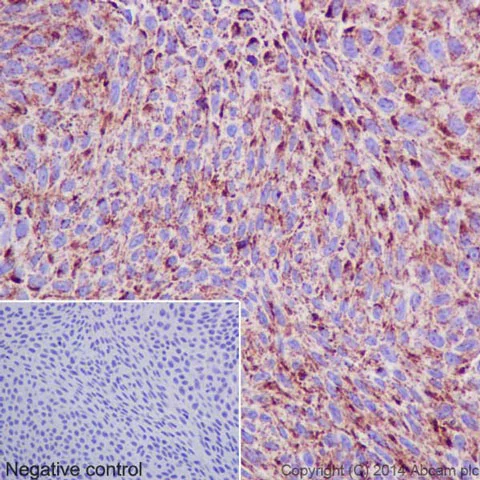
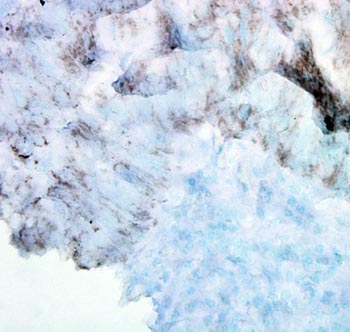
Immunohistochemistry (Formalin/PFA-fixed paraffin-embedded sections) - Anti-Hsp60 antibody [EP1006Y] - BSA and Azide free (AB239835)
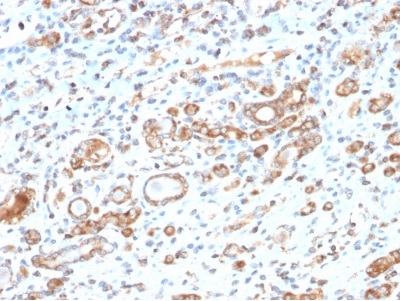
Immunohistochemistry analysis of paraffin-embedded Human transitional carcinoma of bladder labeling Hsp60 with ab45134 at a 1/200 dilution. Cytoplasmic staining on tumor cells of the Human bladder transitional cell carcinoma shown. Secondary antibody ab97051 Goat Anti-Rabbit IgG H&L (HRP) used at a 1/500 dilution. Counter stained with Hematoxylin.
Inset image : negative control obtained using PBS instead of ab45134, secondary antibody is Anti-Rabbit HRP (ab97051) at 1/500 dilution
This data was developed using the same antibody clone in a different buffer formulation containing PBS, BSA, glycerol, and sodium azide (ab45134).
Perform heat mediated antigen retrieval before commencing with IHC staining protocol.
- IHC-P
Unknown
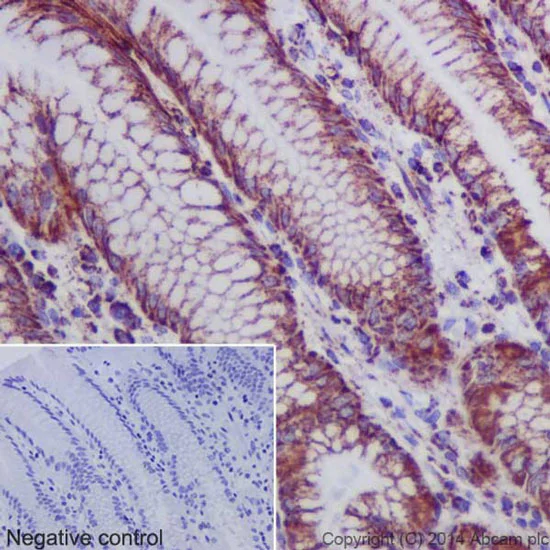
Immunohistochemistry (Formalin/PFA-fixed paraffin-embedded sections) - Anti-Hsp60 antibody [EP1006Y] - BSA and Azide free (AB239835)
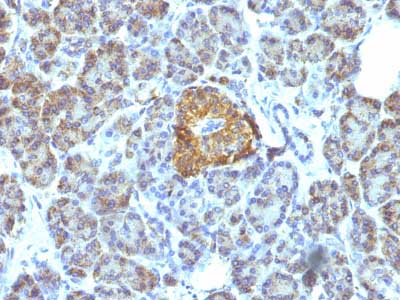
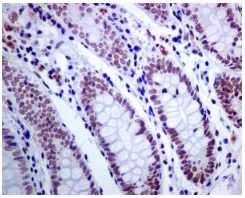
Immunohistochemistry analysis of paraffin-embedded Human stomach labeling Hsp60 with ab45134 at a 1/200 dilution. Cytoplasmic staining on the glandular epithelium of the Human stomach shown. Secondary antibody ab97051 Goat Anti-Rabbit IgG H&L (HRP) used at a 1/500 dilution. Counter stained with Hematoxylin.
Inset image : negative control obtained using PBS instead of ab45134, secondary antibody is Anti-Rabbit HRP (ab97051) at 1/500 dilution
This data was developed using the same antibody clone in a different buffer formulation containing PBS, BSA, glycerol, and sodium azide (ab45134).
Perform heat mediated antigen retrieval before commencing with IHC staining protocol.
- IHC-P
Unknown
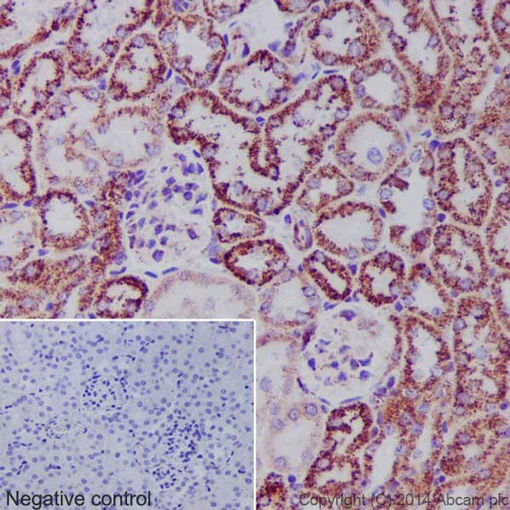
Immunohistochemistry (Formalin/PFA-fixed paraffin-embedded sections) - Anti-Hsp60 antibody [EP1006Y] - BSA and Azide free (AB239835)
Immunohistochemistry analysis of paraffin-embedded Mouse kidney labeling Hsp60 with ab45134 at a 1/200 dilution. Cytoplasmic staining on the epithelium of Mouse kidney tubules shown. Secondary antibody ab97051 Goat Anti-Rabbit IgG H&L (HRP) used at a 1/500 dilution. Counter stained with Hematoxylin.
Inset image : negative control obtained using PBS instead of ab45134, secondary antibody is Anti-Rabbit HRP (ab97051) at 1/500 dilution
This data was developed using the same antibody clone in a different buffer formulation containing PBS, BSA, glycerol, and sodium azide (ab45134).
Perform heat mediated antigen retrieval before commencing with IHC staining protocol.
- IHC-P
Unknown
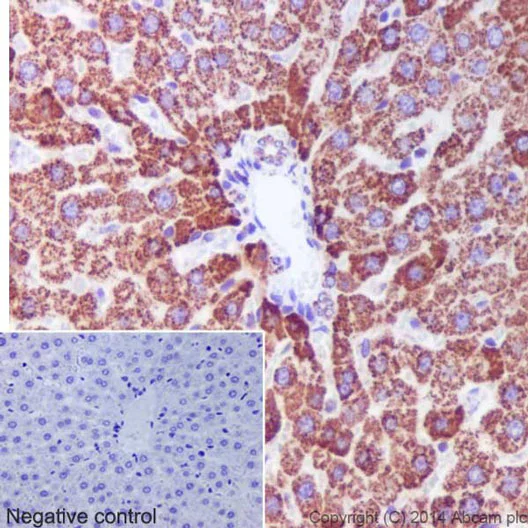
Immunohistochemistry (Formalin/PFA-fixed paraffin-embedded sections) - Anti-Hsp60 antibody [EP1006Y] - BSA and Azide free (AB239835)
Immunohistochemistry analysis of paraffin-embedded Rat liver labeling Hsp60 with ab45134 at a 1/200 dilution. Cytoplasmic staining on the hepatocytes of the Rat liver shown. Secondary antibody ab97051 Goat Anti-Rabbit IgG H&L (HRP) used at a 1/500 dilution. Counter stained with Hematoxylin.
Inset image : negative control obtained using PBS instead of ab45134, secondary antibody is Anti-Rabbit HRP (ab97051) at 1/500 dilution
This data was developed using the same antibody clone in a different buffer formulation containing PBS, BSA, glycerol, and sodium azide (ab45134).
Perform heat mediated antigen retrieval before commencing with IHC staining protocol.
Related conjugates and formulations (1)
-
Anti-Hsp60 antibody [EP1006Y] - Loading Control
Alternative Products

Primary Antibodies
AB234350
Anti-Hsp60 antibody [HSPD1/2206R] - Mitochondrial Marker
Recombinant|Lab Essentials
- 0
- 0
Primary Antibodies
AB46798
Anti-Hsp60 antibody - Mitochondrial Marker
BOND RX™ Validated|Lab Essentials
- 5
- 14
Primary Antibodies
AB224528
Anti-Hsp60 antibody [EPR18245-93] - BSA and Azide free
RabMAb|Recombinant
- 0
- 0
Complementary Products

Primary Antibodies
AB115777
Anti-beta Actin antibody [SP124] - Cytoskeleton Marker
20ul selling size|RabMAb|Lab Essentials|Recombinant
- 4
- 1
Primary Antibodies
AB183734
RabMAb|Recombinant|Lab Essentials|20ul selling size
- 5
- 24
Reactivity data
Product details
ab239835 is the carrier-free version of ab45134.
Patented technology
Our RabMAb® technology is a patented hybridoma-based technology for making rabbit monoclonal antibodies. For details on our patents, please refer to RabMAb® patents.
What are the advantages of a recombinant monoclonal antibody?
This product is a recombinant monoclonal antibody, which offers several advantages including:
- - High batch-to-batch consistency and reproducibility
- - Improved sensitivity and specificity
- - Long-term security of supply
- - Animal-free batch production
For more information, read more on recombinant antibodies.
Conjugation ready
Our carrier-free antibodies are typically supplied in a PBS-only formulation, purified and free of BSA, sodium azide and glycerol. This conjugation-ready format is designed for use with fluorochromes, metal isotopes, oligonucleotides, and enzymes, which makes them ideal for antibody labelling, functional and cell-based assays, flow-based assays (e.g. mass cytometry) and Multiplex Imaging applications.
Use our conjugation kits for antibody conjugates that are ready-to-use in as little as 20 minutes with 1 minute hands-on-time and 100% antibody recovery: available for fluorescent dyes, HRP, biotin and gold.
Compatibility
This product is compatible with the Maxpar® Antibody Labeling Kit from Fluidigm, without the need for antibody preparation. Maxpar® is a trademark of Fluidigm Canada Inc.
Properties and storage information
Form
Purification technique
Storage buffer
Shipped at conditions
Appropriate short-term storage conditions
Appropriate long-term storage conditions
Storage information
Supplementary information
This supplementary information is collated from multiple sources and compiled automatically.
Biological function summary
The protein ensures mitochondrial protein stability by facilitating the refolding of misfolded proteins and cooperating with other chaperonins like Hsp10. Hsp60 participates in forming a complex with these proteins to create a conducive environment for protein folding. It plays a part in regulating mitochondrial homeostasis impacting cell survival and apoptosis processes.
Pathways
Hsp60 links to the ATP synthesis and apoptosis pathways showcasing its importance as a mitochondrial marker. It interacts with proteins like caspase-3 to modulate cell death mechanisms highlighting its influence beyond simple protein folding. In the ATP synthesis pathway it contributes indirectly to energy production by maintaining mitochondrial function.
Product protocols
- Visit the General protocols
- Visit the Troubleshooting
Target data
Alternative Names
Publications (1)
Recent publications for all applications. Explore the full listand refine your search
Antioxidants (Basel, Switzerland) 14: PubMed40563324
2025
Applications
Unspecified application
Species
Unspecified reactive species
Product promise
Please note: All products are 'FOR RESEARCH USE ONLY. NOT FOR USE IN DIAGNOSTIC OR THERAPEUTIC PROCEDURES'.
For licensing inquiries, please contact partnerships@abcam.com