JavaScript is disabled in your browser. Please enable JavaScript to view this website.
AB31010

Anti-Hsp70 antibody

4

(2 Reviews)

|

(21 Publications )

Rabbit Polyclonal Hsp70 antibody. Suitable for IHC-P, IP, WB and reacts with Human samples. Cited in 21 publications.

View Alternative Names

HSP72, HSPA1, HSX70, HSPA1A, Heat shock 70 kDa protein 1A, Heat shock 70 kDa protein 1, Heat shock protein family A member 1A, HSP70-1, HSP70.1, HSP72, HSPA1B, Heat shock 70 kDa protein 1B, Heat shock 70 kDa protein 2, Heat shock protein family A member 1B, HSP70-2, HSP70.2
4 Images
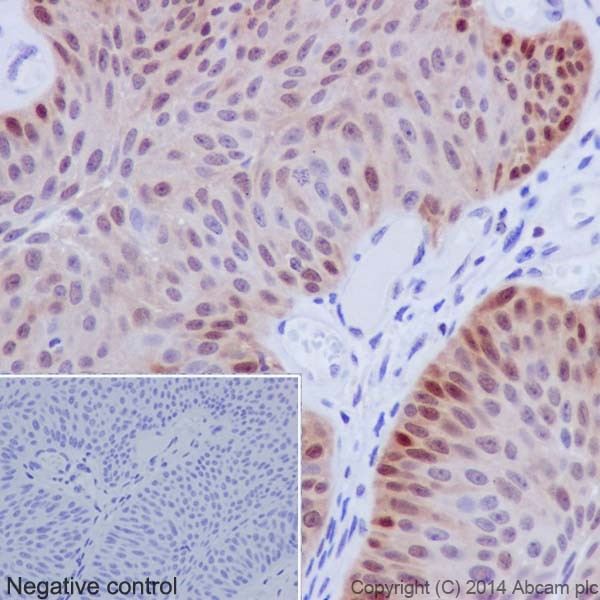
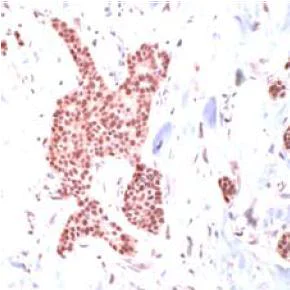
Immunohistochemistry (Formalin/PFA-fixed paraffin-embedded sections) - Anti-Hsp70 antibody (AB31010)
  • IHC-P

Unknown

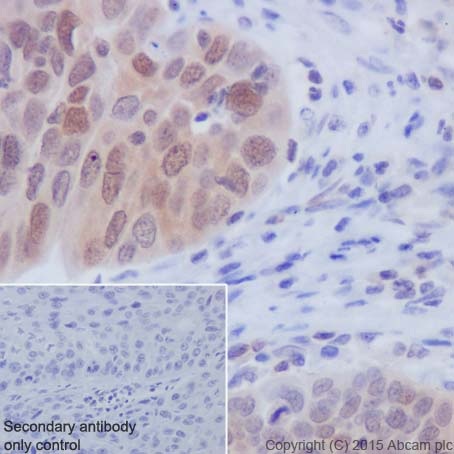
Immunohistochemistry (Formalin/PFA-fixed paraffin-embedded sections) - Anti-Hsp70 antibody (AB31010)

Tissue : Human breast cancer (formalin fixed/paraffin).
Staining : ab31010 at 1/100 dilution for 30 minutes at room temperature.
Immunoprecipitation - Anti-Hsp70 antibody (AB31010)
  • IP

Lab

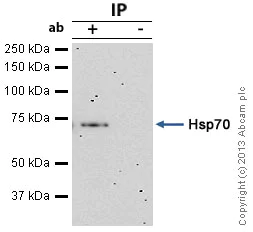
Immunoprecipitation - Anti-Hsp70 antibody (AB31010)

Hsp70 was immunoprecipitated using 0.5mg Hela whole cell extract, 5μg of Rabbit polyclonal to Hsp70 and 50μl of protein G magnetic beads (+). No antibody was added to the control (-).

The antibody was incubated under agitation with Protein G beads for 10min, Hela whole cell extract lysate diluted in RIPA buffer was added to each sample and incubated for a further 10min under agitation.

Proteins were eluted by addition of 40μl SDS loading buffer and incubated for 10min at 70°C; 10μl of each sample was separated on a SDS PAGE gel, transferred to a nitrocellulose membrane, blocked with 5% BSA and probed with ab31010.

Secondary : Mouse monoclonal [SB62a] Secondary Antibody to Rabbit IgG light chain (HRP) (ab99697).

Band : 70kDa; Hsp70

All lanes:

Immunoprecipitation - Anti-Hsp70 antibody (ab31010)

Predicted band size: 70 kDa

true

Exposure time: 20min
Western blot - Anti-Hsp70 antibody (AB31010)
  • WB

Unknown

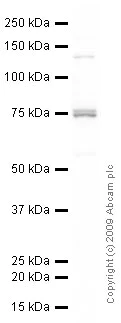
Western blot - Anti-Hsp70 antibody (AB31010)

All lanes:

Western blot - Anti-Hsp70 antibody (ab31010) at 1 µg/mL

All lanes:

HeLa (Human epithelial carcinoma cell line) Whole Cell Lysate at 10 µg

Secondary

All lanes:

Goat polyclonal to Rabbit IgG - H&L - Pre-Adsorbed (HRP) at 1/3000 dilution

Predicted band size: 70 kDa

Observed band size: 72 kDa,76 kDa

false
Western blot - Anti-Hsp70 antibody (AB31010)
  • WB

Unknown

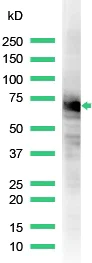
Western blot - Anti-Hsp70 antibody (AB31010)

All lanes:

Western blot - Anti-Hsp70 antibody (ab31010) at 1/25 dilution

All lanes:

293 cell lysate

Predicted band size: 70 kDa

Observed band size: 70 kDa

false

Key facts

Host species

Rabbit

Clonality

Polyclonal

Isotype

IgG

Carrier free

No

Reacts with

Human

Applications

IHC-P, WB, IP

applications

Immunogen

The exact immunogen used to generate this antibody is proprietary information.

Reactivity data

{ "title": "Reactivity Data", "filters": { "stats": ["", "Species", "Dilution Info", "Notes"], "tabs": { "all-applications": {"fullname" : "All Applications", "shortname": "All Applications"}, "IHCP" : {"fullname" : "Immunohistochemistry (Formalin/PFA-fixed paraffin-embedded sections)", "shortname":"IHC-P"}, "IP" : {"fullname" : "Immunoprecipitation", "shortname":"IP"}, "WB" : {"fullname" : "Western blot", "shortname":"WB"} }, "product-promise": { "all": "all", "testedAndGuaranteed": "tested", "guaranteed": "expected", "predicted": "predicted", "notRecommended": "not-recommended" } }, "values": { "Human": { "IHCP-species-checked": "testedAndGuaranteed", "IHCP-species-dilution-info": "1/100", "IHCP-species-notes": "<p></p> Perform heat-mediated antigen retrieval before commencing with IHC staining protocol.", "IP-species-checked": "testedAndGuaranteed", "IP-species-dilution-info": "5 µg/mL", "IP-species-notes": "<p></p>", "WB-species-checked": "testedAndGuaranteed", "WB-species-dilution-info": "", "WB-species-notes": "<p></p>" }, "Mouse": { "IHCP-species-checked": "predicted", "IHCP-species-dilution-info": "", "IHCP-species-notes": "", "IP-species-checked": "predicted", "IP-species-dilution-info": "", "IP-species-notes": "", "WB-species-checked": "predicted", "WB-species-dilution-info": "", "WB-species-notes": "" }, "Rat": { "IHCP-species-checked": "predicted", "IHCP-species-dilution-info": "", "IHCP-species-notes": "", "IP-species-checked": "predicted", "IP-species-dilution-info": "", "IP-species-notes": "", "WB-species-checked": "predicted", "WB-species-dilution-info": "", "WB-species-notes": "" }, "Cow": { "IHCP-species-checked": "predicted", "IHCP-species-dilution-info": "", "IHCP-species-notes": "", "IP-species-checked": "predicted", "IP-species-dilution-info": "", "IP-species-notes": "", "WB-species-checked": "predicted", "WB-species-dilution-info": "", "WB-species-notes": "" }, "Dog": { "IHCP-species-checked": "predicted", "IHCP-species-dilution-info": "", "IHCP-species-notes": "", "IP-species-checked": "predicted", "IP-species-dilution-info": "", "IP-species-notes": "", "WB-species-checked": "predicted", "WB-species-dilution-info": "", "WB-species-notes": "" }, "Pig": { "IHCP-species-checked": "predicted", "IHCP-species-dilution-info": "", "IHCP-species-notes": "", "IP-species-checked": "predicted", "IP-species-dilution-info": "", "IP-species-notes": "", "WB-species-checked": "predicted", "WB-species-dilution-info": "", "WB-species-notes": "" } } }

Properties and storage information

Form
Liquid
Purification technique
Affinity purification Immunogen
Purification notes
ab31010 is an affinity purified IgG.
Storage buffer
pH: 7.6 Preservative: 0.1% Sodium azide Constituents: PBS, 1% BSA
Shipped at conditions
Blue Ice
Appropriate short-term storage conditions
+4°C
Appropriate long-term storage conditions
-20°C
Aliquoting information
Upon delivery aliquot
Storage information
Avoid freeze / thaw cycle

Supplementary information

This supplementary information is collated from multiple sources and compiled automatically.

Hsp70 also known as Heat Shock Protein 70 or HSPA1B is a molecular chaperone with a mass of approximately 70 kDa. It plays a mechanical role by assisting in the proper folding of nascent polypeptide chains and the refolding of misfolded proteins. Researchers often detect Hsp70 using Western blot and immunohistochemistry (IHC) techniques. Hsp70 is widely expressed in many tissues particularly during stress conditions like heat shock where its expression level increases significantly.
Biological function summary

Hsp70 operates by stabilizing intermediate states of folding proteins preventing aggregation and facilitating the correct folding process. It often forms a complex with co-chaperones such as Hsp40 and nucleotide exchange factors. This complex is essential for the protein's activity and function. Additionally Hsp70 participates in protein degradation pathways by guiding misfolded proteins to the proteasome for degradation maintaining cellular homeostasis.

Pathways

This molecular chaperone plays significant roles in the heat shock response and unfolded protein response pathways. Hsp70 interacts closely with proteins such as Hsp90 and co-chaperones which together help protect cells from stress-induced damage. The protein also participates in the JAK/STAT signaling pathway influencing cell proliferation and apoptosis. These interactions suggest an integral role in maintaining cellular integrity during stress conditions.

Overexpression of Hsp70 has been associated with various cancers and neurodegenerative diseases. In cancer Hsp70 helps tumor cells survive the hostile tumor microenvironment partly by interacting with anti-apoptotic proteins such as Bcl-2. In neurodegenerative disorders such as Alzheimer's disease Hsp70 associates with amyloid-beta peptides potentially mitigating their aggregation toxicity. These interactions highlight Hsp70's importance in both protective and pathological cellular processes.

Product protocols

For this product, it's our understanding that no specific protocols are required. You can visit:

Target data

Molecular chaperone implicated in a wide variety of cellular processes, including protection of the proteome from stress, folding and transport of newly synthesized polypeptides, activation of proteolysis of misfolded proteins and the formation and dissociation of protein complexes. Plays a pivotal role in the protein quality control system, ensuring the correct folding of proteins, the re-folding of misfolded proteins and controlling the targeting of proteins for subsequent degradation. This is achieved through cycles of ATP binding, ATP hydrolysis and ADP release, mediated by co-chaperones. The co-chaperones have been shown to not only regulate different steps of the ATPase cycle, but they also have an individual specificity such that one co-chaperone may promote folding of a substrate while another may promote degradation. The affinity for polypeptides is regulated by its nucleotide bound state. In the ATP-bound form, it has a low affinity for substrate proteins. However, upon hydrolysis of the ATP to ADP, it undergoes a conformational change that increases its affinity for substrate proteins. It goes through repeated cycles of ATP hydrolysis and nucleotide exchange, which permits cycles of substrate binding and release. The co-chaperones are of three types : J-domain co-chaperones such as HSP40s (stimulate ATPase hydrolysis by HSP70), the nucleotide exchange factors (NEF) such as BAG1/2/3 (facilitate conversion of HSP70 from the ADP-bound to the ATP-bound state thereby promoting substrate release), and the TPR domain chaperones such as HOPX and STUB1 (PubMed : 24012426, PubMed : 24318877, PubMed : 26865365). Maintains protein homeostasis during cellular stress through two opposing mechanisms : protein refolding and degradation. Its acetylation/deacetylation state determines whether it functions in protein refolding or protein degradation by controlling the competitive binding of co-chaperones HOPX and STUB1. During the early stress response, the acetylated form binds to HOPX which assists in chaperone-mediated protein refolding, thereafter, it is deacetylated and binds to ubiquitin ligase STUB1 that promotes ubiquitin-mediated protein degradation (PubMed : 27708256). Regulates centrosome integrity during mitosis, and is required for the maintenance of a functional mitotic centrosome that supports the assembly of a bipolar mitotic spindle (PubMed : 27137183). Enhances STUB1-mediated SMAD3 ubiquitination and degradation and facilitates STUB1-mediated inhibition of TGF-beta signaling (PubMed : 24613385). Essential for STUB1-mediated ubiquitination and degradation of FOXP3 in regulatory T-cells (Treg) during inflammation (PubMed : 23973223). Required as a co-chaperone for optimal STUB1/CHIP ubiquitination of NFATC3 (By similarity). Negatively regulates heat shock-induced HSF1 transcriptional activity during the attenuation and recovery phase period of the heat shock response (PubMed : 9499401). Involved in the clearance of misfolded PRDM1/Blimp-1 proteins. Sequesters them in the cytoplasm and promotes their association with SYNV1/HRD1, leading to proteasomal degradation (PubMed : 28842558).. (Microbial infection) In case of rotavirus A infection, serves as a post-attachment receptor for the virus to facilitate entry into the cell.
See full target information HSPA1A

Additional targets

HSPA1B

Publications (21)

Recent publications for all applications. Explore the full list and refine your search

Bioactive materials 54:614-630 PubMed40980508

2025

Activatable companion theranostics for dual-modality imaging-escorted pyroptosis-propelled synergistic cancer therapy.

Applications

Unspecified application

Species

Unspecified reactive species

Yilin Wan,Yurong Liu,Weihua Wen,Ting He,Chunying Li,Guohua Wang,Lijun Jin,Meng Li,Yumeng Wu,Rong Wen,Yifan Zhang,Lian-Hua Fu,Jing Lin,Peng Huang,Daxiang Cui

International journal of molecular sciences 25: PubMed39684329

2024

The Effect of Prostaglandin F2 Analog Treatment on the Immunoexpression of Fibrosis-Associated Factors in Patients with Glaucoma Undergoing Deep Sclerotomy.

Applications

Unspecified application

Species

Unspecified reactive species

Robert Stanić,Katarina Vukojević,Natalija Filipović,Benjamin Benzon,Marin Ogorevc,Nenad Kunac,Samir Čanović,Petra Kovačević,Martina Paradžik Šimunović,Suzana Konjevoda

International journal of molecular sciences 25: PubMed38999938

2024

Immunoexpression Pattern of Autophagy-Related Proteins in Human Congenital Anomalies of the Kidney and Urinary Tract.

Applications

Unspecified application

Species

Unspecified reactive species

Mirko Maglica,Nela Kelam,Ilija Perutina,Anita Racetin,Azer Rizikalo,Natalija Filipović,Ivana Kuzmić Prusac,Josip Mišković,Katarina Vukojević

Poultry science 103:103637 PubMed38518665

2024

Intermittent mild cold acclimation ameliorates intestinal inflammation and immune dysfunction in acute cold-stressed broilers by regulating the TLR4/MyD88/NF-κB pathway.

Applications

Unspecified application

Species

Unspecified reactive species

Yanju Bi,Haidong Wei,Yiwen Chai,Hongyu Wang,Qiang Xue,Jianhong Li

Molecular medicine reports 24: PubMed34458929

2021

Serum‑derived exosomes from house dust mite‑sensitized guinea pigs contribute to inflammation in BEAS‑2B cells via the TLR4‑NF‑κB pathway.

Applications

Unspecified application

Species

Unspecified reactive species

Chao Liu,Xiao-Lin Huang,Jian-Ping Liang,Xu Zhong,Zi-Feng Wei,Li-Xue Dai,Jun Wang

Antioxidants (Basel, Switzerland) 10: PubMed34203726

2021

Addition of Popular Exogenous Antioxidant Agent, PBN, to Culture Media May Be an Important Step to Optimization of Myogenic Stem/Progenitor Cell Preparation Protocol.

Applications

Unspecified application

Species

Unspecified reactive species

Magdalena Nowaczyk,Agnieszka Malcher,Agnieszka Zimna,Wojciech Łabędź,Łukasz Kubaszewski,Wojciech Barczak,Błażej Rubiś,Natalia Rozwadowska,Maciej Kurpisz

OncoTargets and therapy 13:6709-6720 PubMed32764961

2020

Exosomal miR-638 Inhibits Hepatocellular Carcinoma Progression by Targeting SP1.

Applications

Unspecified application

Species

Unspecified reactive species

Jing Yang,Bo Li,Shuo Zhao,Hongyu Du,Yaming Du

Journal of orthopaedics 17:134-138 PubMed31879492

2019

Expression pattern of Syndecan-1 and HSP-70 in hip tissue of patients with osteoarthritis.

Applications

Unspecified application

Species

Unspecified reactive species

Julian Kaufman,Davor Caric,Katarina Vukojevic

Aging 11:8777-8791 PubMed31659145

2019

LncRNA MALAT1 shuttled by bone marrow-derived mesenchymal stem cells-secreted exosomes alleviates osteoporosis through mediating microRNA-34c/SATB2 axis.

Applications

Unspecified application

Species

Unspecified reactive species

Xucheng Yang,Junxiao Yang,Pengfei Lei,Ting Wen

Redox biology 26:101294 PubMed31450104

2019

Redox responses in skeletal muscle following denervation.

Applications

Unspecified application

Species

Unspecified reactive species

Mattia Scalabrin,Natalie Pollock,Caroline A Staunton,Susan V Brooks,Anne McArdle,Malcolm J Jackson,Aphrodite Vasilaki
View all publications

Product promise

We are committed to supporting your work with high-quality reagents, and we're here for you every step of the way. In the unlikely event that one of our products does not perform as expected, you're protected by our Product Promise.
For full details, please see our Terms & Conditions

Please note: All products are 'FOR RESEARCH USE ONLY. NOT FOR USE IN DIAGNOSTIC OR THERAPEUTIC PROCEDURES'.

For licensing inquiries, please contact partnerships@abcam.com