JavaScript is disabled in your browser. Please enable JavaScript to view this website.
AB115040

Anti-HSPC142 antibody

Be the first to review this product! Submit a review

|

(1 Publication)

Rabbit Polyclonal HSPC142 antibody. Suitable for IP and reacts with Human samples. Cited in 1 publication. Immunogen corresponding to Synthetic Peptide within Human BABAM1 aa 1-50.
1 Images
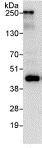
Immunoprecipitation - Anti-HSPC142 antibody (AB115040)
  • IP

Unknown

Immunoprecipitation - Anti-HSPC142 antibody (AB115040)

Detection of HSPC142 by Western Blot of Immunprecipitates.
ab115040 at 1µg/ml staining HSPC142 in HeLa whole cell lysate immunoprecipitated using ab115040 at 3µg/mg lysate (1 mg/IP; 20% of IP loaded).
Detection : Chemiluminescence with exposure time of 10 seconds.

All lanes:

Immunoprecipitation - Anti-HSPC142 antibody (ab115040)

Predicted band size: 37 kDa

false

Key facts

Host species

Rabbit

Clonality

Polyclonal

Isotype

IgG

Carrier free

No

Reacts with

Human

Applications

IP

applications

Immunogen

Synthetic Peptide within Human BABAM1 aa 1-50. The exact immunogen used to generate this antibody is proprietary information.

Q9NWV8

Reactivity data

{ "title": "Reactivity Data", "filters": { "stats": ["", "Species", "Dilution Info", "Notes"], "tabs": { "all-applications": {"fullname" : "All Applications", "shortname": "All Applications"}, "IP" : {"fullname" : "Immunoprecipitation", "shortname":"IP"} }, "product-promise": { "all": "all", "testedAndGuaranteed": "tested", "guaranteed": "expected", "predicted": "predicted", "notRecommended": "not-recommended" } }, "values": { "Human": { "IP-species-checked": "testedAndGuaranteed", "IP-species-dilution-info": "2-5 µg/mg of lysate", "IP-species-notes": "<p></p>" }, "Chimpanzee": { "IP-species-checked": "predicted", "IP-species-dilution-info": "", "IP-species-notes": "" }, "Gorilla": { "IP-species-checked": "predicted", "IP-species-dilution-info": "", "IP-species-notes": "" }, "Orangutan": { "IP-species-checked": "predicted", "IP-species-dilution-info": "", "IP-species-notes": "" } } }

Properties and storage information

Form
Liquid
Purification technique
Affinity purification Immunogen
Storage buffer
pH: 7 - 8 Preservative: 0.09% Sodium azide Constituents: 99% Tris citrate/phosphate
Shipped at conditions
Blue Ice
Appropriate short-term storage conditions
+4°C
Appropriate long-term storage conditions
+4°C
Aliquoting information
Upon delivery aliquot
Storage information
Avoid freeze / thaw cycle

Supplementary information

This supplementary information is collated from multiple sources and compiled automatically.

HSPC142 also called CCDC53 is a protein involved mechanically in several cellular processes. It weighs approximately 38 kDa and is expressed broadly in many tissues. HSPC142 plays a significant role in the regulation of cytoskeletal dynamics suggesting it is important in maintaining cellular integrity. Researchers often study HSPC142 to understand its localization and interactions within different cellular compartments.
Biological function summary

HSPC142 contributes to the organization and function of the actin cytoskeleton. It forms part of the WASH (Wiskott-Aldrich syndrome protein and SCAR homolog) complex which is important for actin nucleation. This complex works with other proteins to facilitate processes like endosomal sorting and membrane trafficking. It aids in maintaining proper cellular function by influencing actin filament assembly and disassembly.

Pathways

Researchers recognize HSPC142’s role in the regulation of the Arp2/3 complex pathway and the WASH pathway. Here HSPC142 interacts with proteins such as WASH1 and F-actin driving changes in the cytoskeleton necessary for cellular transport activities. These interactions ensure that cells can move materials efficiently indicating a broader impact on cellular homeostasis and signaling processes.

Studies link HSPC142 to neurodegenerative conditions and cancers. Disruptions in its function can lead to abnormal cell migration and changes in the brain's cellular architecture. In Alzheimer's disease models alterations in cytoskeletal dynamics due to faulty HSPC142 pathways show significant connections with tau proteins. In cancer unregulated HSPC142 activity associates with increased cell invasion and metastasis implicating other proteins like WAVE2 in these transformative processes.

Product protocols

For this product, it's our understanding that no specific protocols are required. You can visit:

Target data

Component of the BRCA1-A complex, a complex that specifically recognizes 'Lys-63'-linked ubiquitinated histones H2A and H2AX at DNA lesions sites, leading to target the BRCA1-BARD1 heterodimer to sites of DNA damage at double-strand breaks (DSBs). The BRCA1-A complex also possesses deubiquitinase activity that specifically removes 'Lys-63'-linked ubiquitin on histones H2A and H2AX. In the BRCA1-A complex, it is required for the complex integrity and its localization at DSBs. Component of the BRISC complex, a multiprotein complex that specifically cleaves 'Lys-63'-linked ubiquitin in various substrates (PubMed : 24075985, PubMed : 26195665). In these 2 complexes, it is probably required to maintain the stability of BABAM2 and help the 'Lys-63'-linked deubiquitinase activity mediated by BRCC3/BRCC36 component. The BRISC complex is required for normal mitotic spindle assembly and microtubule attachment to kinetochores via its role in deubiquitinating NUMA1 (PubMed : 26195665). Plays a role in interferon signaling via its role in the deubiquitination of the interferon receptor IFNAR1; deubiquitination increases IFNAR1 activity by enhancing its stability and cell surface expression (PubMed : 24075985). Down-regulates the response to bacterial lipopolysaccharide (LPS) via its role in IFNAR1 deubiquitination (PubMed : 24075985).
See full target information BABAM1

Alternative Names

C19orf62, MERIT40, NBA1, HSPC142, BABAM1, BRISC and BRCA1-A complex member 1, Mediator of RAP80 interactions and targeting subunit of 40 kDa, New component of the BRCA1-A complex

Publications (1)

Recent publications for all applications. Explore the full listand refine your search

Transcription 8:133-149 PubMed28340332

2017

Super elongation complex promotes early HIV transcription and its function is modulated by P-TEFb.

Applications

Unspecified application

Species

Unspecified reactive species

Alona Kuzmina,Simona Krasnopolsky,Ran Taube
View all publications

Product promise

We are committed to supporting your work with high-quality reagents, and we're here for you every step of the way. In the unlikely event that one of our products does not perform as expected, you're protected by our Product Promise.
For full details, please see our Terms & Conditions

Please note: All products are 'FOR RESEARCH USE ONLY. NOT FOR USE IN DIAGNOSTIC OR THERAPEUTIC PROCEDURES'.

For licensing inquiries, please contact partnerships@abcam.com