JavaScript is disabled in your browser. Please enable JavaScript to view this website.
AB6513

Anti-HSV1 ICP0 antibody [5H7]

5

(1 Review)

|

(54 Publications )
Mouse Monoclonal ICP0 antibody. Suitable for ICC/IF, WB, ELISA and reacts with Herpes simplex virus samples. Cited in 54 publications. Immunogen corresponding to Virus preparation containing HSV1 ICP0 protein.
1 Images
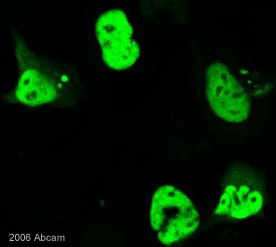
Immunocytochemistry/ Immunofluorescence - Anti-HSV1 ICP0 antibody [5H7] (AB6513)
  • ICC/IF

AbReview8776****

Immunocytochemistry/ Immunofluorescence - Anti-HSV1 ICP0 antibody [5H7] (AB6513)

ab6513 (1/25600) staining HSV1 ICP0 in human cells. Cells were PFA-fixed, permeabilized in 0.3% TritonX-100/PBS and blocked in 1% serum /30 minutes /25oC. A fluorescently labeled donkey anti-mouse antibody was used as the secondary.

This image is courtesy of an anonymous Abreview

Key facts

Host species

Mouse

Clonality

Monoclonal

Clone number

5H7

Isotype

IgG1

Light chain type

kappa

Carrier free

No

Reacts with

Herpes simplex virus

Applications

ICC/IF, WB, ELISA

applications

Immunogen

The exact immunogen used to generate this antibody is proprietary information.

Reactivity data

{ "title": "Reactivity Data", "filters": { "stats": ["", "Species", "Dilution Info", "Notes"], "tabs": { "all-applications": {"fullname" : "All Applications", "shortname": "All Applications"}, "ICCIF" : {"fullname" : "Immunocytochemistry/ Immunofluorescence", "shortname":"ICC/IF"}, "WB" : {"fullname" : "Western blot", "shortname":"WB"}, "ELISA" : {"fullname" : "ELISA", "shortname":"ELISA"} }, "product-promise": { "all": "all", "testedAndGuaranteed": "tested", "guaranteed": "expected", "predicted": "predicted", "notRecommended": "not-recommended" } }, "values": { "Herpes simplex virus": { "ICCIF-species-checked": "testedAndGuaranteed", "ICCIF-species-dilution-info": "1/200 - 1/500", "ICCIF-species-notes": "<p></p>", "WB-species-checked": "guaranteed", "WB-species-dilution-info": "1/8000", "WB-species-notes": "<p></p>", "ELISA-species-checked": "guaranteed", "ELISA-species-dilution-info": "1/12800", "ELISA-species-notes": "<p></p>" } } }

Properties and storage information

Form
Liquid
Purification technique
Affinity purification Protein A
Storage buffer
pH: 7.4
Shipped at conditions
Blue Ice
Appropriate short-term storage conditions
+4°C
Appropriate long-term storage conditions
-20°C
Aliquoting information
Upon delivery aliquot
Storage information
Avoid freeze / thaw cycle

Supplementary information

This supplementary information is collated from multiple sources and compiled automatically.

HSV1 ICP0 also known as Herpes Simplex Virus type 1 Infected Cell Protein 0 is a multifunctional viral protein expressed during infection with HSV1. It has a molecular mass of approximately 110 kDa. ICP0 acts as an E3 ubiquitin ligase targeting cellular proteins for ubiquitination and subsequent proteasomal degradation. This helps the virus evade the host's antiviral defenses. HSV1 ICP0 is expressed in the nuclei of infected cells and facilitates the viral lytic replication cycle enabling the virus to reactivate from latency.
Biological function summary

The protein HSV1 ICP0 dismantles host cellular defenses by disrupting PML nuclear bodies which are involved in the intrinsic immune response. ICP0 does not operate alone as it is part of a larger regulatory complex that modulates the expression of viral and host genes. By interacting with key host factors ICP0 enhances the efficiency of viral replication ensuring the successful propagation of HSV1 in the host.

Pathways

ICP0 influences both immune evasion and viral replication pathways through its interactions with host proteins. It plays a role in the host's ubiquitin-proteasome system and interferes with the DNA damage response pathway. Interactions with proteins like ubiquitin-specific protease 7 (USP7) and the ubiquitin ligase RNF8 illustrate ICP0's multifunctional role in manipulating host-cell pathways to favor viral replication.

HSV1 ICP0 plays a significant role in herpes simplex virus infections. It contributes to the reactivation of latent infections leading to diseases such as herpes labialis (cold sores) and even more serious conditions like encephalitis. ICP0 interacts with cellular proteins involved in neuroinflammation such as NF-kB impacting the progression of these diseases. Understanding the role of ICP0 in these processes provides essential insights for developing therapeutic strategies targeting HSV1 and related conditions.

Product protocols

For this product, it's our understanding that no specific protocols are required. You can visit:

Target data

SUMO-targeted ubiquitin ligase that plays an essential role in nuclear antiviral defense evasion triggered by dsDNA viruses (PubMed : 32001251). Acts during the initial stages of lytic infection and the reactivation of latent viral genome. Prevents the antiviral effect of nuclear bodies by degrading host PML, SP100, MORC2 and MORC3 (PubMed : 27440897, PubMed : 34759314, PubMed : 39589886). Prevents antiviral response to viral DNA induced by IFI16 by degrading it. Additionally, inhibits host IRF3 nuclear signaling to prevent interferon production by the infected cells. Interestingly, the E3 ubiquitin ligase activity associated with the RING finger domain does not seem to be directly required to inhibit the activation of IRF3 but instead plays a critical role in modulating the cellular localization of ICP0. Upon reactivation of latent genome, suppresses the silencing of viral DNA by dissociating either HDAC1 or HDAC2 from the HDAC-RCOR1-REST-KDM1A complex localized at the ND10 structures and causes their dispersal. Two cellular histone ubiquitin ligases RNF8 and RNF168 are also targeted by ICP0 for degradation, leading to a loss of ubiquitinated forms of H2A, a relief of transcriptional repression, and the activation of latent viral genomes. Enhances the localization of host CCND3 to ND10 bodies that serve as precursors of replication compartments to enable efficient viral replication. Like many RING-finger E3 ubiquitin ligases, ICP0 can induce its own ubiquitination, an activity that promotes its instability due to its targeting to the 26S proteasome for degradation. ICP0 restricts this process by recruiting the cellular ubiquitin-specific protease USP7 that cleaves the anchored ubiquitin chains from ICP0, thereby promoting its stabilization.
See full target information ICP0

Alternative Names

IE110, ICP0, E3 ubiquitin-protein ligase ICP0, Alpha-0 protein, Immediate-early protein IE110, RING-type E3 ubiquitin transferase ICP0, Trans-acting transcriptional protein ICP0, VMW110

Publications (54)

Recent publications for all applications. Explore the full listand refine your search

PLoS pathogens 21:e1013509 PubMed40982560

2025

The viral BCL2 protein BHRF1 of Epstein-Barr virus promotes AIM2 inflammasome activation to facilitate lytic replication.

Applications

Unspecified application

Species

Unspecified reactive species

Qingping Lan,Xiaolin Zhang,Yifan Sun,Jing Yang,Xiaojuan Li,Ersheng Kuang

Frontiers in cellular and infection microbiology 15:1548038 PubMed40636257

2025

Aryl hydrocarbon receptor facilitates HSV-1 lytic infection by enhancing viral gene transcription and receptor expression.

Applications

Unspecified application

Species

Unspecified reactive species

Pu Huang,Xiaohong Pan,Hongli Chen,Mengyue Lei,Ying Ma,Xiaomei Guo,Jiaxin Xie,Jixiong Li,Jing Sun,Yunzhang Hu,Jiandong Shi

Proceedings of the National Academy of Sciences of the United States of America 122:e2504962122 PubMed40601626

2025

Akt isoform specificity drives intrinsic immune regulation during HSV-1 infection.

Applications

Unspecified application

Species

Unspecified reactive species

Rahul K Suryawanshi,Chandrashekhar D Patil,Hemant Borase,Deepak Shukla

Journal of virology 99:e0163824 PubMed39945537

2025

Herpes simplex virus assembly and spread in murine skin after infection from the outside.

Applications

Unspecified application

Species

Unspecified reactive species

Timmy Richardo,Xiaokun Liu,Katinka Döhner,Tsung-Yu Chao,Anna Buch,Anne Binz,Anja Pohlmann,Madeleine de le Roi,Wolfgang Baumgärtner,Korbinian Brand,Rudolf Bauerfeind,Reinhold Förster,Beate Sodeik,Stephan Halle

EMBO reports 26:720-747 PubMed39747662

2025

HDAC6 deacetylates TRIM56 to negatively regulate cGAS-STING-mediated type I interferon responses.

Applications

Unspecified application

Species

Unspecified reactive species

Qiongzhen Zeng,Zixin Chen,Shan Li,Ziwei Huang,Zhe Ren,Cuifang Ye,Xiao Wang,Jun Zhou,Kaisheng Liu,Kai Zheng,Yifei Wang

Frontiers in microbiology 15:1411655 PubMed38915300

2024

Herpes Simplex Virus type 1 inhibits autophagy in glial cells but requires ATG5 for the success of viral replication.

Applications

Unspecified application

Species

Unspecified reactive species

Inés Ripa,Sabina Andreu,Fernando Josa-Prado,Beatriz Fernández Gómez,Fernando de Castro,María Arribas,Raquel Bello-Morales,José Antonio López-Guerrero

mBio 14:e0061123 PubMed37712680

2023

Interferon-stimulated gene TDRD7 interacts with AMPK and inhibits its activation to suppress viral replication and pathogenesis.

Applications

Unspecified application

Species

Unspecified reactive species

Sukanya Chakravarty,Gayatri Subramanian,Sonam Popli,Manoj Veleeparambil,Shumin Fan,Ritu Chakravarti,Saurabh Chattopadhyay

Journal of virology 97:e0175822 PubMed36916936

2023

YTHDF2 Is Downregulated in Response to Host Shutoff Induced by DNA Virus Infection and Regulates Interferon-Stimulated Gene Expression.

Applications

Unspecified application

Species

Unspecified reactive species

Charles R Hesser,Derek Walsh

Virology journal 20:8 PubMed36647143

2023

Ethanol extract from Artemisia argyi leaves inhibits HSV-1 infection by destroying the viral envelope.

Applications

Unspecified application

Species

Unspecified reactive species

Ping Liu,Lishan Zhong,Ji Xiao,Yuze Hu,Tao Liu,Zhe Ren,Yifei Wang,Kai Zheng

International journal of molecular sciences 24: PubMed36675052

2023

Metabolomics Profiles Reveal New Insights of Herpes Simplex Virus Type 1 Infection.

Applications

Unspecified application

Species

Unspecified reactive species

Pu Huang,Xu Wang,Mengyue Lei,Ying Ma,Hongli Chen,Jing Sun,Yunzhang Hu,Jiandong Shi
View all publications

Product promise

We are committed to supporting your work with high-quality reagents, and we're here for you every step of the way. In the unlikely event that one of our products does not perform as expected, you're protected by our Product Promise.
For full details, please see our Terms & Conditions

Please note: All products are 'FOR RESEARCH USE ONLY. NOT FOR USE IN DIAGNOSTIC OR THERAPEUTIC PROCEDURES'.

For licensing inquiries, please contact partnerships@abcam.com