JavaScript is disabled in your browser. Please enable JavaScript to view this website.
AB225697

Anti-IMP3 antibody

Be the first to review this product! Submit a review

|

(4 Publications )

Rabbit Polyclonal IMP3 antibody. Suitable for IP, WB and reacts with Human, Mouse samples. Cited in 4 publications. Immunogen corresponding to Synthetic Peptide within Human IGF2BP3 aa 500 to C-terminus.

View Alternative Names

IMP3, KOC1, VICKZ3, IGF2BP3, Insulin-like growth factor 2 mRNA-binding protein 3, IGF2 mRNA-binding protein 3, IMP-3, IGF-II mRNA-binding protein 3, KH domain-containing protein overexpressed in cancer, VICKZ family member 3, hKOC
2 Images
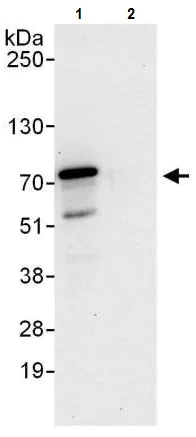
Immunoprecipitation - Anti-IMP3 antibody (AB225697)
  • IP

Supplier Data

Immunoprecipitation - Anti-IMP3 antibody (AB225697)

IMP3 was immunoprecipitated from HeLa (human epithelial cell line from cervix adenocarcinoma) whole cell lysate (1 mg for IP, 20% of IP loaded) with ab225697 at 6 μg/mg lysate. Western blot was performed from the immunoprecipitate using ab225697 at 1 μg/ml.

Lane 1 : ab225697 IP in HeLa whole cell lysate.

Lane 2 : Control IgG IP in HeLa whole cell lysate.

Detection : Chemiluminescence with exposure time of 10 seconds.

All lanes:

Immunoprecipitation - Anti-IMP3 antibody (ab225697)

Predicted band size: 63 kDa

false
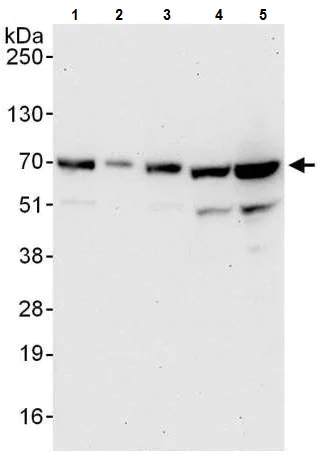
Western blot - Anti-IMP3 antibody (AB225697)
  • WB

Supplier Data

Western blot - Anti-IMP3 antibody (AB225697)

All lanes:

Western blot - Anti-IMP3 antibody (ab225697) at 0.04 µg/mL

Lane 1:

HeLa (human epithelial cell line from cervix adenocarcinoma) whole cell lysate at 50 µg

Lane 2:

HeLa (human epithelial cell line from cervix adenocarcinoma) whole cell lysate at 15 µg

Lane 3:

HEK-293T (human epithelial cell line from embryonic kidney transformed with large T antigen) whole cell lysate at 50 µg

Lane 4:

Jurkat (human T cell leukemia cell line from peripheral blood) whole cell lysate at 50 µg

Lane 5:

NIH/3T3 (mouse embryo fibroblast cell line) whole cell lysate at 50 µg

Predicted band size: 63 kDa

true

Exposure time: 30s

Key facts

Host species

Rabbit

Clonality

Polyclonal

Isotype

IgG

Carrier free

No

Reacts with

Human, Mouse

Applications

WB, IP

applications

Immunogen

Synthetic Peptide within Human IGF2BP3 aa 500 to C-terminus. The exact immunogen used to generate this antibody is proprietary information.

O00425

Reactivity data

{ "title": "Reactivity Data", "filters": { "stats": ["", "Species", "Dilution Info", "Notes"], "tabs": { "all-applications": {"fullname" : "All Applications", "shortname": "All Applications"}, "IP" : {"fullname" : "Immunoprecipitation", "shortname":"IP"}, "WB" : {"fullname" : "Western blot", "shortname":"WB"} }, "product-promise": { "all": "all", "testedAndGuaranteed": "tested", "guaranteed": "expected", "predicted": "predicted", "notRecommended": "not-recommended" } }, "values": { "Human": { "IP-species-checked": "testedAndGuaranteed", "IP-species-dilution-info": "2-10 µg/mg of lysate", "IP-species-notes": "<p></p>", "WB-species-checked": "testedAndGuaranteed", "WB-species-dilution-info": "1/2000 - 1/10000", "WB-species-notes": "<p></p>" }, "Mouse": { "IP-species-checked": "guaranteed", "IP-species-dilution-info": "", "IP-species-notes": "", "WB-species-checked": "testedAndGuaranteed", "WB-species-dilution-info": "1/2000 - 1/10000", "WB-species-notes": "<p></p>" }, "Chimpanzee": { "IP-species-checked": "predicted", "IP-species-dilution-info": "", "IP-species-notes": "", "WB-species-checked": "predicted", "WB-species-dilution-info": "", "WB-species-notes": "" }, "Chinese hamster": { "IP-species-checked": "predicted", "IP-species-dilution-info": "", "IP-species-notes": "", "WB-species-checked": "predicted", "WB-species-dilution-info": "", "WB-species-notes": "" }, "Cynomolgus monkey": { "IP-species-checked": "predicted", "IP-species-dilution-info": "", "IP-species-notes": "", "WB-species-checked": "predicted", "WB-species-dilution-info": "", "WB-species-notes": "" }, "Gorilla": { "IP-species-checked": "predicted", "IP-species-dilution-info": "", "IP-species-notes": "", "WB-species-checked": "predicted", "WB-species-dilution-info": "", "WB-species-notes": "" }, "Horse": { "IP-species-checked": "predicted", "IP-species-dilution-info": "", "IP-species-notes": "", "WB-species-checked": "predicted", "WB-species-dilution-info": "", "WB-species-notes": "" }, "Orangutan": { "IP-species-checked": "predicted", "IP-species-dilution-info": "", "IP-species-notes": "", "WB-species-checked": "predicted", "WB-species-dilution-info": "", "WB-species-notes": "" }, "Rhesus monkey": { "IP-species-checked": "predicted", "IP-species-dilution-info": "", "IP-species-notes": "", "WB-species-checked": "predicted", "WB-species-dilution-info": "", "WB-species-notes": "" } } }

Properties and storage information

Form
Liquid
Purification technique
Affinity purification Immunogen
Purification notes
ab225697 was affinity purified using an epitope specific to IMP3 immobilized on solid support.
Storage buffer
pH: 6.8 - 7.4 Preservative: 0.09% Sodium azide Constituents: Tris buffered saline, 0.1% BSA
Shipped at conditions
Blue Ice
Appropriate short-term storage duration
1-2 weeks
Appropriate short-term storage conditions
+4°C
Appropriate long-term storage conditions
+4°C
Aliquoting information
Upon delivery aliquot
Storage information
Avoid freeze / thaw cycle

Supplementary information

This supplementary information is collated from multiple sources and compiled automatically.

IMP3 also known as IGF2BP3 is an oncofetal protein belonging to the insulin-like growth factor 2 mRNA-binding protein family. It has a molecular weight of around 65 kDa. IMP3 expresses in various tissues including embryonic tissues and several cancer types. In healthy adults the expression is minimal observed mostly in the testis placenta and some parts of the nervous system. It's significance in development and cancer makes it an important target for research.
Biological function summary

IMP3 plays a role in the regulation of mRNA stability localization and translation. It is a part of ribonucleoprotein complexes that facilitate these processes by binding to the 3' untranslated regions of target mRNAs. The protein influences the expression of genes involved in cell growth differentiation and migration. IMP3's ability to modulate mRNA fate contributes to cellular events essential for development and has implications in cancer progression.

Pathways

The involvement of IMP3 is significant in pathways like the insulin-like growth factor (IGF) signaling pathway and epithelial-mesenchymal transition (EMT). Within these pathways IMP3 modulates the activities of proteins such as IGF2 influencing cell proliferation and survival. Its participation in EMT is essential for processes like metastasis in cancer cells linking it to broader biological processes that govern cell movement and identity change.

High IMP3 expression associates with various cancers including pancreatic and ovarian cancers. It has been connected to the progression and poor prognosis of these cancers. In pancreatic cancer IMP3 can interact with proteins like IGF2 enhancing tumor growth and metastasis. This connection makes IMP3 a potential biomarker for cancer diagnostics and therapeutic targeting.

Product protocols

For this product, it's our understanding that no specific protocols are required. You can visit:

Target data

RNA-binding factor that may recruit target transcripts to cytoplasmic protein-RNA complexes (mRNPs). This transcript 'caging' into mRNPs allows mRNA transport and transient storage. It also modulates the rate and location at which target transcripts encounter the translational apparatus and shields them from endonuclease attacks or microRNA-mediated degradation. Preferentially binds to N6-methyladenosine (m6A)-containing mRNAs and increases their stability (PubMed : 29476152). Binds to the 3'-UTR of CD44 mRNA and stabilizes it, hence promotes cell adhesion and invadopodia formation in cancer cells. Binds to beta-actin/ACTB and MYC transcripts. Increases MYC mRNA stability by binding to the coding region instability determinant (CRD) and binding is enhanced by m6A-modification of the CRD (PubMed : 29476152). Binds to the 5'-UTR of the insulin-like growth factor 2 (IGF2) mRNAs.
See full target information IGF2BP3

Publications (4)

Recent publications for all applications. Explore the full list and refine your search

Molecular medicine (Cambridge, Mass.) 28:134 PubMed36401176

2022

CircRNA AFF4 induced by KDM1A promotes osteogenic differentiation through FNDC5/Irisin pathway.

Applications

Unspecified application

Species

Unspecified reactive species

Ansong Liu,Yong Chen,Da Zhong,Chenggong Wang,Mi Yu,Chao Liu,Zhijun Yang,Wenkang Chen,Ke Yin

International journal of biological sciences 18:5624-5640 PubMed36263181

2022

Regulation of Podocyte Injury by CircHIPK3/FUS Complex in Diabetic Kidney Disease.

Applications

Unspecified application

Species

Unspecified reactive species

Feng Liu,Jing Huang,Chunyun Zhang,Yaru Xie,Yiling Cao,Li Tao,Hui Tang,Jihong Lin,Hans-Peter Hammes,Kun Huang,Fan Yi,Hua Su,Chun Zhang

Cellular and molecular neurobiology 43:1199-1218 PubMed35748966

2022

LncRNA Pnky Positively Regulates Neural Stem Cell Migration by Modulating mRNA Splicing and Export of Target Genes.

Applications

Unspecified application

Species

Unspecified reactive species

Jiannan Du,Yuan Li,Yuting Su,Wenqian Zhi,Jiale Zhang,Cheng Zhang,Juan Wang,Wensheng Deng,Shasha Zhao

International journal of molecular medicine 45:451-460 PubMed31894303

2020

Circular RNA_101237 mediates anoxia/reoxygenation injury by targeting let‑7a‑5p/IGF2BP3 in cardiomyocytes.

Applications

Unspecified application

Species

Unspecified reactive species

Jianting Gan,Jun Yuan,Yu Liu,Zhengde Lu,Yan Xue,Lei Shi,Huayuan Zeng
View all publications

Product promise

We are committed to supporting your work with high-quality reagents, and we're here for you every step of the way. In the unlikely event that one of our products does not perform as expected, you're protected by our Product Promise.
For full details, please see our Terms & Conditions

Please note: All products are 'FOR RESEARCH USE ONLY. NOT FOR USE IN DIAGNOSTIC OR THERAPEUTIC PROCEDURES'.

For licensing inquiries, please contact partnerships@abcam.com