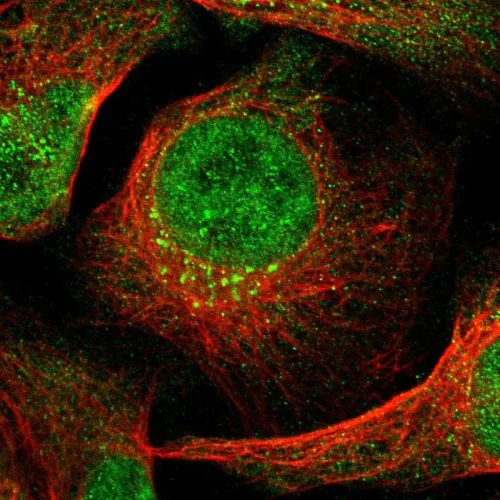
- ICC/IF
Unknown
Immunocytochemistry/ Immunofluorescence - Anti-ING2 antibody (AB244387)
PFA-fixed, Triton X-100 permeabilized U-2 OS (human bone osteosarcoma epithelial cell line) cells stained for ING2 (green) using ab244387 at 4 μg/ml in ICC/IF.
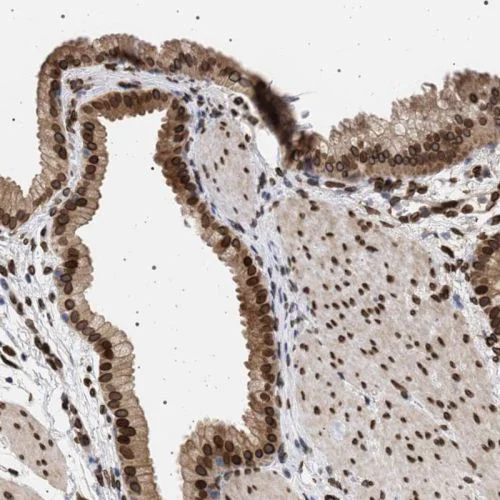
- IHC-P
Unknown
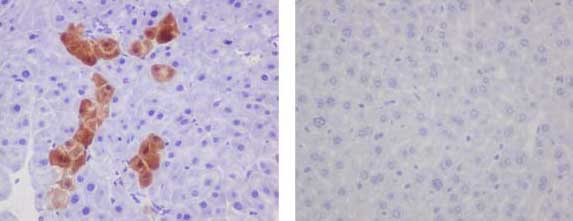
Immunohistochemistry (Formalin/PFA-fixed paraffin-embedded sections) - Anti-ING2 antibody (AB244387)
Paraffin-embedded human gallbladder tissue stained for ING2 using ab244387 at 1/50 dilution in immunohistochemical analysis.
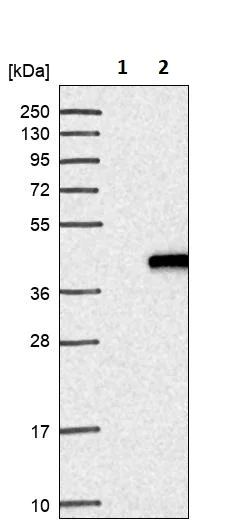
- WB
Unknown
Western blot - Anti-ING2 antibody (AB244387)
All lanes:
Western blot - Anti-ING2 antibody (ab244387) at 0.4 µg/mL
Lane 1:
Vector only transfected HEK-293T (Human epithelial cell line from embryonic kidney transformed with large T antigen) lysate
Lane 2:
ING2 overexpression HEK-293T cell lysate
Predicted band size: 33 kDa
false
Alternative Products
Complementary Products
Primary Antibodies
AB1791
Anti-Histone H3 antibody - Nuclear Marker and ChIP Grade
Lab Essentials

- 5
- 233
Primary Antibodies
AB183734
RabMAb|Recombinant|Lab Essentials|20ul selling size
- 5
- 24
Primary Antibodies
AB129195
Anti-KDM1/LSD1 antibody [EPR6825] - Nuclear Marker and ChIP Grade
KO Validated|RabMAb|Recombinant|Lab Essentials|20ul selling size|Advanced Validation

- 4
- 5
Primary Antibodies
AB246550
Anti-p53 antibody [EPR20416-120]
RabMAb|Recombinant|Lab Essentials|20ul selling size|Advanced Validation
- 0
- 0
Reactivity data
Properties and storage information
Form
Purification technique
Storage buffer
Shipped at conditions
Appropriate short-term storage duration
Appropriate short-term storage conditions
Appropriate long-term storage conditions
Aliquoting information
Storage information
Supplementary information
This supplementary information is collated from multiple sources and compiled automatically.
Biological function summary
ING2 functions as a tumor suppressor by controlling the transcription of genes involved in cell cycle regulation and apoptosis. It interacts with histone acetyltransferase (HAT) and histone deacetylase (HDAC) complexes contributing to chromatin remodeling. As part of the Sin3A-HDAC complex ING2 has the ability to repress transcription influencing the expression of genes important for maintaining cellular homeostasis and preventing oncogenesis.
Pathways
The ING2 protein actively participates in the p53 signaling pathway as well as the MAPK signaling pathway. Its interaction with p53 leads to the enhancement of p53-mediated transcriptional activation which promotes cell cycle arrest and apoptosis. ING2 also interacts with proteins like TP53 and EP300 modulating the cellular responses to stress signals and contributing to cell survival and repair mechanisms.
Product protocols
- Visit the General protocols
- Visit the Troubleshooting
Target data
Alternative Names
Product promise
Please note: All products are 'FOR RESEARCH USE ONLY. NOT FOR USE IN DIAGNOSTIC OR THERAPEUTIC PROCEDURES'.
For licensing inquiries, please contact partnerships@abcam.com