Anti-ING2 antibody [EPR4597-5]
- RabMAb
- Recombinant
- What is this?
Be the first to review this product! Submit a review
|
(1 Publication)
- IP
Supplier Data
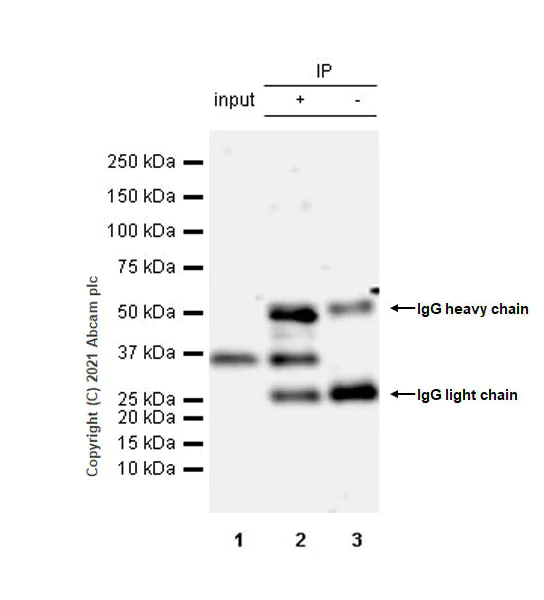
Immunoprecipitation - Anti-ING2 antibody [EPR4597-5] (AB174305)
ING2 was immunoprecipitated from 0.35 mg Mouse brain tissue lysate 10 μg with ab174305 at 1/30 dilution (2μg in 0.35mg lysates). Western blot was performed on the immunoprecipitate using ab174305 at 1/1000 dilution. VeriBlot for IP secondary antibody(HRP) (ab131366) was used at 1/5000 dilution.
Lane 1 : Mouse brain tissue lysate 10 μg
Lane 2 : ab174305 IP in mouse brain tissue lysate
Lane 3 : Rabbit monoclonal IgG (ab172730) instead of ab174305 in mouse brain tissue lysate
Blocking and dilution buffer and concentration : 5% NFDM/TBST.
All lanes:
Immunoprecipitation - Anti-ING2 antibody [EPR4597-5] (ab174305)
Predicted band size: 33 kDa
false
Exposure time: 3min
- WB
Supplier Data
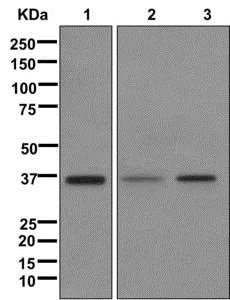
Western blot - Anti-ING2 antibody [EPR4597-5] (AB174305)
All lanes:
Western blot - Anti-ING2 antibody [EPR4597-5] (ab174305) at 1/1000 dilution
Lane 1:
HeLa cell lysate at 10 µg
Lane 2:
HT-1080 cell lysate at 10 µg
Lane 3:
Saos-2 cell lysate at 10 µg
Predicted band size: 33 kDa
false
- WB
Supplier Data
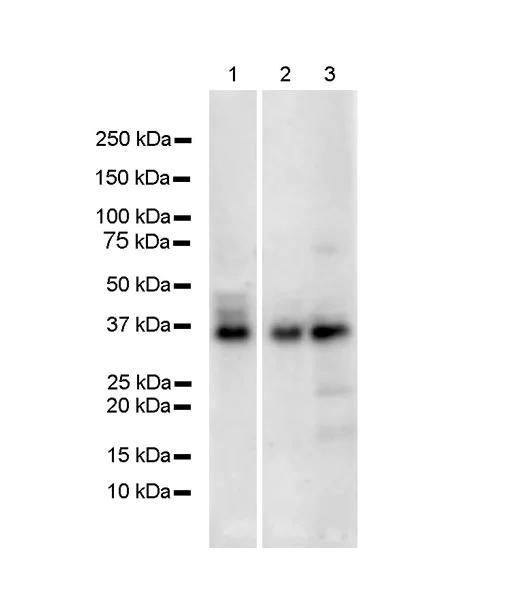
Western blot - Anti-ING2 antibody [EPR4597-5] (AB174305)
Blocking and diluting buffer : 5% NFDM/TBST
This blot was developed using a higher sensitivity ECL substrate.
All lanes:
Western blot - Anti-ING2 antibody [EPR4597-5] (ab174305) at 1/1000 dilution
Lane 1:
Mouse brain tissue lysate at 20 µg
Lane 2:
Mouse heart tissue lysate at 20 µg
Lane 3:
Mouse spleen tissue lysate at 20 µg
Secondary
All lanes:
Western blot - Goat Anti-Rabbit IgG H&L (HRP) (<a href='/en-us/products/secondary-antibodies/goat-rabbit-igg-h-l-hrp-ab97051'>ab97051</a>) at 1/100000 dilution
Predicted band size: 33 kDa
Observed band size: 33 kDa
true
Exposure time: 103s
- WB
Supplier Data
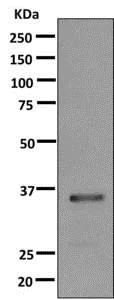
Western blot - Anti-ING2 antibody [EPR4597-5] (AB174305)
All lanes:
Western blot - Anti-ING2 antibody [EPR4597-5] (ab174305) at 1/1000 dilution
All lanes:
ING2 recombinant protein (10ng)
Predicted band size: 33 kDa
false
Related conjugates and formulations (1)
-
Anti-ING2 antibody [EPR4597-5] - BSA and Azide free
Alternative Products
Complementary Products
Primary Antibodies
AB246550
Anti-p53 antibody [EPR20416-120]
RabMAb|Recombinant|Lab Essentials|20ul selling size|Advanced Validation

- 0
- 0
Primary Antibodies
AB68481
20ul selling size|RabMAb|Recombinant|KO Validated

- 5
- 2
Primary Antibodies
AB40676
Anti-NAK/TBK1 antibody [EP611Y]
20ul selling size|RabMAb|Recombinant|KO Validated

- 5
- 2
Primary Antibodies
AB76493
Anti-IRF3 (phospho S386) antibody [EPR2346]
20ul selling size|RabMAb|Recombinant

- 4
- 2
Reactivity data
Product details
Patented technology
Our RabMAb® technology is a patented hybridoma-based technology for making rabbit monoclonal antibodies. For details on our patents, please refer to RabMAb® patents.
What are the advantages of a recombinant monoclonal antibody?
This product is a recombinant monoclonal antibody, which offers several advantages including:
- - High batch-to-batch consistency and reproducibility
- - Improved sensitivity and specificity
- - Long-term security of supply
- - Animal-free batch production
For more information, read more on recombinant antibodies.
Species reactivity
Rat: We have preliminary internal testing data to indicate this antibody may not react with this species.
Please contact us for more information.
Properties and storage information
Form
Purification technique
Storage buffer
Shipped at conditions
Appropriate short-term storage duration
Appropriate short-term storage conditions
Appropriate long-term storage conditions
Aliquoting information
Storage information
Supplementary information
This supplementary information is collated from multiple sources and compiled automatically.
Biological function summary
ING2 functions as a tumor suppressor by controlling the transcription of genes involved in cell cycle regulation and apoptosis. It interacts with histone acetyltransferase (HAT) and histone deacetylase (HDAC) complexes contributing to chromatin remodeling. As part of the Sin3A-HDAC complex ING2 has the ability to repress transcription influencing the expression of genes important for maintaining cellular homeostasis and preventing oncogenesis.
Pathways
The ING2 protein actively participates in the p53 signaling pathway as well as the MAPK signaling pathway. Its interaction with p53 leads to the enhancement of p53-mediated transcriptional activation which promotes cell cycle arrest and apoptosis. ING2 also interacts with proteins like TP53 and EP300 modulating the cellular responses to stress signals and contributing to cell survival and repair mechanisms.
Product protocols
- Visit the General protocols
- Visit the Troubleshooting
Target data
Alternative Names
Publications (1)
Recent publications for all applications. Explore the full listand refine your search
BMJ open respiratory research 11: PubMed38569671
2024
Applications
Unspecified application
Species
Unspecified reactive species
Product promise
Please note: All products are 'FOR RESEARCH USE ONLY. NOT FOR USE IN DIAGNOSTIC OR THERAPEUTIC PROCEDURES'.
For licensing inquiries, please contact partnerships@abcam.com