Anti-Inhibin beta E chain antibody
Be the first to review this product! Submit a review
|
(2 Publications )
- WB
Unknown
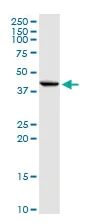
Western blot - Anti-Inhibin beta E chain antibody (AB103167)
All lanes:
Western blot - Anti-Inhibin beta E chain antibody (ab103167) at 1/500 dilution
All lanes:
Mouse liver tissue lysate at 50 µg
Predicted band size: 39 kDa
false
- WB
Unknown
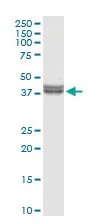
Western blot - Anti-Inhibin beta E chain antibody (AB103167)
All lanes:
Western blot - Anti-Inhibin beta E chain antibody (ab103167) at 1/500 dilution
All lanes:
Human liver tissue lysate at 50 µg
Predicted band size: 118 kDa,39 kDa,49 kDa,67 kDa
false
- WB
Lab
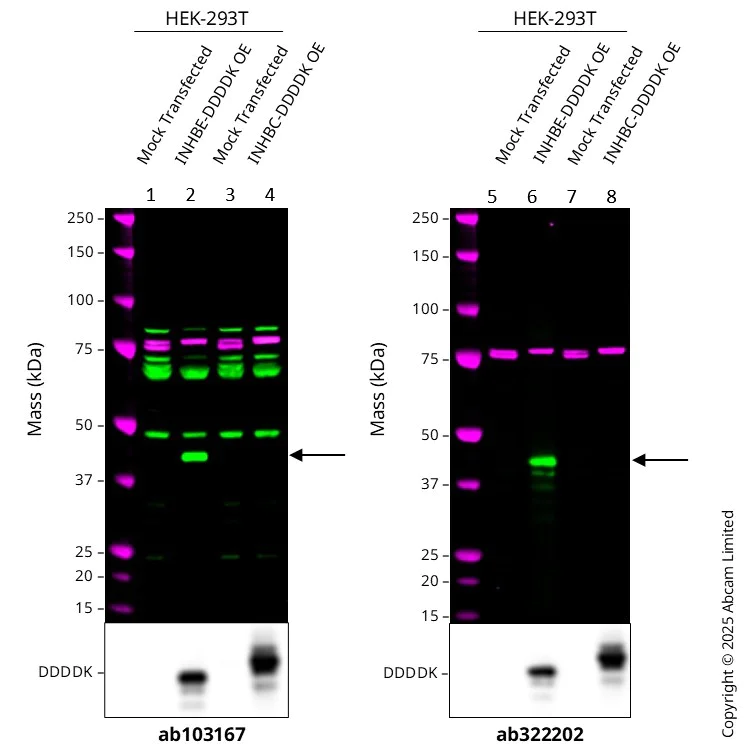
Western blot - Anti-Inhibin beta E chain antibody (AB103167)
Left : Anti-Inhibin beta E chain antibody ab103167 staining at 1/1000 dilution, shown in green; Mouse anti-CANX (ab238078) loading control staining at 1/20,000 dilution, shown in magenta.
Right : Rabbit Monoclonal [EPR29191-125] to Inhibin beta E chain ab322202 staining at 1/1000 dilution, shown in green; Mouse anti-CANX (ab238078) loading control staining at 1/20,000 dilution, shown in magenta.
A band was observed at 43 kDa in INHBE-DDDDK HEK-293T overexpression lysate with no signal observed at this size in INHBC-DDDDK HEK-293T overexpression lysate.
To generate this image, samples were run on an SDS-PAGE gel then transferred onto a nitrocellulose membrane. Membranes were blocked in 3pc Milk in TBS-0.1 % Tween® 20 (TBS-T) before incubation with primary antibodies overnight at 4°C. Blots were washed four times in TBS-T, incubated with secondary antibodies for 1 h at room temperature, washed again four times then imaged. Secondary antibodies used were Goat anti-Rabbit 800CW & Goat anti-Mouse 680RD at 1/20,000 dilution. For DDDDK-tag detection, HRP Anti-DDDDK tag (Binds to FLAG® tag sequence) antibody [M2] (ab49763) was used at 1/1000 dilution and developed using the ECL technique.
Neither ab103167 nor ab322202 cross-reacts with Inhibin beta C chain (INHBC). In Western Blot, we recommend ab322202 as the superior alternative to ab103167 for better specificity and sensitivity.
Exposure time for DDDDK tag : 2s.
Lanes 1 - 4:
Western blot - Anti-Inhibin beta E chain antibody (ab103167) at 1/1000 dilution
Lanes 2, 4, 6 and 8:
Western blot - HRP Anti-DDDDK tag (Binds to FLAG® tag sequence) antibody [M2] (<a href='/en-us/products/primary-antibodies/hrp-ddddk-tag-binds-to-flag-tag-sequence-antibody-m2-ab49763'>ab49763</a>)
Lanes 5 - 8:
Western blot - Anti-Inhibin beta E chain antibody [EPR29191-125] (<a href='/en-us/products/primary-antibodies/inhibin-beta-e-chain-antibody-epr29191-125-ab322202'>ab322202</a>) at 1/1000 dilution
Lanes 1, 3, 5 and 7:
HEK-293 Mock Transfection Lysate at 20 µg
Lanes 2 and 6:
INHBE-DDDDK HEK-293T Overexpression Lysate at 20 µg
Lanes 4 and 8:
INHBC-DDDDK HEK-293T Overexpression Lysate at 20 µg
Secondary
Lanes 1 - 8:
Goat anti-Rabbit 800CW at 1/20000 dilution
Lanes 1 - 8:
Goat anti-Mouse 680RD at 1/20000 dilution
Predicted band size: 35 kDa
Observed band size: 43 kDa
true
- WB
Unknown
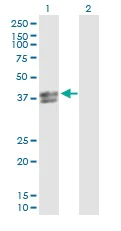
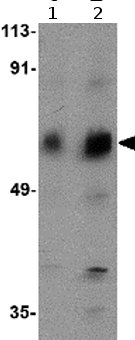
Western blot - Anti-Inhibin beta E chain antibody (AB103167)
All lanes:
Western blot - Anti-Inhibin beta E chain antibody (ab103167) at 1/500 dilution
Lane 1:
INHBE transfected 293T cell line lysate at 25 µg
Lane 2:
Non-transfected 293T cell line lysate at 25 µg
Predicted band size: 23 kDa,29 kDa,31 kDa,32 kDa,33 kDa,39 kDa,41 kDa,43 kDa,48 kDa,59 kDa,60 kDa,69 kDa,96 kDa
Observed band size: 35 kDa,60 kDa
false
Alternative Products

Complementary Products
Primary Antibodies
AB181602
Anti-GAPDH antibody [EPR16891] - Loading Control
KD Validated|RabMAb|Recombinant|Lab Essentials|20ul selling size

- 5
- 23
Primary Antibodies
AB109520
RabMAb|Recombinant|KO Validated|Lab Essentials|20ul selling size

- 5
- 17
Reactivity data
Product details
Anti-Inhibin beta E chain antibody (ab103167) is a rabbit polyclonal antibody and is validated for use in Western Blot (WB) in Human, Mouse samples.
What is the molecular weight of Inhibin beta E chain?
Anti-Inhibin beta E chain (ab103167) specifically detects a band for Inhibin beta E chain (UniProt: P58166) at a molecular weight of 39kDa.
Properties and storage information
Form
Purification technique
Storage buffer
Shipped at conditions
Appropriate short-term storage conditions
Appropriate long-term storage conditions
Aliquoting information
Storage information
Supplementary information
This supplementary information is collated from multiple sources and compiled automatically.
Biological function summary
The Inhibin beta E chain participates in the regulation of reproductive hormone activity. It forms either homodimers or heterodimers combining with other inhibin and activin molecules. The dimerization with alpha chains forms inhibins while pairing with other beta subunits forms activins. These complexes then modulate signaling pathways that adjust hormonal secretion particularly in the pituitary and gonadal tissues.
Pathways
Inhibin beta E chain plays a significant role in the activin signaling pathway. This pathway affects the regulation of FSH (follicle-stimulating hormone) secretion which is important for reproductive processes. INHBE relates to proteins such as follistatin and activin A within these pathways influencing activities flowing from ligand-receptor interactions to transcriptional regulation.
Product protocols
- Visit the General protocols
- Visit the Troubleshooting
Target data
Alternative Names
Publications (2)
Recent publications for all applications. Explore the full listand refine your search
Biomolecules & biomedicine 25:1528-1539 PubMed39748602
2025
Applications
Unspecified application
Species
Unspecified reactive species
European journal of cancer (Oxford, England : 1990) 50:731-8 PubMed24315626
2013
Applications
Unspecified application
Species
Unspecified reactive species
Product promise
Please note: All products are 'FOR RESEARCH USE ONLY. NOT FOR USE IN DIAGNOSTIC OR THERAPEUTIC PROCEDURES'.
For licensing inquiries, please contact partnerships@abcam.com