Anti-IRAK-1 antibody [EPR18630]
- RabMAb
- Recombinant
- KO Validated
- What is this?
Be the first to review this product! Submit a review
|
(7 Publications )
- IP
Supplier Data
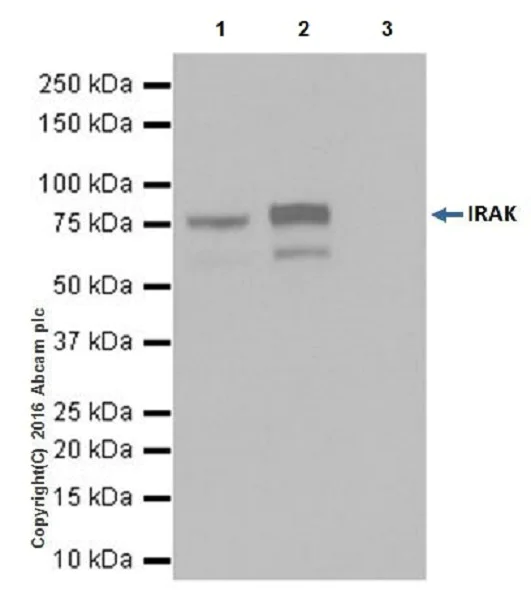
Immunoprecipitation - Anti-IRAK-1 antibody [EPR18630] (AB180747)
IRAK-1 was immunoprecipitated from 0.35 mg of HEK-293 (Human epithelial cell line from embryonic kidney) whole cell lysate with ab180747 at 1/100 dilution. Western blot was performed from the immunoprecipitate using ab180747 at 1/1000 dilution. VeriBlot for IP Detection Reagent (HRP) (ab131366), was used for detection at 1/1000 dilution.
Lane 1 : HEK-293 whole cell lysate 10μg (Input).
Lane 2 : ab180747 IP in HEK-293 whole cell lysate.
Lane 3 : Rabbit monoclonal IgG (ab172730) instead of ab180747 in HEK-293 whole cell lysate.
Blocking and dilution buffer and concentration : 5% NFDM/TBST.
Exposure time : 30 seconds.
The 68kDa band observed is likely a splice variant, according to PMID : 16690127.
All lanes:
Immunoprecipitation - Anti-IRAK-1 antibody [EPR18630] (ab180747)
Predicted band size: 76 kDa
false
- WB
Supplier Data
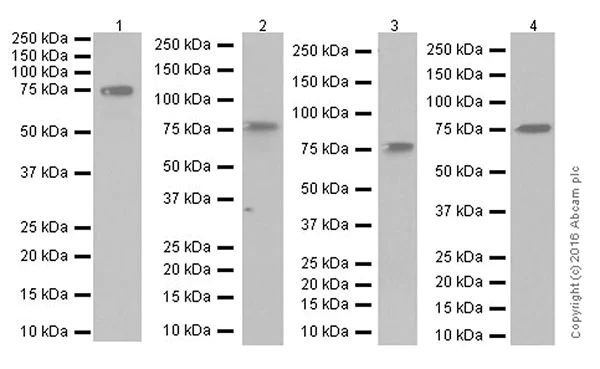
Western blot - Anti-IRAK-1 antibody [EPR18630] (AB180747)
Blocking/Dilution buffer : 5% NFDM/TBST.
Exposure time : Lane 1 : 10 seconds; Lane 2 : 3 minutes; Lane 3 : 30 seconds; Lane 4 : 1 minute.
There are two splice variants for IRAK-1, IRAK-1b and IRAK-1c, respectively. The product recognizes full length IRAK-1 (80kDa).
All lanes:
Western blot - Anti-IRAK-1 antibody [EPR18630] (ab180747) at 1/1000 dilution
Lane 1:
HEK-293 (Human epithelial cell line from embryonic kidney) whole cell lysate at 10 µg
Lane 2:
Jurkat (Human T cell leukemia cell line from peripheral blood) whole cell lysate at 10 µg
Lane 3:
K562 (Human chronic myelogenous leukemia cell line from bone marrow) whole cell lysate at 10 µg
Lane 4:
HeLa (Human epithelial cell line from cervix adenocarcinoma) whole cell lysate at 10 µg
Secondary
All lanes:
Western blot - Goat Anti-Rabbit IgG H&L (HRP) (<a href='/en-us/products/secondary-antibodies/goat-rabbit-igg-h-l-hrp-ab97051'>ab97051</a>) at 1/100000 dilution
Predicted band size: 76 kDa
Observed band size: 77 kDa
false
- WB
Lab
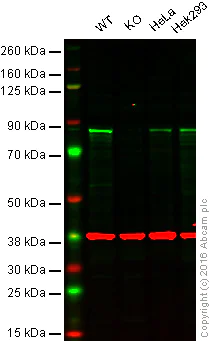
Western blot - Anti-IRAK-1 antibody [EPR18630] (AB180747)
Lane 1 : Wild type HAP1 whole cell lysate (20 μg)
Lane 2 : IRAK-1 knockout HAP1 whole cell lysate (20 μg)
Lane 3 : HeLa whole cell lysate (20 μg)
Lane 4 : Hek293 whole cell lysate (20 μg)
Lanes 1 - 4 : Merged signal (red and green). Green - ab180747 observed at 85 kDa. Red - loading control, ab8245, observed at 37 kDa.
ab180747 was shown to specifically react with IRAK-1 when IRAK-1 knockout samples were used. Wild-type and IRAK-1 knockout samples were subjected to SDS-PAGE. ab180747 and ab8245 (Mouse anti GAPDH loading control) were incubated overnight at 4°C at 1/1000 dilution and 1/10000 dilution respectively. Blots were developed with 800CW Goat anti-Rabbit and 680CW Goat anti-Mouse secondary antibodies at 1/10000 dilution for 1 hour at room temperature before imaging.
All lanes:
Western blot - Anti-IRAK-1 antibody [EPR18630] (ab180747)
Predicted band size: 76 kDa
false
Related conjugates and formulations (1)
-
Anti-IRAK-1 antibody [EPR18630] - BSA and Azide free
Alternative Products
Complementary Products
Primary Antibodies
AB219413
Anti-MyD88 antibody [EPR21824]
20ul selling size|RabMAb|Recombinant|KO Validated

- 0
- 0
Primary Antibodies
AB33915
RabMAb|Recombinant|KO Validated|20ul selling size

- 4
- 9
Primary Antibodies
AB32536
Anti-NF-kB p65 antibody [E379]
BOND RX™ Validated|20ul selling size|RabMAb|Recombinant|KO Validated

- 4
- 15
Primary Antibodies
AB92700
Anti-IKB alpha (phospho S32) antibody [EPR3148]
20ul selling size|RabMAb|Recombinant

- 5
- 1
Reactivity data
Product details
Patented technology
Our RabMAb® technology is a patented hybridoma-based technology for making rabbit monoclonal antibodies. For details on our patents, please refer to RabMAb® patents.
What are the advantages of a recombinant monoclonal antibody?
This product is a recombinant monoclonal antibody, which offers several advantages including:
- - High batch-to-batch consistency and reproducibility
- - Improved sensitivity and specificity
- - Long-term security of supply
- - Animal-free batch production
For more information, read more on recombinant antibodies.
Properties and storage information
Form
Purification technique
Storage buffer
Shipped at conditions
Appropriate short-term storage duration
Appropriate short-term storage conditions
Appropriate long-term storage conditions
Aliquoting information
Storage information
Supplementary information
This supplementary information is collated from multiple sources and compiled automatically.
Biological function summary
IRAK-1 mediates the inflammatory response by promoting the production of cytokines and other inflammatory mediators. It is a component of the Myddosome a multi-protein complex that assembles upon receptor activation and includes MyD88 an adaptor protein needed for signal transduction. IRAK-1 phosphorylates other targets and itself leading to its own degradation which is an important step for turning off the signaling and preventing prolonged activation. Its precise activity modulation ensures balanced immune responses and prevents overreaction that could cause tissue damage.
Pathways
IRAK-1 functions in the IL-1 and Toll-like receptor signaling pathways both of which are important for innate immunity. In these pathways IRAK-1 interacts with key proteins such as TRAF6 which transduces signals leading to NF-κB and MAPK activation critical for inflammatory gene expression. Its role in these pathways highlights the importance of proper function and regulation as deficiencies or dysregulation can result in inappropriate immune responses.
Product protocols
- Visit the General protocols
- Visit the Troubleshooting
Target data
Alternative Names
Publications (7)
Recent publications for all applications. Explore the full listand refine your search
Acta Cardiologica Sinica 39:742-754 PubMed37720410
2023
Applications
Unspecified application
Species
Unspecified reactive species
International journal of medical sciences 20:1427-1447 PubMed37790851
2023
Applications
Unspecified application
Species
Unspecified reactive species
Annals of translational medicine 10:1307 PubMed36660623
2023
Applications
Unspecified application
Species
Unspecified reactive species
Experimental and therapeutic medicine 24:615 PubMed36160881
2022
Applications
Unspecified application
Species
Unspecified reactive species
Journal of microbiology and biotechnology 32:1344-1354 PubMed36224753
2022
Applications
Unspecified application
Species
Unspecified reactive species
Bioengineered 12:369-381 PubMed33380238
2021
Applications
Unspecified application
Species
Unspecified reactive species
Oncology letters 19:3643-3652 PubMed32382320
2020
Applications
Unspecified application
Species
Unspecified reactive species
Product promise
Please note: All products are 'FOR RESEARCH USE ONLY. NOT FOR USE IN DIAGNOSTIC OR THERAPEUTIC PROCEDURES'.
For licensing inquiries, please contact partnerships@abcam.com