JavaScript is disabled in your browser. Please enable JavaScript to view this website.
AB112042

Anti-IRAK-1 (phospho T387) antibody

4

(2 Reviews)

|

(1 Publication)

Rabbit Polyclonal IRAK-1 phospho T387 antibody. Suitable for ICC/IF and reacts with Mouse samples. Cited in 1 publication. Immunogen corresponding to Synthetic Peptide within Human IRAK1 pT387.

View Alternative Names

IRAK, IRAK1, Interleukin-1 receptor-associated kinase 1, IRAK-1
1 Images
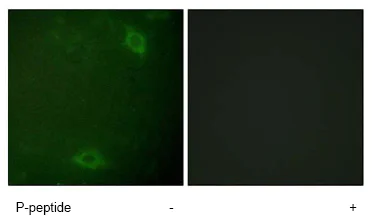
Immunocytochemistry/ Immunofluorescence - Anti-IRAK-1 (phospho T387) antibody (AB112042)
  • ICC/IF

Unknown

Immunocytochemistry/ Immunofluorescence - Anti-IRAK-1 (phospho T387) antibody (AB112042)

ab112042 at 1/100 dilution staining IRAK-1 in NIH3T3 cells by Immunofluorescence. The image on the right is treated with the synthesized phosphopeptide.

Key facts

Host species

Rabbit

Clonality

Polyclonal

Isotype

IgG

Carrier free

No

Reacts with

Mouse

Applications

ICC/IF

applications

Immunogen

Synthetic Peptide within Human IRAK1 pT387. The exact immunogen used to generate this antibody is proprietary information.

P51617

Reactivity data

{ "title": "Reactivity Data", "filters": { "stats": ["", "Species", "Dilution Info", "Notes"], "tabs": { "all-applications": {"fullname" : "All Applications", "shortname": "All Applications"}, "ICCIF" : {"fullname" : "Immunocytochemistry/ Immunofluorescence", "shortname":"ICC/IF"} }, "product-promise": { "all": "all", "testedAndGuaranteed": "tested", "guaranteed": "expected", "predicted": "predicted", "notRecommended": "not-recommended" } }, "values": { "Mouse": { "ICCIF-species-checked": "testedAndGuaranteed", "ICCIF-species-dilution-info": "1/100 - 1/500", "ICCIF-species-notes": "<p></p>" }, "Rat": { "ICCIF-species-checked": "predicted", "ICCIF-species-dilution-info": "", "ICCIF-species-notes": "" } } }

Properties and storage information

Form
Liquid
Purification technique
Affinity purification Immunogen
Purification notes
ab112042 was affinity-purified from rabbit antiserum by affinity-chromatography using epitope-specific phosphopeptide. The antibody against non-phosphopeptide was removed by chromatography using non-phosphopeptide corresponding to the phosphorylation site.
Storage buffer
pH: 7.4 Preservative: 0.02% Sodium azide Constituents: PBS, 50% Glycerol (glycerin, glycerine), 0.88% Sodium chloride
Shipped at conditions
Blue Ice
Appropriate short-term storage conditions
+4°C
Appropriate long-term storage conditions
-20°C

Supplementary information

This supplementary information is collated from multiple sources and compiled automatically.

IRAK-1 also known as Interleukin-1 Receptor-Associated Kinase 1 is a serine/threonine kinase that plays a role in the immune response. With a molecular mass around 76 kDa this protein is heavily expressed in immune cells such as macrophages and monocytes. IRAK-1 is an important player in the signal transduction process following the activation of the Toll-like and interleukin-1 receptor (IL-1R) families. The kinase activity of IRAK-1 occurs when it associates with the receptor complex transmitting signals that activate downstream pathways.
Biological function summary

IRAK-1 mediates the inflammatory response by promoting the production of cytokines and other inflammatory mediators. It is a component of the Myddosome a multi-protein complex that assembles upon receptor activation and includes MyD88 an adaptor protein needed for signal transduction. IRAK-1 phosphorylates other targets and itself leading to its own degradation which is an important step for turning off the signaling and preventing prolonged activation. Its precise activity modulation ensures balanced immune responses and prevents overreaction that could cause tissue damage.

Pathways

IRAK-1 functions in the IL-1 and Toll-like receptor signaling pathways both of which are important for innate immunity. In these pathways IRAK-1 interacts with key proteins such as TRAF6 which transduces signals leading to NF-κB and MAPK activation critical for inflammatory gene expression. Its role in these pathways highlights the importance of proper function and regulation as deficiencies or dysregulation can result in inappropriate immune responses.

IRAK-1 has been connected to autoimmune diseases such as rheumatoid arthritis and certain cancers. This protein affects how the immune system responds to inflammation and can influence disease progression through its regulatory actions. For instance alterations in IRAK-1 activity or expression can lead to an increase in pro-inflammatory cytokines that exacerbate conditions like rheumatoid arthritis. Additionally in cancer pathways influenced by IRAK-1 can affect tumor growth and metastasis. Its interaction with proteins such as MyD88 and TRAF6 within these pathological contexts underlines its importance as a potential target for therapeutic intervention.

Product protocols

For this product, it's our understanding that no specific protocols are required. You can visit:

Target data

Serine/threonine-protein kinase that plays a critical role in initiating innate immune response against foreign pathogens. Involved in Toll-like receptor (TLR) and IL-1R signaling pathways. Is rapidly recruited by MYD88 to the receptor-signaling complex upon TLR activation. Association with MYD88 leads to IRAK1 phosphorylation by IRAK4 and subsequent autophosphorylation and kinase activation. Phosphorylates E3 ubiquitin ligases Pellino proteins (PELI1, PELI2 and PELI3) to promote pellino-mediated polyubiquitination of IRAK1. Then, the ubiquitin-binding domain of IKBKG/NEMO binds to polyubiquitinated IRAK1 bringing together the IRAK1-MAP3K7/TAK1-TRAF6 complex and the NEMO-IKKA-IKKB complex. In turn, MAP3K7/TAK1 activates IKKs (CHUK/IKKA and IKBKB/IKKB) leading to NF-kappa-B nuclear translocation and activation. Alternatively, phosphorylates TIRAP to promote its ubiquitination and subsequent degradation. Phosphorylates the interferon regulatory factor 7 (IRF7) to induce its activation and translocation to the nucleus, resulting in transcriptional activation of type I IFN genes, which drive the cell in an antiviral state. When sumoylated, translocates to the nucleus and phosphorylates STAT3.
See full target information IRAK1 pT387

Publications (1)

Recent publications for all applications. Explore the full list and refine your search

Frontiers in oncology 12:1036401 PubMed36408174

2022

DJ-1 promotes osteosarcoma progression through activating CDK4/RB/E2F1 signaling pathway.

Applications

Unspecified application

Species

Unspecified reactive species

Zhitao Han,Lining Wang,Dongshuo Wang,Luosheng Zhang,Yifeng Bi,Xinlei Zheng,Weibo Liu,Guangjian Bai,Zhenhua Wang,Wei Wan,Yong Ma,Xiaopan Cai,Tielong Liu,Qi Jia
View all publications

Product promise

We are committed to supporting your work with high-quality reagents, and we're here for you every step of the way. In the unlikely event that one of our products does not perform as expected, you're protected by our Product Promise.
For full details, please see our Terms & Conditions

Please note: All products are 'FOR RESEARCH USE ONLY. NOT FOR USE IN DIAGNOSTIC OR THERAPEUTIC PROCEDURES'.

For licensing inquiries, please contact partnerships@abcam.com