JavaScript is disabled in your browser. Please enable JavaScript to view this website.
AB246879

Anti-KAT6B / MORF antibody

Be the first to review this product! Submit a review

|

(4 Publications )

Rabbit Polyclonal KAT6B / MORF antibody. Suitable for IHC-P, WB, ICC/IF and reacts with Human samples. Cited in 4 publications. Immunogen corresponding to Recombinant Fragment Protein within Human KAT6B aa 1150 to C-terminus.

View Alternative Names

KIAA0383, MORF, MOZ2, MYST4, KAT6B, Histone acetyltransferase KAT6B, Histone acetyltransferase MOZ2, Monocytic leukemia zinc finger protein-related factor, MYST-4

5 Images
Immunocytochemistry/ Immunofluorescence - Anti-KAT6B / MORF antibody (AB246879)
  • ICC/IF

Unknown

Immunocytochemistry/ Immunofluorescence - Anti-KAT6B / MORF antibody (AB246879)

Immunocytochemical analysis A431 (Human epidermoid carcinoma cell line) whole cells stained for KAT6B / MORF (green) in the nucleus and nuclear bodies with ab246879 at 2 μg/ml.

Immunohistochemistry (Formalin/PFA-fixed paraffin-embedded sections) - Anti-KAT6B / MORF antibody (AB246879)
  • IHC-P

Unknown

Immunohistochemistry (Formalin/PFA-fixed paraffin-embedded sections) - Anti-KAT6B / MORF antibody (AB246879)

Immunohistochemical analysis human pancreas tissue stained for KAT6B / MORF in exocrine cells with ab246879 at a 1/200 dilution.

Performed heat mediated antigen retrieval with citrate buffer pH 6 before commencing with IHC staining protocol.
Immunohistochemistry (Formalin/PFA-fixed paraffin-embedded sections) - Anti-KAT6B / MORF antibody (AB246879)
  • IHC-P

Unknown

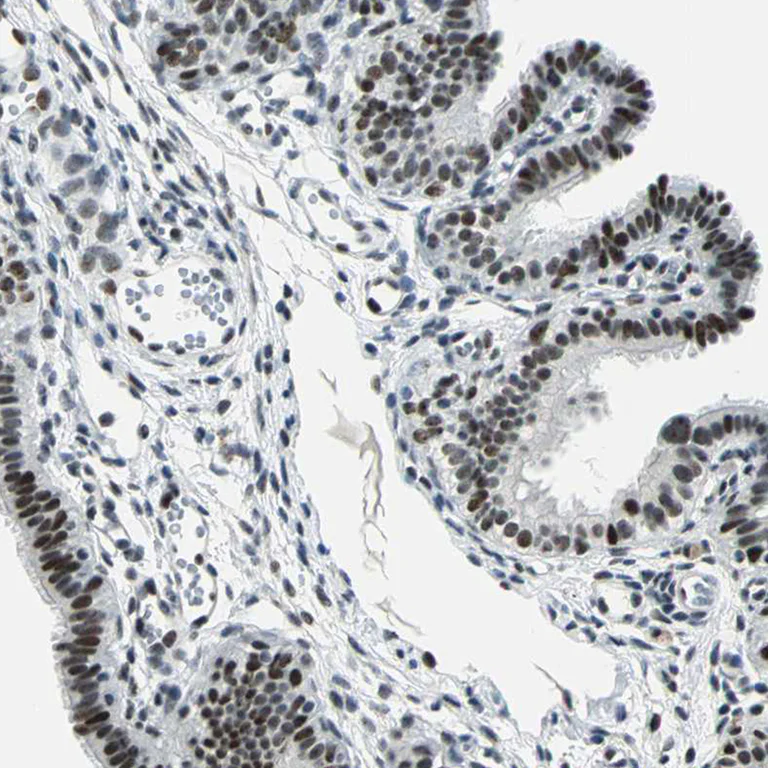
Immunohistochemistry (Formalin/PFA-fixed paraffin-embedded sections) - Anti-KAT6B / MORF antibody (AB246879)

Immunohistochemical analysis human Fallopian tube tissue stained for KAT6B / MORF in the nucleus of glandular cells with ab246879 at a 1/200 dilution.

Performed heat mediated antigen retrieval with citrate buffer pH 6 before commencing with IHC staining protocol.

Immunohistochemistry (Formalin/PFA-fixed paraffin-embedded sections) - Anti-KAT6B / MORF antibody (AB246879)
  • IHC-P

Unknown

Immunohistochemistry (Formalin/PFA-fixed paraffin-embedded sections) - Anti-KAT6B / MORF antibody (AB246879)

Immunohistochemical analysis human small intestine tissue stained for KAT6B / MORF in glandular cells with ab246879 at a 1/200 dilution.

Performed heat mediated antigen retrieval with citrate buffer pH 6 before commencing with IHC staining protocol.
Immunohistochemistry (Formalin/PFA-fixed paraffin-embedded sections) - Anti-KAT6B / MORF antibody (AB246879)
  • IHC-P

Unknown

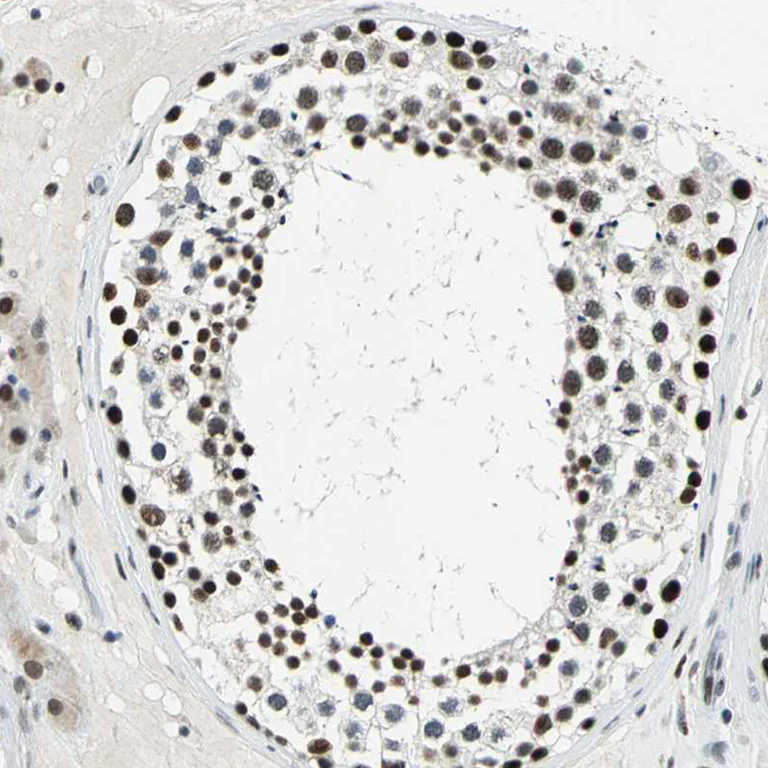
Immunohistochemistry (Formalin/PFA-fixed paraffin-embedded sections) - Anti-KAT6B / MORF antibody (AB246879)

Immunohistochemical analysis human testis tissue stained for KAT6B / MORF in the nucleus of cells in seminiferous ducts with ab246879 at a 1/200 dilution.

Performed heat mediated antigen retrieval with citrate buffer pH 6 before commencing with IHC staining protocol.

Key facts

Host species

Rabbit

Clonality

Polyclonal

Isotype

IgG

Carrier free

No

Reacts with

Human

Applications

IHC-P, ICC/IF, WB

applications

Immunogen

Recombinant Fragment Protein within Human KAT6B aa 1150 to C-terminus. The exact immunogen used to generate this antibody is proprietary information.

Q8WYB5

Reactivity data

{ "title": "Reactivity Data", "filters": { "stats": ["", "Species", "Dilution Info", "Notes"], "tabs": { "all-applications": {"fullname" : "All Applications", "shortname": "All Applications"}, "IHCP" : {"fullname" : "Immunohistochemistry (Formalin/PFA-fixed paraffin-embedded sections)", "shortname":"IHC-P"}, "WB" : {"fullname" : "Western blot", "shortname":"WB"}, "ICCIF" : {"fullname" : "Immunocytochemistry/ Immunofluorescence", "shortname":"ICC/IF"} }, "product-promise": { "all": "all", "testedAndGuaranteed": "tested", "guaranteed": "expected", "predicted": "predicted", "notRecommended": "not-recommended" } }, "values": { "Human": { "IHCP-species-checked": "testedAndGuaranteed", "IHCP-species-dilution-info": "1/200 - 1/500", "IHCP-species-notes": "<p></p> Perform heat-mediated antigen retrieval with citrate buffer pH 6 before commencing with IHC staining protocol.", "WB-species-checked": "testedAndGuaranteed", "WB-species-dilution-info": "0.04-0.4 µg/mL", "WB-species-notes": "<p></p>", "ICCIF-species-checked": "testedAndGuaranteed", "ICCIF-species-dilution-info": "0.25-2 µg/mL", "ICCIF-species-notes": "<p></p>" }, "Cynomolgus monkey": { "IHCP-species-checked": "predicted", "IHCP-species-dilution-info": "", "IHCP-species-notes": "", "WB-species-checked": "predicted", "WB-species-dilution-info": "", "WB-species-notes": "", "ICCIF-species-checked": "predicted", "ICCIF-species-dilution-info": "", "ICCIF-species-notes": "" } } }

Properties and storage information

Form
Liquid
Purification technique
Affinity purification Immunogen
Storage buffer
pH: 7.2 Preservative: 0.02% Sodium azide Constituents: PBS, 40% Glycerol (glycerin, glycerine)
Shipped at conditions
Blue Ice
Appropriate short-term storage duration
1-2 weeks
Appropriate short-term storage conditions
+4°C
Appropriate long-term storage conditions
-20°C
Aliquoting information
Upon delivery aliquot
Storage information
Avoid freeze / thaw cycle

Supplementary information

This supplementary information is collated from multiple sources and compiled automatically.

KAT6B also known as MORF is a lysine acetyltransferase that plays an important role in chromatin remodeling by acetylating histone H3 at lysine 23. This modification influences gene expression. KAT6B has a molecular mass of approximately 250 kDa. The protein is expressed widely in various tissues including the brain and developmental tissues where it modulates several gene regulatory processes by altering chromatin structure.
Biological function summary

KAT6B is a part of the Moz Ybf2/Sas3 Sas2 and Tip60 (MYST) family which is a group of acetyltransferases known for their involvement in gene transcription regulation. KAT6B forms a complex with other proteins such as BRPF1 which acts as a scaffold protein to enhance its acetyltransferase activity. This complex plays an important role in cellular differentiation processes and maintenance of gene expression patterns important for development.

Pathways

KAT6B interacts with key regulatory mechanisms that include the Wnt signaling pathway and the transcriptional regulation by TP53. Within these pathways KAT6B influences gene transcription and cell cycle progression. It also cooperates with proteins like KAT6A another member of the MYST family sharing similar functions in the regulation of gene expression. Their coordinated activity is essential for normal cell function growth and prevention of unregulated cell proliferation.

Alterations in KAT6B function or expression associate with developmental disorders including Say-Barber-Biesecker-Young-Simpson syndrome also known as genitopatellar syndrome. These disorders often involve mutations that disrupt normal acetyltransferase activity leading to developmental abnormalities. KAT6B has a connection with other MYST family proteins such as KAT5 contributing to similar phenotypic outcomes when mutated. Understanding KAT6B's role in these disorders provides insights into potential therapeutic targets for treatment.

Product protocols

For this product, it's our understanding that no specific protocols are required. You can visit:

Target data

Histone acetyltransferase which may be involved in both positive and negative regulation of transcription. Required for RUNX2-dependent transcriptional activation. May be involved in cerebral cortex development. Component of the MOZ/MORF complex which has a histone H3 acetyltransferase activity.
See full target information KAT6B

Publications (4)

Recent publications for all applications. Explore the full list and refine your search

BMC cancer 23:586 PubMed37365518

2023

Expression profiles and functional prediction of histone acetyltransferases of the MYST family in kidney renal clear cell carcinoma.

Applications

Unspecified application

Species

Unspecified reactive species

Fan Liang,Xiangke Li,Xiaoman Shen,Runlei Yang,Chuan Chen

Clinical and translational medicine 13:e1166 PubMed36639835

2023

XBP1-elicited environment by chemotherapy potentiates repopulation of tongue cancer cells by enhancing miR-22/lncRNA/KAT6B-dependent NF-κB signalling.

Applications

Unspecified application

Species

Unspecified reactive species

Xiaoting Jia,Ge Wang,Lihong Wu,Hao Pan,Li Ling,Jianlei Zhang,Qingquan Wen,Jie Cui,Zhimin He,Bin Qi,Shuxu Zhang,Liyun Luo,Guopei Zheng

Molecular genetics & genomic medicine 9:e1809 PubMed34519438

2021

Novel variants in KAT6B spectrum of disorders expand our knowledge of clinical manifestations and molecular mechanisms.

Applications

Unspecified application

Species

Unspecified reactive species

Megan Yabumoto,Jessica Kianmahd,Meghna Singh,Maria F Palafox,Angela Wei,Kathryn Elliott,Dana H Goodloe,S Joy Dean,Catherine Gooch,Brianna K Murray,Erin Swartz,Samantha A Schrier Vergano,Meghan C Towne,Kimberly Nugent,Elizabeth R Roeder,Christina Kresge,Beth A Pletcher,Katheryn Grand,John M Graham,Ryan Gates,Natalia Gomez-Ospina,Subhadra Ramanathan,Robin Dawn Clark,Kimberly Glaser,Paul J Benke,Julie S Cohen,Ali Fatemi,Weiyi Mu,Kristin W Baranano,Jill A Madden,Cynthia S Gubbels,Timothy W Yu,Pankaj B Agrawal,Mary-Kathryn Chambers,Chanika Phornphutkul,John A Pugh,Kate A Tauber,Svetlana Azova,Jessica R Smith,Anne O'Donnell-Luria,Hannah Medsker,Siddharth Srivastava,Deborah Krakow,Daniela N Schweitzer,Valerie A Arboleda

OncoTargets and therapy 14:2853-2865 PubMed33953570

2021

TCEB3 is Regulated by Circ-0000212/miR-140-3p Axis to Promote the Progression of Cervical Cancer.

Applications

Unspecified application

Species

Unspecified reactive species

Yufeng Wang,Chuanhui Miao,Xiang Gao
View all publications

Product promise

We are committed to supporting your work with high-quality reagents, and we're here for you every step of the way. In the unlikely event that one of our products does not perform as expected, you're protected by our Product Promise.
For full details, please see our Terms & Conditions

Please note: All products are 'FOR RESEARCH USE ONLY. NOT FOR USE IN DIAGNOSTIC OR THERAPEUTIC PROCEDURES'.

For licensing inquiries, please contact partnerships@abcam.com