JavaScript is disabled in your browser. Please enable JavaScript to view this website.
AB833

Anti-Ki67 antibody

4

(13 Reviews)

|

(219 Publications )
Rabbit Polyclonal Ki67 antibody. Suitable for IHC-P and reacts with Human samples. Cited in 219 publications. Immunogen corresponding to Synthetic Peptide within Human MKI67.
3 Images
Immunohistochemistry (Formalin/PFA-fixed paraffin-embedded sections) - Anti-Ki67 antibody (AB833)
  • IHC-P

Unknown

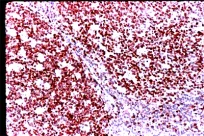
Immunohistochemistry (Formalin/PFA-fixed paraffin-embedded sections) - Anti-Ki67 antibody (AB833)

ab833 - immunohistochemistry

Formalin fixed paraffin embedded human tonsil stained with Ki-67, using ABC and AEC chromogen.
Immunohistochemistry (Formalin/PFA-fixed paraffin-embedded sections) - Anti-Ki67 antibody (AB833)
  • IHC-P

PubMed

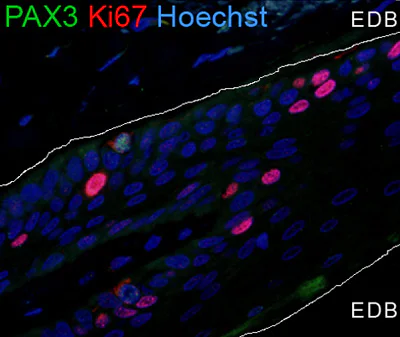
Immunohistochemistry (Formalin/PFA-fixed paraffin-embedded sections) - Anti-Ki67 antibody (AB833)

Immunohistochemical analysis of Human skin tissue, staining Ki67 (red) with ab833.

Antigen retrieval was performed by heat mediation in a EDTA/Tris buffer (pH 8.0). Sections were blocked with 10% NGS for 1 hour at room temperature, followed by incubation with primary antibody (1/25). An AlexFluor®546 anti-rabbit IgG (1/500) was used as the secondary antibody.

Image from Medic S et al., PLoS One. 2010 Apr 22;5(4):e9977. Fig 3.; doi:10.1371/journal.pone.0009977; April 22, 2010, PLoS ONE 5(4): e9977.
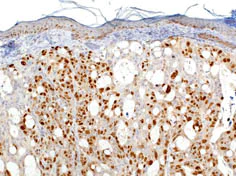
Immunohistochemistry (Formalin/PFA-fixed paraffin-embedded sections) - Anti-Ki67 antibody (AB833)
  • IHC-P

AbReview2816****

Immunohistochemistry (Formalin/PFA-fixed paraffin-embedded sections) - Anti-Ki67 antibody (AB833)

HT-29 xenograft tumor in mouse 20x pretreatment w/ citrate pH 6.0 using anti-Ki67 antibody ab833 at 5 ug/mL for 30 min at RT.

This image is courtesy of an abreview submitted by Mithra Mahmoudi.

Key facts

Host species

Rabbit

Clonality

Polyclonal

Isotype

IgG

Carrier free

No

Reacts with

Human

Applications

IHC-P

applications

Immunogen

Synthetic Peptide within Human MKI67. The exact immunogen used to generate this antibody is proprietary information.

P46013

Reactivity data

{ "title": "Reactivity Data", "filters": { "stats": ["", "Species", "Dilution Info", "Notes"], "tabs": { "all-applications": {"fullname" : "All Applications", "shortname": "All Applications"}, "IHCP" : {"fullname" : "Immunohistochemistry (Formalin/PFA-fixed paraffin-embedded sections)", "shortname":"IHC-P"} }, "product-promise": { "all": "all", "testedAndGuaranteed": "tested", "guaranteed": "expected", "predicted": "predicted", "notRecommended": "not-recommended" } }, "values": { "Human": { "IHCP-species-checked": "testedAndGuaranteed", "IHCP-species-dilution-info": "1/25 - 1/50", "IHCP-species-notes": "<p>We recommend using an ABC system for detection of this antibody.</p><p>Positive Control: Hu tonsil tissue</p>" } } }

Properties and storage information

Form
Liquid
Purification technique
Affinity purification Protein A
Storage buffer
pH: 7.3 - 7.5 Preservative: 0.05% Sodium azide Constituents: 1% BSA
Shipped at conditions
Blue Ice
Appropriate short-term storage duration
1-2 weeks
Appropriate short-term storage conditions
+4°C
Appropriate long-term storage conditions
-20°C
Storage information
Avoid freeze / thaw cycle

Supplementary information

This supplementary information is collated from multiple sources and compiled automatically.

Ki67 is a nuclear protein often referred to as MKI67 with a molecular weight of approximately 345 kDa. This protein is strongly associated with cell proliferation. Scientists commonly use Ki67 staining techniques to identify and quantify proliferating cells in tissues. Ki67 is expressed in the nucleus during active cell cycle phases—G1 S G2 and M—but not in resting cells in G0 phase. It is detectable through methods such as Ki67 immunofluorescence and Ki67 flow cytometry which are important for analyzing cell division.
Biological function summary

The Ki67 protein plays an essential role in cellular proliferation processes. It does not form part of a stable complex but interacts transiently with other cell cycle-related proteins. Research indicates that Ki67 maintains the structure of the perichromosomal layer during mitosis impacting chromosome separation. It is particularly active in tissues with high cell turnover such as bone marrow and lymphoid organs.

Pathways

Ki67 influences several key cellular pathways that control cell proliferation and differentiation. The protein acts within the regulation of the cell cycle and the PI3K/AKT signaling pathway important for cell growth and survival. Within these pathways Ki67 interacts with proteins like cyclin-dependent kinases (CDKs) which regulate transitions between different phases of the cell cycle.

Ki67 has significant implications in oncology and can be used as a biomarker for cancer prognosis. Its expression levels help determine the aggressiveness of tumors especially in breast cancer and prostate cancer. High Ki67 levels correlate with poor prognosis as it indicates rapid cell division. In cancer Ki67 associates with p53 a protein that regulates the cell cycle and function as a tumor suppressor.

Product protocols

For this product, it's our understanding that no specific protocols are required. You can visit:

Target data

Protein that associates with the surface of mitotic chromosomes and acts both as a chromosome repellent during early mitosis and chromosome attractant during late mitosis (PubMed : 27362226, PubMed : 32879492, PubMed : 35513709, PubMed : 39153474). Required to maintain individual mitotic chromosomes dispersed in the cytoplasm following nuclear envelope disassembly (PubMed : 27362226). During early mitosis, relocalizes from nucleoli to the chromosome surface where it forms extended brush structures that cover a substantial fraction of the chromosome surface (PubMed : 27362226). The MKI67 brush structure prevents chromosomes from collapsing into a single chromatin mass by forming a steric and electrostatic charge barrier : the protein has a high net electrical charge and acts as a surfactant, dispersing chromosomes and enabling independent chromosome motility (PubMed : 27362226). During mitotic anaphase, the MKI67 brush structure collapses and MKI67 switches from a chromosome repellent to a chromosome attractant to promote chromosome clustering and facilitate the exclusion of large cytoplasmic particles from the future nuclear space (PubMed : 32879492, PubMed : 39153474). Mechanistically, dephosphorylation during mitotic exit and simultaneous exposure of a conserved basic patch induce the RNA-dependent formation of a liquid-like condensed phase on the chromosome surface, promoting coalescence of neighboring chromosome surfaces and clustering of chromosomes (PubMed : 39153474). Binds premature ribosomal RNAs during anaphase; promoting liquid-liquid phase separation (PubMed : 28935370, PubMed : 39153474). Binds DNA, with a preference for supercoiled DNA and AT-rich DNA (PubMed : 10878551). Does not contribute to the internal structure of mitotic chromosomes (By similarity). May play a role in chromatin organization; it is however unclear whether it plays a direct role in chromatin organization or whether it is an indirect consequence of its function in mitotic chromosome (PubMed : 24867636).
See full target information MKI67

Alternative Names

Proliferation marker protein Ki-67, Antigen identified by monoclonal antibody Ki-67, Antigen KI-67, Antigen Ki67, MKI67

Publications (219)

Recent publications for all applications. Explore the full listand refine your search

Materials today. Bio 34:102256 PubMed40977832

2025

Melt electrowritten medium chain length polyhydroxyalkanoate cardiac patches for Post-MI cardiac regeneration.

Applications

Unspecified application

Species

Unspecified reactive species

Qasim A Majid,Pragati Pandey,Mohamed Bellahcene,Christopher L Grigsby,Molly M Stevens,Virpi Talman,Daniel J Stuckey,Sian E Harding,Ipsita Roy,Gábor Földes

Biochemistry and biophysics reports 44:102217 PubMed40917722

2025

β-Hydroxybutyrate promotes chemoresistance and proliferation in breast cancer cells.

Applications

Unspecified application

Species

Unspecified reactive species

Milad Mashinchian,Somayeh Vandghanooni,Amir Reza Karamibonari,Morteza Eskandani

BMC cancer 25:977 PubMed40452015

2025

Cholesterol-induced colorectal cancer progression and its mitigation through gut microbiota remodeling and simvastatin treatment.

Applications

Unspecified application

Species

Unspecified reactive species

Xiaoliang Xie,Wenjing Wang,Haiming Zhang,Shaohui Zhao,Na Zhang,Ying Gao,Quanxia Liu,Xiaomei Chen

iScience 28:111731 PubMed39898026

2025

Succinate supplementation alleviates liver cancer by inhibiting the FN1/SQLE axis-mediated cholesterol biosynthesis.

Applications

Unspecified application

Species

Unspecified reactive species

Shuyuan Chang,Ayaka Tomii,Yunfei Zhou,Xun Yang,Yihong Dong,Jun Yan,Aodi Wu,Yumeng Wang,Qingxin Zhang,Hongxue Meng,Lei Yu,Wei Sun,Dabin Liu

Experimental and therapeutic medicine 29:39 PubMed39781195

2025

Human collagen type I‑based scaffold retains human‑derived fibroblasts in a patient‑derived tumor xenograft mouse model.

Applications

Unspecified application

Species

Unspecified reactive species

Haruka Okami,Ryo Muranushi,Takehiko Yokobori,Bilguun Erkhem-Ochir,Gendensuren Dorjkhorloo,Takaomi Seki,Takayuki Okuyama,Ryousuke Fukushima,Shunsuke Kawai,Kouki Hoshino,Gantumur Dolgormaa,Kei Hagiwara,Takahiro Yamanaka,Norihiro Ishii,Mariko Tsukagoshi,Takamichi Igarashi,Akira Watanabe,Norio Kubo,Kenichiro Araki,Hiroshi Saeki,Ken Shirabe

Chemistry & biodiversity 22:e202402782 PubMed39714972

2024

Combining Water-Soluble Porphyrin and Phthalocyanine Photosensitizers With Doxorubicin Improves the Efficacy of Chemo-Photodynamic Therapy Against DMBA-Induced Breast Carcinoma.

Applications

Unspecified application

Species

Unspecified reactive species

Aya Mokhtar,Tarek Mohamed,Ahmed O Eigza,Mohamed E El-Khouly

iScience 27:111282 PubMed39628564

2024

IFRD1 is required for maintenance of bladder epithelial homeostasis.

Applications

Unspecified application

Species

Unspecified reactive species

Bisiayo E Fashemi,Amala K Rougeau,Arnold M Salazar,Steven J Bark,Rayvanth Chappidi,Jeffrey W Brown,Charles J Cho,Jason C Mills,Indira U Mysorekar

Heliyon 10:e37254 PubMed39309830

2024

Knockdown of LncRNA-HAGLR restrains the viability and motility of pancreatic cancer via miR-625-5p/TAF15 axis and .

Applications

Unspecified application

Species

Unspecified reactive species

Jiafu Wang,Huiqi Gao,Peng Fu,Lin Lin,Lifan Wang,Yue Han

Cellular and molecular life sciences : CMLS 81:334 PubMed39115595

2024

IER3IP1-mutations cause microcephaly by selective inhibition of ER-Golgi transport.

Applications

Unspecified application

Species

Unspecified reactive species

Mihaela Anitei,Francesca Bruno,Christina Valkova,Therese Dau,Emilio Cirri,Iván Mestres,Federico Calegari,Christoph Kaether

EBioMedicine 106:105263 PubMed39067135

2024

KIT in oocytes: a key factor for oocyte survival and reproductive lifespan.

Applications

Unspecified application

Species

Unspecified reactive species

Yi Luan,Wonmi So,Rosemary Dong,Amirhossein Abazarikia,So-Youn Kim
View all publications

Product promise

We are committed to supporting your work with high-quality reagents, and we're here for you every step of the way. In the unlikely event that one of our products does not perform as expected, you're protected by our Product Promise.
For full details, please see our Terms & Conditions

Please note: All products are 'FOR RESEARCH USE ONLY. NOT FOR USE IN DIAGNOSTIC OR THERAPEUTIC PROCEDURES'.

For licensing inquiries, please contact partnerships@abcam.com