Anti-Kindlin-1 antibody [RP23040116]
- Recombinant
- What is this?
Be the first to review this product! Submit a review
|
(0 Publication)
- ICC/IF
Supplier Data
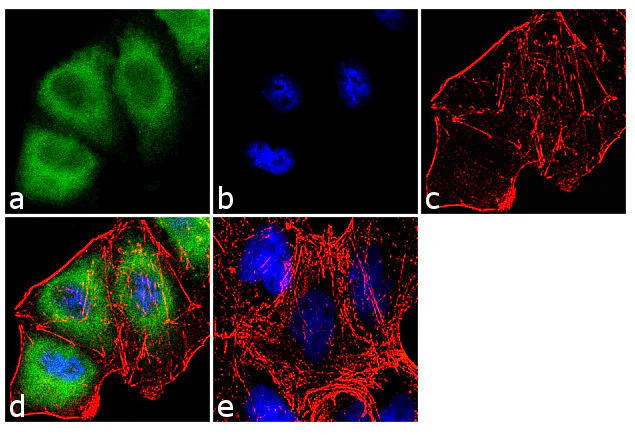
Immunocytochemistry/ Immunofluorescence - Anti-Kindlin-1 antibody [RP23040116] (AB313441)
Immunofluorescent analysis of A-431 cells fixed using 4% formaldehyde (reconstituted in 1X PBS) for 10 min at room temperature and permeabilized using 0.1 % Triton X-100 in PBS for 15 min at room temperature labeling Kindlin1 with ab313441 at 2 µg/mL followed by Goat anti-Rabbit IgG (H+L) Secondary Antibody, Alexa Fluor 488 conjugate at 1/2000 dilution. Panel a) shows representative cells that were stained for detection and localization of Kindlin1 protein (green), Panel b) is stained for nuclei (blue) using DAPI. Panel c) represents cytoskeletal F-actin staining using Alexa Fluor 555 Rhodamine Phalloidin at 1/300 dilution. Panel d) is a composite image of Panels a, b and c clearly demonstrating cytoplasmic localization of Kindlin1. Panel e) represents control cells with no primary antibody to assess background.
Complementary Products
Primary Antibodies
AB303518
Anti-NKCC1 antibody [EPR26256-60]
BOND RX™ Validated|20ul selling size|RabMAb|Recombinant
- 0
- 0

Reactivity data
Product details
What are recombinant multiclonals?
Recombinant multiclonals are a mixture of recombinant antibodies co-expressed from a library of heavy and light chains. They offer several advantages including:
- - The sensitivity of polyclonal antibodies by recognising multiple epitopes
- - High batch-to-batch consistency and reproducibility
- - Improved sensitivity and specificity
- - Long-term security of supply
- - Animal-free batch production
View our range of recombinant multiclonal antibodies.
Properties and storage information
Form
Purification technique
Storage buffer
Shipped at conditions
Appropriate short-term storage duration
Appropriate short-term storage conditions
Appropriate long-term storage conditions
Aliquoting information
Storage information
Supplementary information
This supplementary information is collated from multiple sources and compiled automatically.
Biological function summary
Kindlin-1 influences cell adhesion migration and proliferation. It is a component of a complex that includes talin another integrin activator which stabilizes interactions at the cell matrix interface. The Kindlin-integrin interaction impacts actin cytoskeleton remodeling an important step for maintaining the structural integrity and functions of epithelial tissues. The proper functioning of Kindlin-1 in cellular dynamics ensures tissue homeostasis and repair.
Pathways
Kindlin-1 is involved in the integrin signaling pathway and the focal adhesion pathway. Integrin signaling is essential for transmitting mechanical and chemical signals from the extracellular matrix into the cell influencing cellular responses. The cooperation with proteins like talin and paxillin in these pathways highlights Kindlin-1’s role in regulating cell movement and mechanical sensing. These pathways contribute to pathological and physiological processes including wound healing and tissue morphogenesis.
Product protocols
- Visit the General protocols
- Visit the Troubleshooting
Target data
Alternative Names
Product promise
Please note: All products are 'FOR RESEARCH USE ONLY. NOT FOR USE IN DIAGNOSTIC OR THERAPEUTIC PROCEDURES'.
For licensing inquiries, please contact partnerships@abcam.com