Anti-KLF10 antibody [EPR12102(2)]
- RabMAb
- Recombinant
- What is this?
Be the first to review this product! Submit a review
|
(7 Publications )
- WB
Supplier Data
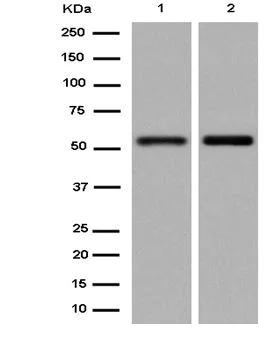
Western blot - Anti-KLF10 antibody [EPR12102(2)] (AB184182)
All lanes:
Western blot - Anti-KLF10 antibody [EPR12102(2)] (ab184182) at 1/2000 dilution
Lane 1:
HeLa cell lysate at 20 µg
Lane 2:
K652 cell lysate at 20 µg
Secondary
All lanes:
Goat Anti-Rabbit IgG, (H+L), Peroxidase conjugated at 1/1000 dilution
Predicted band size: 53 kDa
false
- WB
Supplier Data
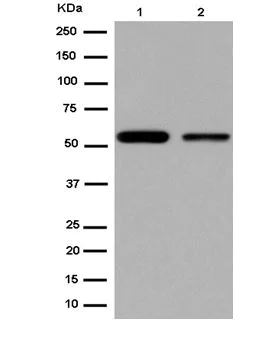
Western blot - Anti-KLF10 antibody [EPR12102(2)] (AB184182)
All lanes:
Western blot - Anti-KLF10 antibody [EPR12102(2)] (ab184182) at 1/10000 dilution
Lane 1:
HepG2 cell lysate at 20 µg
Lane 2:
Jurkat cell lysate at 20 µg
Secondary
All lanes:
Goat Anti-Rabbit IgG, (H+L), Peroxidase conjugated at 1/1000 dilution
Predicted band size: 53 kDa
false
Alternative Products
Complementary Products
Primary Antibodies
AB181602
Anti-GAPDH antibody [EPR16891] - Loading Control
RabMAb|Recombinant|Lab Essentials|20ul selling size

- 5
- 23
Primary Antibodies
AB40854
20ul selling size|Recombinant|KO Validated|Advanced Validation|RabMAb

- 5
- 10
Primary Antibodies
AB52903
Anti-SMAD3 (pS423/425) + SMAD5 (pS463/465) + SMAD1 (pS463/465) + SMAD2 (pS465/467) antibody [EP823Y]
20ul selling size|Recombinant|Advanced Validation|RabMAb

- 4
- 21
Primary Antibodies
AB124964
Anti-alpha smooth muscle Actin antibody [EPR5368]
BOND RX™ Validated|RabMAb|Recombinant|KO Validated|20ul selling size

- 5
- 19
Reactivity data
Product details
Patented technology
Our RabMAb® technology is a patented hybridoma-based technology for making rabbit monoclonal antibodies. For details on our patents, please refer to RabMAb® patents.
What are the advantages of a recombinant monoclonal antibody?
This product is a recombinant monoclonal antibody, which offers several advantages including:
- - High batch-to-batch consistency and reproducibility
- - Improved sensitivity and specificity
- - Long-term security of supply
- - Animal-free batch production
For more information, read more on recombinant antibodies.
Properties and storage information
Form
Purity
Storage buffer
Shipped at conditions
Appropriate short-term storage duration
Appropriate short-term storage conditions
Appropriate long-term storage conditions
Aliquoting information
Storage information
Supplementary information
This supplementary information is collated from multiple sources and compiled automatically.
Biological function summary
KLF10 affects several pathways through its interactions with other proteins and DNA elements. As a member of the human transcription machinery it acts as a coregulator often partnering with SMAD proteins to modulate gene expression in TGF-β signaling. KLF10 influences cellular activities by regulating genes involved in tissue development and repair making it integral to maintaining cellular homeostasis and function across numerous organ systems.
Pathways
This protein integrates into key signaling cascades most notably TGF-β and bone morphogenetic protein (BMP) signaling pathways. In TGF-β signaling KLF10 works closely with SMAD4 to regulate genes that control cellular growth and differentiation. This partnership is important for transmitting signals that govern cell fate decisions often influencing how cells respond to their immediate environment and driving critical cellular processes.
Product protocols
- Visit the General protocols
- Visit the Troubleshooting
Target data
Alternative Names
Publications (7)
Recent publications for all applications. Explore the full listand refine your search
The FEBS journal 291:4714-4731 PubMed39206622
2024
Applications
Unspecified application
Species
Unspecified reactive species
Translational lung cancer research 12:2520-2537 PubMed38205211
2024
Applications
Unspecified application
Species
Unspecified reactive species
Polish journal of pathology : official journal of the Polish Society of Pathologists 74:182-193 PubMed37955537
2023
Applications
Unspecified application
Species
Unspecified reactive species
Cell death discovery 9:82 PubMed36878898
2023
Applications
Unspecified application
Species
Unspecified reactive species
Oncology letters 23:175 PubMed35497935
2022
Applications
Unspecified application
Species
Unspecified reactive species
Aging 13:14399-14415 PubMed34031263
2021
Applications
Unspecified application
Species
Unspecified reactive species
Cancer research 77:2387-2400 PubMed28249899
2017
Applications
Unspecified application
Species
Unspecified reactive species
Product promise
Please note: All products are 'FOR RESEARCH USE ONLY. NOT FOR USE IN DIAGNOSTIC OR THERAPEUTIC PROCEDURES'.
For licensing inquiries, please contact partnerships@abcam.com