JavaScript is disabled in your browser. Please enable JavaScript to view this website.
AB187973

Anti-KLF16 antibody

Be the first to review this product! Submit a review

|

(3 Publications )

Rabbit Polyclonal KLF16 antibody. Suitable for IHC-P, ICC/IF and reacts with Human samples. Cited in 3 publications. Immunogen corresponding to Recombinant Fragment Protein within Human KLF16 aa 200-250.
2 Images
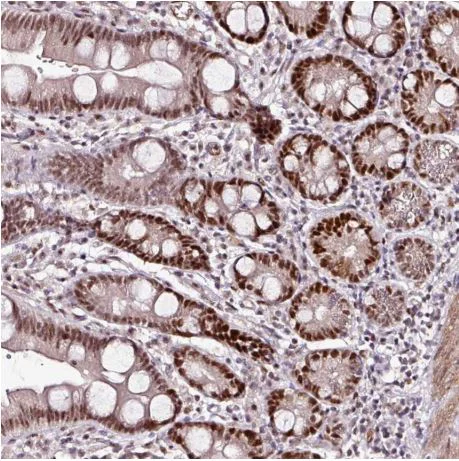
Immunohistochemistry (Formalin/PFA-fixed paraffin-embedded sections) - Anti-KLF16 antibody (AB187973)
  • IHC-P

Supplier Data

Immunohistochemistry (Formalin/PFA-fixed paraffin-embedded sections) - Anti-KLF16 antibody (AB187973)

Immunohistochemical analysis of paraffin-embedded human small intestine tissue labeling KLF16 in the nucleus of glandular cells with ab187973 at a 1/50 dilution.

Performed heat mediated antigen retrieval with citrate buffer pH 6 before commencing with IHC staining protocol.
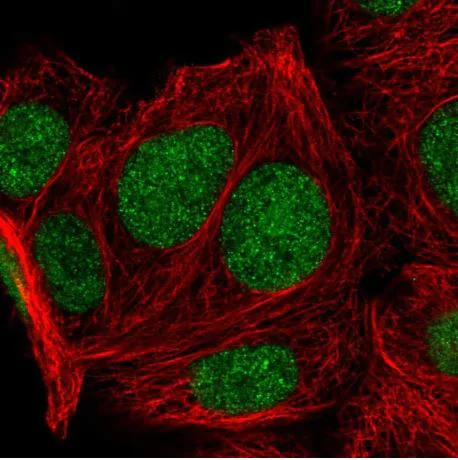
Immunocytochemistry/ Immunofluorescence - Anti-KLF16 antibody (AB187973)
  • ICC/IF

Supplier Data

Immunocytochemistry/ Immunofluorescence - Anti-KLF16 antibody (AB187973)

Immunocytochemical analysis of MCF7 (Human breast adenocarcinoma cell line) whole cells labeling KLF16 in the nucleus with ab187973 at 2 μg/ml.

Key facts

Host species

Rabbit

Clonality

Polyclonal

Isotype

IgG

Carrier free

No

Reacts with

Human

Applications

ICC/IF, IHC-P

applications

Immunogen

Recombinant Fragment Protein within Human KLF16 aa 200-250. The exact immunogen used to generate this antibody is proprietary information.

Q9BXK1

Reactivity data

{ "title": "Reactivity Data", "filters": { "stats": ["", "Species", "Dilution Info", "Notes"], "tabs": { "all-applications": {"fullname" : "All Applications", "shortname": "All Applications"}, "IHCP" : {"fullname" : "Immunohistochemistry (Formalin/PFA-fixed paraffin-embedded sections)", "shortname":"IHC-P"}, "ICCIF" : {"fullname" : "Immunocytochemistry/ Immunofluorescence", "shortname":"ICC/IF"} }, "product-promise": { "all": "all", "testedAndGuaranteed": "tested", "guaranteed": "expected", "predicted": "predicted", "notRecommended": "not-recommended" } }, "values": { "Human": { "IHCP-species-checked": "testedAndGuaranteed", "IHCP-species-dilution-info": "1/50 - 1/200", "IHCP-species-notes": "<p></p> Perform heat-mediated antigen retrieval with citrate buffer pH 6 before commencing with IHC staining protocol.", "ICCIF-species-checked": "testedAndGuaranteed", "ICCIF-species-dilution-info": "0.25-2 µg/mL", "ICCIF-species-notes": "<p>Fixation/Permeabilization: PFA/Triton X-100</p>" } } }

Properties and storage information

Form
Liquid
Purification technique
Affinity purification Immunogen
Storage buffer
pH: 7.2 Preservative: 0.02% Sodium azide Constituents: PBS, 40% Glycerol (glycerin, glycerine)
Shipped at conditions
Blue Ice
Appropriate short-term storage duration
1-2 weeks
Appropriate short-term storage conditions
+4°C
Appropriate long-term storage conditions
-20°C
Aliquoting information
Upon delivery aliquot
Storage information
Avoid freeze / thaw cycle

Supplementary information

This supplementary information is collated from multiple sources and compiled automatically.

KLF16 also known as Krüppel-like factor 16 is a transcription factor belonging to the KLF family. It possesses C2H2 zinc finger domains that allow it to bind DNA and regulate transcription of target genes. KLF16 has a molecular mass of about 31 kDa. This protein predominantly expresses in the brain particularly in areas such as the hypothalamus where it influences neuronal function and brain physiology.
Biological function summary

KLF16 plays an important role in the regulation of gene expression related to metabolic processes and neurogenesis. It does not work alone; rather it interacts with other transcription factors and proteins to modulate the transcriptional machinery. KLF16 acts by binding specific DNA sequences which results in the activation or suppression of gene transcription affecting cellular responses and overall metabolic balance.

Pathways

KLF16 at least important roles in the insulin signaling and circadian rhythm regulation pathways. In the insulin signaling pathway KLF16 modulates the expression of genes involved in glucose metabolism. Related to this process it can influence proteins like insulin receptor substrate-1 (IRS-1) that participate in this signaling. In circadian rhythm regulation KLF16 affects the expression of clock genes which are essential for maintaining biological rhythms and homeostasis.

KLF16 has links to metabolic disorders such as diabetes and neurodegenerative diseases including Alzheimer's disease. In the context of diabetes KLF16 interacts with proteins like PGC-1α which are regulators of energy metabolism. For neurodegenerative diseases especially Alzheimer's disease changes in KLF16 expression can disrupt genes involved in neuronal survival and function highlighting its potential as a therapeutic target.

Product protocols

For this product, it's our understanding that no specific protocols are required. You can visit:

Target data

Transcription factor that binds GC and GT boxes and displaces Sp1 and Sp3 from these sequences. Modulates dopaminergic transmission in the brain (By similarity).
See full target information KLF16

Alternative Names

BTEB4, NSLP2, KLF16, Krueppel-like factor 16, Basic transcription element-binding protein 4, Novel Sp1-like zinc finger transcription factor 2, Transcription factor BTEB4, Transcription factor NSLP2, BTE-binding protein 4

Publications (3)

Recent publications for all applications. Explore the full listand refine your search

Cell death & disease 14:26 PubMed36639679

2023

SF3B4 promotes Twist1 expression and clear cell renal cell carcinoma progression by facilitating the export of KLF 16 mRNA from the nucleus to the cytoplasm.

Applications

Unspecified application

Species

Unspecified reactive species

Zhan Yang,Ya-Xuan Wang,Jin-Kun Wen,Hai-Tao Gao,Zhen-Wei Han,Jin-Chun Qi,Jun-Fei Gu,Chen-Ming Zhao,Hong Zhang,Bei Shi,Dan-Dan Wang,Xiao-Lu Wang,Chang-Bao Qu

Bioengineered 13:9482-9494 PubMed35387557

2022

Kruppel like factor 16 promotes lung adenocarcinoma progression by upregulating lamin B2.

Applications

Unspecified application

Species

Unspecified reactive species

Xiaodan Jiao,Weinian Gao,Hongxin Ren,Yanning Wu,Tiezhi Li,Shujun Li,Hongjiang Yan

Nature communications 11:988 PubMed32080171

2020

A serine/threonine protein kinase encoding gene KERNEL NUMBER PER ROW6 regulates maize grain yield.

Applications

Unspecified application

Species

Unspecified reactive species

Haitao Jia,Manfei Li,Weiya Li,Lei Liu,Yinan Jian,Zhixing Yang,Xiaomeng Shen,Qiang Ning,Yanfang Du,Ran Zhao,David Jackson,Xiaohong Yang,Zuxin Zhang
View all publications

Product promise

We are committed to supporting your work with high-quality reagents, and we're here for you every step of the way. In the unlikely event that one of our products does not perform as expected, you're protected by our Product Promise.
For full details, please see our Terms & Conditions

Please note: All products are 'FOR RESEARCH USE ONLY. NOT FOR USE IN DIAGNOSTIC OR THERAPEUTIC PROCEDURES'.

For licensing inquiries, please contact partnerships@abcam.com