Anti-KMT2B / MLL4 antibody [EPR27970-7] - C-terminal - BSA and Azide free
- Advanced Validation
- Recombinant
- RabMAb
- What is this?
Be the first to review this product! Submit a review
|
(0 Publication)

- ChIP-seq
Lab
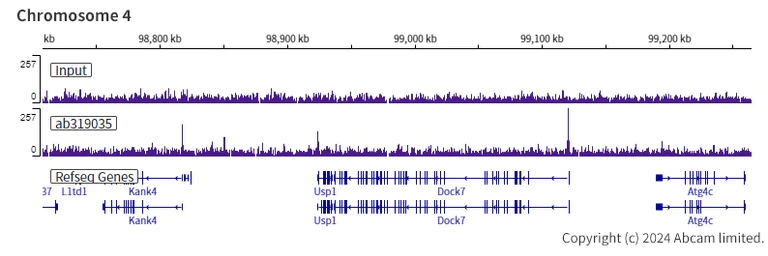
ChIP-sequencing - Anti-KMT2B / MLL4 antibody [EPR27970-7] - C-terminal - BSA and Azide free (AB319036)
This data was developed using the same antibody clone in a different buffer formulation (ab319035).
Chromatin was prepared from ES-D3 cells. Cells were fixed with 1% formaldehyde for 10 minutes. ChIP was performed with 107 cells and 8 μg of ab319035 [EPR27970-7]. ChIP DNA was sequenced on the Illumina NovaSeq 6000 to a depth of 30 million reads.
The Input control is also shown.
- ChIP-seq
Lab
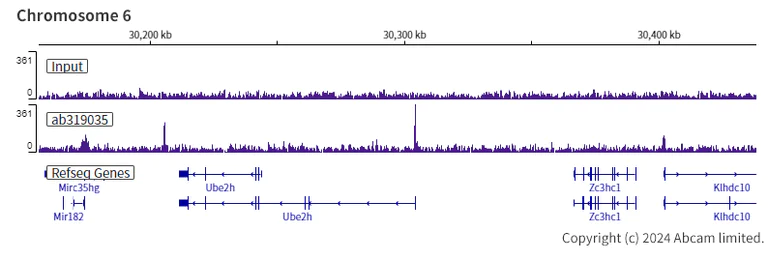
ChIP-sequencing - Anti-KMT2B / MLL4 antibody [EPR27970-7] - C-terminal - BSA and Azide free (AB319036)
This data was developed using the same antibody clone in a different buffer formulation (ab319035).
Chromatin was prepared from ES-D3 cells. Cells were fixed with 1% formaldehyde for 10 minutes. ChIP was performed with 107 cells and 8 µg of ab319035 [EPR27970-7]. ChIP DNA was sequenced on the Illumina NovaSeq 6000 to a depth of 30 million reads.
The Input control is also shown.
- ChIP-seq
Lab
ChIP-sequencing - Anti-KMT2B / MLL4 antibody [EPR27970-7] - C-terminal - BSA and Azide free (AB319036)
This data was developed using the same antibody clone in a different buffer formulation (ab319035).
Chromatin was prepared from ES-D3 cells. Cells were fixed with 1% formaldehyde for 10 minutes. ChIP was performed with 107 cells and 8 μg of ab319035 [EPR27970-7]. ChIP DNA was sequenced on the Illumina NovaSeq 6000 to a depth of 30 million reads.
The Input control is also shown.

- WB
Supplier Data
Western blot - Anti-KMT2B / MLL4 antibody [EPR27970-7] - C-terminal - BSA and Azide free (AB319036)
This data was developed using ab319035, the same antibody clone in a different buffer formulation.
Blocking and diluting buffer and concentration : 5% NFDM/TBST.
Negative control : HCT 116.
The identity of the lower MW band at approximately 60 kDa is unknown.
Lysates were freshly made and used immediately to minimize protein degradation.
In Western blot, Anti-GAPDH antibody [EPR16891] - Loading Control (ab181602) staining at 1/200000 dilution.
Exposure time : Lanes 1-3 : 180 seconds; Lane 4 : 15 seconds; Lanes 5-12 : 103 seconds
All lanes:
Western blot - Anti-KMT2B / MLL4 antibody [EPR27970-7] - C-terminal (<a href='/en-us/products/primary-antibodies/kmt2b-mll4-antibody-epr27970-7-c-terminal-ab319035'>ab319035</a>) at 1/1000 dilution
Lane 1:
NCCIT (human pluripotent embryonic carcinoma epithelial cell) whole cell lysate at 20 µg
Lane 2:
HCT 116 (human colorectal carcinoma epithelial cell) whole cell lysate at 20 µg
Lane 3:
HepG2 (human hepatocellular carcinoma epithelial cell) whole cell lysate at 20 µg
Lane 4:
ES-D3 D3 (mouse blastocyst-derived embryonic stem cell) whole cell lysate at 20 µg
Lane 5:
HeLa (human cervical adenocarcinoma epithelial cell) whole cell lysate at 20 µg
Lane 6:
293T (human embryonic kidney epithelial cell) whole cell lysate at 20 µg
Lane 7:
NIH/3T3 (mouse embryonic fibroblast) whole cell lysate at 20 µg
Lane 8:
PC-12 (rat adrenal gland pheochromocytoma cell) whole cell lysate at 20 µg
Lane 9:
C6 (rat glial tumor glial cell) whole cell lysate at 20 µg
Lane 10:
Neuro-2a (mouse neuroblastoma neuroblast) whole cell lysate at 20 µg
Lane 11:
U-87 MG (human glioblastoma-astrocytoma epithelial cell) whole cell lysate at 20 µg
Lane 12:
SH-SY5Y (human neuroblastoma epithelial cell) whole cell lysate at 20 µg
Secondary
All lanes:
Western blot - Goat Anti-Rabbit IgG H&L (HRP) (<a href='/en-us/products/secondary-antibodies/goat-rabbit-igg-h-l-hrp-ab97051'>ab97051</a>) at 1/20000 dilution
Observed band size: 80 kDa,36 kDa
false

- Dot
Supplier Data
Dot Blot - Anti-KMT2B / MLL4 antibody [EPR27970-7] - C-terminal - BSA and Azide free (AB319036)
This data was developed using ab319035, the same antibody clone in a different buffer formulation.
Dot blot analysis of KMT2B / MLL4 - C-terminal using ab319035 at 1 : 1000 (0.512 ug/ml) followed by a Goat Anti-Rabbit IgG, (H+L), Peroxidase conjugated (ab97051) at 1 : 100,000 dilution.
Lane1 : His-tagged human KMT2B / MLL4 fragment
Lane2 : His-tagged human KMT2A / MLL fragment
Blocking and diluting buffer and concentration : 5% NFDM/TBST.
This antibody does not cross-react with human KMT2A / MLL.
In dot blot, anti-6X His tag® antibody [EPR20547] - ChIP Grade (ab213204) staining at 1/5000 dilution.
All lanes:
Dot Blot - Anti-KMT2B / MLL4 antibody [EPR27970-7] - C-terminal (<a href='/en-us/products/primary-antibodies/kmt2b-mll4-antibody-epr27970-7-c-terminal-ab319035'>ab319035</a>) at 1/1000 dilution
Lane 1:
His-tagged human KMT2B / MLL4 fragment
Lane 2:
His-tagged human KMT2A / MLL fragment
Secondary
All lanes:
Dot Blot - Goat Anti-Rabbit IgG H&L (HRP) (<a href='/en-us/products/secondary-antibodies/goat-rabbit-igg-h-l-hrp-ab97051'>ab97051</a>) at 1/100000 dilution
false
Exposure time: 180s

- WB
Supplier Data
Western blot - Anti-KMT2B / MLL4 antibody [EPR27970-7] - C-terminal - BSA and Azide free (AB319036)
This data was developed using ab319035, the same antibody clone in a different buffer formulation.
Blocking and diluting buffer and concentration : 5% NFDM/TBST.
Low expression : liver (PMID : 10409430).
The identity of the lower MW band at approximately 37 kDa in Lane 1 is unknown.
Lysates were freshly made and used immediately to minimize protein degradation.
In Western blot, Anti-GAPDH antibody [EPR16891] - Loading Control (ab181602) staining at 1/200000 dilution.
All lanes:
Western blot - Anti-KMT2B / MLL4 antibody [EPR27970-7] - C-terminal (<a href='/en-us/products/primary-antibodies/kmt2b-mll4-antibody-epr27970-7-c-terminal-ab319035'>ab319035</a>) at 1/1000 dilution
Lane 1:
Mouse liver tissue lysate at 20 µg
Lane 2:
Mouse testis tissue lysate at 20 µg
Lane 3:
Rat liver tissue lysate at 20 µg
Lane 4:
Rat testis tissue lysate at 20 µg
Secondary
All lanes:
Western blot - Goat Anti-Rabbit IgG H&L (HRP) (<a href='/en-us/products/secondary-antibodies/goat-rabbit-igg-h-l-hrp-ab97051'>ab97051</a>) at 1/20000 dilution
Observed band size: 80 kDa,36 kDa
false
Exposure time: 180s
Related conjugates and formulations (1)
-
Anti-KMT2B / MLL4 antibody [EPR27970-7] - C-terminal
Complementary Products
Sample Prep & Detection Kits
AB270709
5’ Feature Barcode Antibody Conjugation Kit - Lightning-Link® - Oligos 21-30
- 0
- 0
Primary Antibodies
AB32072
Anti-c-Myc antibody [Y69] - ChIP Grade
BOND RX™ Validated|KO Validated|RabMAb|Recombinant|Lab Essentials|20ul selling size|Advanced Validation

- 4
- 56
Primary Antibodies
AB315464
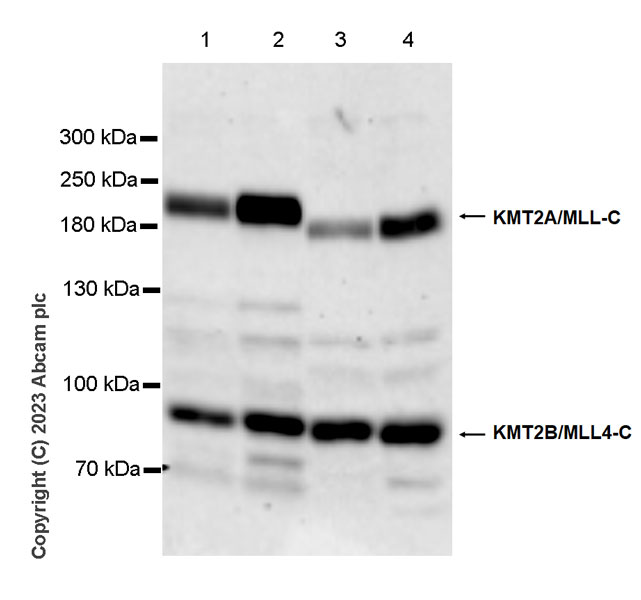
Anti-KMT2A / MLL + KMT2B / MLL4 antibody [EPR28282-16] - C-terminal
20ul selling size|RabMAb|Recombinant|KO Validated
- 0
- 0
Primary Antibodies
AB213721
Anti-KMT2D / MLL2 antibody [EPR20604-73]
RabMAb|Recombinant|20ul selling size|Advanced Validation

- 0
- 0
Primary Antibodies
AB317442
Anti-CEBP Alpha/CEBPA antibody [EPR27924-90]
KD Validated|BOND RX™ Validated|20ul selling size|Recombinant|Advanced Validation|RabMAb

- 0
- 0
Reactivity data
Product details
ab319036 is the carrier-free version of ab319035.
Patented technology
Our RabMAb® technology is a patented hybridoma-based technology for making rabbit monoclonal antibodies. For details on our patents, please refer to RabMAb® patents.
What are the advantages of a recombinant monoclonal antibody?
This product is a recombinant monoclonal antibody, which offers several advantages including:
- - High batch-to-batch consistency and reproducibility
- - Improved sensitivity and specificity
- - Long-term security of supply
- - Animal-free batch production
For more information, read more on recombinant antibodies.
Conjugation ready
Our carrier-free antibodies are typically supplied in a PBS-only formulation, purified and free of BSA, sodium azide and glycerol. This conjugation-ready format is designed for use with fluorochromes, metal isotopes, oligonucleotides, and enzymes, which makes them ideal for antibody labelling, functional and cell-based assays, flow-based assays (e.g. mass cytometry) and Multiplex Imaging applications.
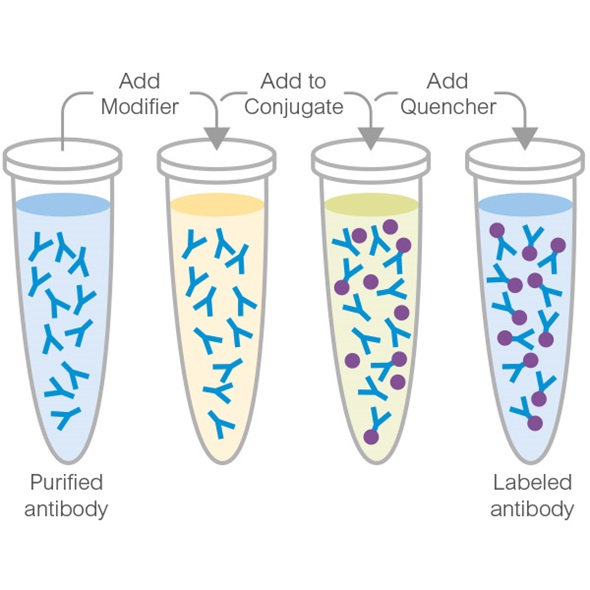
Use our conjugation kits for antibody conjugates that are ready-to-use in as little as 20 minutes with 1 minute hands-on-time and 100% antibody recovery: available for fluorescent dyes, HRP, biotin and gold.
Compatibility
This product is compatible with the Maxpar® Antibody Labeling Kit from Fluidigm, without the need for antibody preparation. Maxpar® is a trademark of Fluidigm Canada Inc.
Properties and storage information
Form
Purification technique
Storage buffer
Shipped at conditions
Appropriate short-term storage conditions
Appropriate long-term storage conditions
Supplementary information
This supplementary information is collated from multiple sources and compiled automatically.
Biological function summary
KMT2B contributes to regulating gene expression. As part of the larger COMPASS-like complex it cooperates with other regulatory proteins to modify chromatin structure facilitating easier access of transcriptional machinery to DNA. This action influences the activation of genes important for cell differentiation and development. KMT2B interacts with several cofactors including WRAD components (WDR5 RBBP5 ASH2L and DPY30) enhancing its enzymatic activity.
Pathways
KMT2B functions prominently in signaling mechanisms like the Wnt and MAPK pathways. These pathways are integral to cell growth and differentiation. The protein intricately connects with other pathways’ proteins including beta-catenin in the Wnt pathway and ERK1/2 in the MAPK pathway. These interactions highlight KMT2B's role in regulating cellular functions and development.
Product protocols
- Visit the General protocols
- Visit the Troubleshooting
Target data
Alternative Names
Product promise
Please note: All products are 'FOR RESEARCH USE ONLY. NOT FOR USE IN DIAGNOSTIC OR THERAPEUTIC PROCEDURES'.
For licensing inquiries, please contact partnerships@abcam.com