Anti-KMT6 / EZH2 antibody [SP129] - BSA and Azide free
- RabMAb
- Advanced Validation
- Recombinant
- What is this?
Be the first to review this product! Submit a review
|
(1 Publication)

- IHC-P
Supplier Data
Immunohistochemistry (Formalin/PFA-fixed paraffin-embedded sections) - Anti-KMT6 / EZH2 antibody [SP129] - BSA and Azide free (AB245738)
Formalin-fixed, paraffin-embedded human prostate cancer tissue stained for KMT6 / EZH2 using ab227648 at 1/100 dilution in immunohistochemical analysis.
This data was developed using the same antibody clone in a different buffer formulation containing PBS#44; BSA#44; and sodium azide (ab227648)

- Flow Cyt (Intra)
Supplier Data
Flow Cytometry (Intracellular) - Anti-KMT6 / EZH2 antibody [SP129] - BSA and Azide free (AB245738)
Flow cytometric analysis of HeLa (human epithelial cell line from cervix adenocarcinoma) cell line labeling KMT6 / EZH2 with ab227648 at 1/100 dilution (green) compared with a negative control of rabbit IgG (blue).
This data was developed using the same antibody clone in a different buffer formulation containing PBS, BSA and sodium azide (ab227648).
- IP
Lab
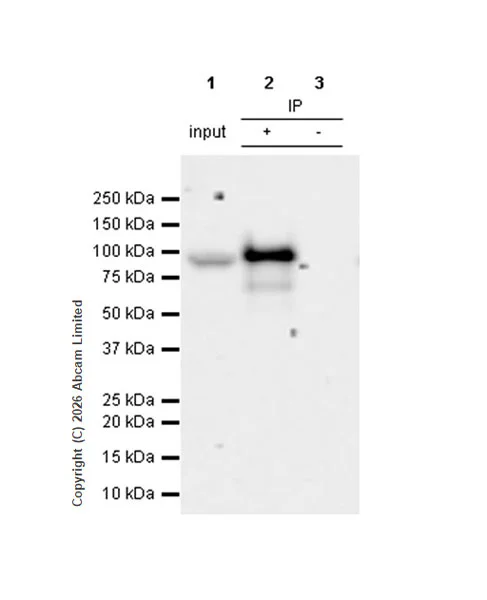
Immunoprecipitation - Anti-KMT6 / EZH2 antibody [SP129] - BSA and Azide free (AB245738)
This data was developed using ab227648, the same antibody clone in a different buffer formulation.
KMT6 / EZH2 was immunoprecipitated from 0.35mg lysate HEK-293 (human embryonic kidney epithelial cell) whole cell lysate with ab227648 at 1/30 dilution (2μg in 0.35mg lysates). Western blot was performed on the immunoprecipitate using ab227648 at 1/1000 dilution. Capture antibody, 1 : 30 dilution (2μg in 0.35mg lysates) VeriBlot for IP secondary antibody (HRP) (ab131366) was used at 1/5000 dilution.
To minimize protein degradation, cells were lysed immediately after harvest and then applied for Immunoprecipitation as soon as possible.
Rabbit monoclonal IgG (ab172730) Isotype Control was used instead of ab185971 in HEK-293 whole cell lysate (Lane 3).
Blocking and dilution buffer and concentration : 5% NFDM/TBST.
To minimize protein degradation, cells were lysed immediately after harvest and then applied for Immunoprecipitation as soon as possible.
All lanes:
Immunoprecipitation - Anti-KMT6 / EZH2 antibody [SP129] (<a href='/en-us/products/primary-antibodies/kmt6-ezh2-antibody-sp129-ab227648'>ab227648</a>) at 1/30 dilution
Lane 1:
HEK-293 (human embryonic kidney epithelial cell) whole cell lysate 10 μg
Lane 2:
HEK-293 (human embryonic kidney epithelial cell) whole cell lysate
Secondary
All lanes:
Immunoprecipitation - VeriBlot for IP Detection Reagent (HRP) (<a href='/en-us/products/reagents/veriblot-for-ip-detection-reagent-hrp-ab131366'>ab131366</a>) at 1/5000 dilution
Observed band size: 85 kDa
false
Exposure time: 32s
- WB
Lab
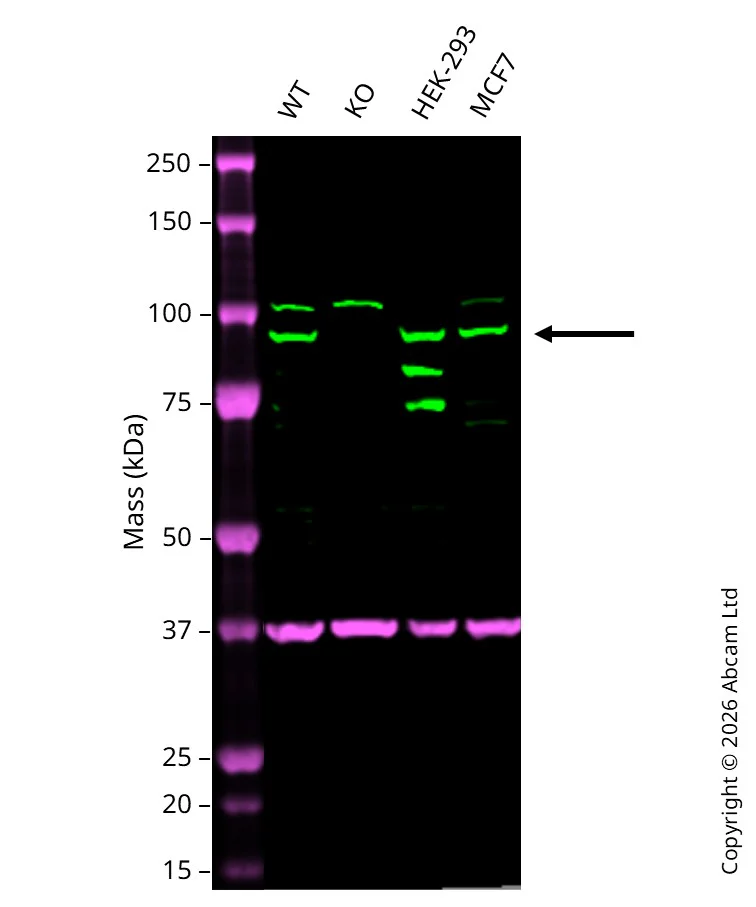
Western blot - Anti-KMT6 / EZH2 antibody [SP129] - BSA and Azide free (AB245738)
This data was developed using the same antibody clone in a different buffer formulation containing PBS, BSA, glycerol, and sodium azide (ab227648).
Western blot : Anti-KMT6 / EZH2 antibody [SP129] ab227648 staining at 1/1000 dilution, shown in green; Mouse anti GAPDH ab8245 loading control staining at 1/20000 dilution, shown in magenta. A band was observed at 85 kDa in Wild-type A375 cell lysates with no signal observed at this size in EZH2 knockout A375 cell line. To generate this image, samples were run on an SDS-PAGE gel then transferred onto a nitrocellulose membrane. Membranes were blocked in 5% Milk in TBS-0.1 % Tween® 20 (TBS-T) before incubation with primary antibodies overnight at 4 °C. Blots were washed four times in TBS-T, incubated with secondary antibodies for 1 h at room temperature, washed again four times then imaged. Secondary antibodies used were Goat anti-Rabbit 800CW and Goat anti-Mouse 680RD at 1/20,000 dilution.
All lanes:
Western blot - Anti-KMT6 / EZH2 antibody [SP129] (<a href='/en-us/products/primary-antibodies/kmt6-ezh2-antibody-sp129-ab227648'>ab227648</a>) at 1/1000 dilution
Lane 1:
Wild-type A375 cell lysates at 20 µg
Lane 2:
EZH2 knockout A375 cell lysates at 20 µg
Lane 3:
HEK-293 cell lysates at 20 µg
Lane 4:
MCF7 cell lysates at 20 µg
Secondary
All lanes:
Goat anti-Rabbit 800CW & Goat anti-Mouse 680RD at 1/20000 dilution
Predicted band size: 85 kDa
Observed band size: 85 kDa
false

- ChIC/CUT&RUN-seq
Supplier Data
ChIC/CUT&RUN sequencing - Anti-KMT6 / EZH2 antibody [SP129] - BSA and Azide free (AB245738)
ChIC/CUT&RUN was performed using a pAG-MNAse at a final concentration of 700 ng/mL, 2 x 10^5 K-562 (Human chronic myelogenous leukemia lymphoblast) cells and 5 µg of ab227648 [SP129]. The resulting DNA was sequenced on the Illumina NovaSeq 6000 to a depth of 10 million reads. The negative IgG control ab172730 is also shown. Additional screenshots of mapped reads can be found in the Protocol booklet in the Product Protocol section. The University of Geneva owns patents relevant to ChIC (Chromatin Immuno-Cleavage) methods. This data was developed using the same antibody clone in a different buffer formulation containing PBS, BSA and sodium azide (ab227648).
Related conjugates and formulations (8)
-
Anti-KMT6 / EZH2 antibody [SP129]
-
660 APC
APC Anti-KMT6 / EZH2 antibody [SP129]
-
519 Alexa Fluor® 488
Alexa Fluor® 488 Anti-KMT6 / EZH2 antibody [SP129]
-
565 Alexa Fluor® 555
Alexa Fluor® 555 Anti-KMT6 / EZH2 antibody [SP129]
-
617 Alexa Fluor® 594
Alexa Fluor® 594 Anti-KMT6 / EZH2 antibody [SP129]
-
665 Alexa Fluor® 647
Alexa Fluor® 647 Anti-KMT6 / EZH2 antibody [SP129]
-
775 Alexa Fluor® 750
Alexa Fluor® 750 Anti-KMT6 / EZH2 antibody [SP129]
-
578 PE
PE Anti-KMT6 / EZH2 antibody [SP129]
Alternative Products


Primary Antibodies
AB191080
Anti-KMT6 / EZH2 antibody [EPR9307(2)] - N-terminal
20ul selling size|RabMAb|Recombinant|KO Validated|Trial Size

- 2
- 1
Primary Antibodies
AB191250
Anti-KMT6 / EZH2 antibody [EPR20108] - ChIP Grade
RabMAb|Recombinant|KO Validated|20ul selling size

- 4
- 5

Primary Antibodies
AB240992
Anti-KMT6 / EZH2 antibody [EPR20108] - BSA and Azide free
RabMAb|Recombinant|KO Validated

- 0
- 0
Primary Antibodies
AB240119
Anti-KMT6 / EZH2 antibody [EPR9307] - BSA and Azide free
RabMAb|Recombinant|KO Validated

- 0
- 0
Primary Antibodies
AB231165
Anti-KMT6 / EZH2 antibody [EPR9307(2)] - BSA and Azide free
RabMAb|Recombinant|KO Validated

- 0
- 0
Primary Antibodies
AB225362
Alexa Fluor® 488 Anti-KMT6 / EZH2 antibody [EPR9307(2)]
RabMAb|Recombinant

- 0
- 0
Complementary Products

Primary Antibodies
AB181602
Anti-GAPDH antibody [EPR16891] - Loading Control
KD Validated|RabMAb|Recombinant|Lab Essentials|20ul selling size

- 5
- 23
Primary Antibodies
AB172730
Rabbit IgG, monoclonal [EPR25A] - Isotype Control
KD Validated|RabMAb|Advanced Validation|Recombinant

- 0
- 0
Primary Antibodies
AB16667
BOND RX™ Validated|KO Validated|RabMAb|Advanced Validation|Recombinant|20ul selling size

- 5
- 133

Reactivity data
Product details
ab245738 is the carrier-free version of ab227648.
Patented technology
Our RabMAb® technology is a patented hybridoma-based technology for making rabbit monoclonal antibodies. For details on our patents, please refer to RabMAb® patents.
What are the advantages of a recombinant monoclonal antibody?
This product is a recombinant monoclonal antibody, which offers several advantages including:
- - High batch-to-batch consistency and reproducibility
- - Improved sensitivity and specificity
- - Long-term security of supply
- - Animal-free batch production
For more information, read more on recombinant antibodies.
Conjugation ready
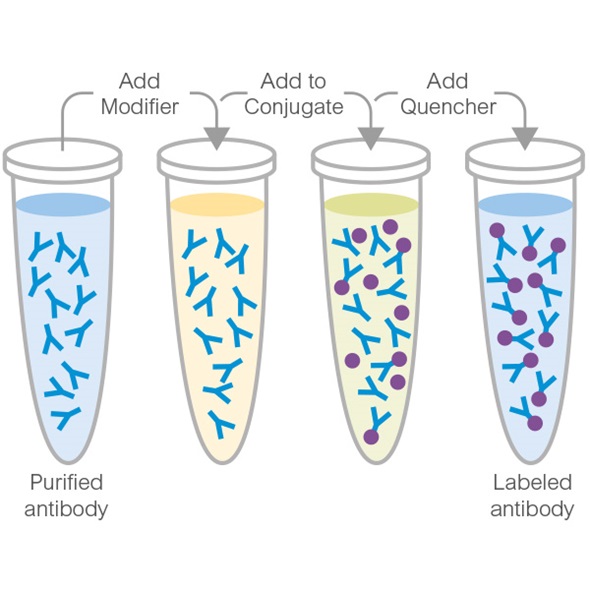
Our carrier-free antibodies are typically supplied in a PBS-only formulation, purified and free of BSA, sodium azide and glycerol. This conjugation-ready format is designed for use with fluorochromes, metal isotopes, oligonucleotides, and enzymes, which makes them ideal for antibody labelling, functional and cell-based assays, flow-based assays (e.g. mass cytometry) and Multiplex Imaging applications.
Use our conjugation kits for antibody conjugates that are ready-to-use in as little as 20 minutes with 1 minute hands-on-time and 100% antibody recovery: available for fluorescent dyes, HRP, biotin and gold.
Compatibility
This product is compatible with the Maxpar® Antibody Labeling Kit from Fluidigm, without the need for antibody preparation. Maxpar® is a trademark of Fluidigm Canada Inc.
Properties and storage information
Form
Purification technique
Purification notes
Storage buffer
Shipped at conditions
Appropriate short-term storage conditions
Appropriate long-term storage conditions
Storage information
Supplementary information
This supplementary information is collated from multiple sources and compiled automatically.
Biological function summary
EZH2 plays a central role in regulating gene expression during development and differentiation. It is a core component of the PRC2 complex which includes other proteins such as EED and SUZ12. Through its catalytic activity EZH2 contributes to the maintenance of the transcriptionally repressed state of genes influencing processes such as cell identity and proliferation. In many cell types EZH2-mediated gene silencing is necessary for normal development and dysregulation can lead to aberrant cellular processes.
Pathways
EZH2 participates in key regulatory networks notably the Wnt signaling pathway and the p53 pathway. Within the Wnt pathway EZH2's activity contributes to controlling gene expression that influences cellular differentiation and proliferation. Meanwhile interaction with the p53 pathway can impact the cellular response to stress and DNA damage highlighting EZH2’s regulatory dimension. Other proteins like β-catenin in the Wnt pathway interact with EZH2 reflecting its integration in these complex signaling networks.
Product protocols
- Visit the General protocols
- Visit the Troubleshooting
- Download chicCutRunSequencingBooklet|en
Target data
Alternative Names
Publications (1)
Recent publications for all applications. Explore the full listand refine your search
Cancer cell 42:396-412.e5 PubMed38242124
2024
Applications
Unspecified application
Species
Unspecified reactive species
Product promise
Please note: All products are 'FOR RESEARCH USE ONLY. NOT FOR USE IN DIAGNOSTIC OR THERAPEUTIC PROCEDURES'.
For licensing inquiries, please contact partnerships@abcam.com