JavaScript is disabled in your browser. Please enable JavaScript to view this website.
AB83501

Anti-Ku70 antibody

5

(4 Reviews)

|

(17 Publications )

Rabbit Polyclonal Ku70 antibody. Suitable for IHC-P, IP, WB, ICC/IF and reacts with Human samples. Cited in 17 publications.
4 Images
Immunocytochemistry/ Immunofluorescence - Anti-Ku70 antibody (AB83501)
  • ICC/IF

Lab

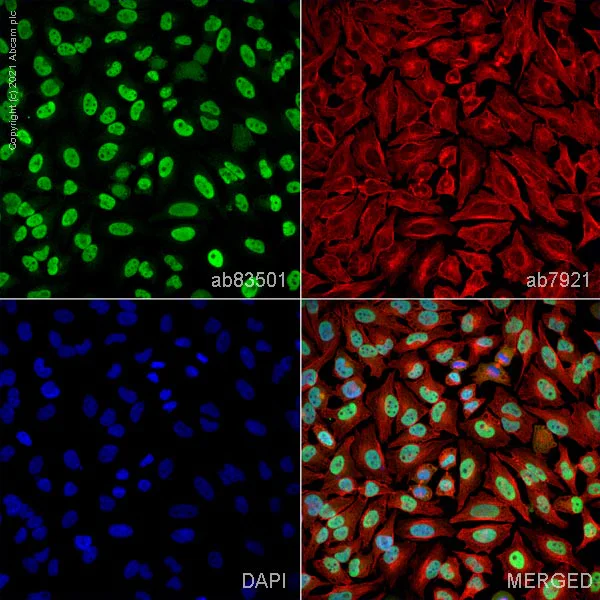
Immunocytochemistry/ Immunofluorescence - Anti-Ku70 antibody (AB83501)

ab83501 staining Ku70 in HeLa cells. The cells were fixed with 4% paraformaldehyde (10 min), permeabilized with 0.1% PBS-Triton X-100 for 5 minutes and then blocked with 1% BSA/10% normal goat serum/0.3M glycine in 0.1% PBS-Tween for 1h. The cells were then incubated overnight at 4°C with ab83501 at 5µg/ml and ab7291, Mouse monoclonal [DM1A] to alpha Tubulin - Loading Control. Cells were then incubated with ab150081, Goat polyclonal Secondary Antibody to Rabbit IgG - H&L (Alexa Fluor® 488), pre-adsorbed at 1/1000 dilution (shown in green) and ab150120, Goat polyclonal Secondary Antibody to Mouse IgG - H&L (Alexa Fluor® 594), pre-adsorbed at 1/1000 dilution (shown in pseudocolour red). Nuclear DNA was labelled with DAPI (shown in blue).

Image was acquired with a high-content analyser (Operetta CLS, Perkin Elmer) and a maximum intensity projection of confocal sections is shown.
Immunohistochemistry (Formalin/PFA-fixed paraffin-embedded sections) - Anti-Ku70 antibody (AB83501)
  • IHC-P

Unknown

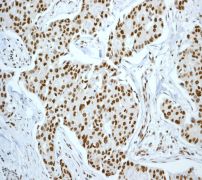
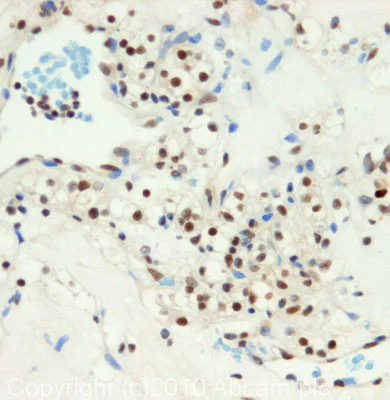
Immunohistochemistry (Formalin/PFA-fixed paraffin-embedded sections) - Anti-Ku70 antibody (AB83501)

IHC image of Ku70 staining in human kidney carcinoma formalin fixed paraffin embedded tissue section, performed on a Leica BondTM system using the standard protocol F. The section was pre-treated using heat mediated antigen retrieval with sodium citrate buffer (pH6, epitope retrieval solution 1) for 20 mins. The section was then incubated with ab83501, 1µg/ml, for 15 mins at room temperature and detected using an HRP conjugated compact polymer system. DAB was used as the chromogen. The section was then counterstained with haematoxylin and mounted with DPX.
Immunoprecipitation - Anti-Ku70 antibody (AB83501)
  • IP

Unknown

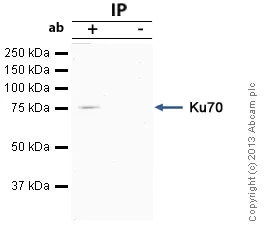
Immunoprecipitation - Anti-Ku70 antibody (AB83501)

Ku70 was immunoprecipitated using 0.5mg Hela whole cell extract, 5μg of Rabbit polyclonal to Ku70 and 50μl of protein G magnetic beads (+). No antibody was added to the control (-).

The antibody was incubated under agitation with Protein G beads for 10min, Hela whole cell extract lysate diluted in RIPA buffer was added to each sample and incubated for a further 10min under agitation.

Proteins were eluted by addition of 40μl SDS loading buffer and incubated for 10min at 70°C; 10μl of each sample was separated on a SDS PAGE gel, transferred to a nitrocellulose membrane, blocked with 5% BSA and probed with ab83501.

Secondary : Mouse monoclonal [SB62a] Secondary Antibody to Rabbit IgG light chain (HRP) (ab99697).

Band : 70kDa; Ku70

All lanes:

Immunoprecipitation - Anti-Ku70 antibody (ab83501)

Predicted band size: 70 kDa

true

Exposure time: 12min
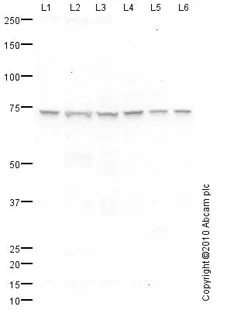
Western blot - Anti-Ku70 antibody (AB83501)
  • WB

Unknown

Western blot - Anti-Ku70 antibody (AB83501)

All lanes:

Western blot - Anti-Ku70 antibody (ab83501) at 1 µg/mL

Lane 1:

HeLa (Human epithelial carcinoma cell line) Whole Cell Lysate at 10 µg

Lane 2:

Irradiated Hela Whole Cell Lysate at 10 µg

Lane 3:

HepG2 (Human hepatocellular liver carcinoma cell line) Whole Cell Lysate at 10 µg

Lane 4:

Jurkat (Human T cell lymphoblast-like cell line) Whole Cell Lysate at 10 µg

Lane 5:

MCF7 (Human breast adenocarcinoma cell line) Whole Cell Lysate at 10 µg

Lane 6:

U2OS (Human osteosarcoma cell line) Whole Cell Lysate at 10 µg

Secondary

All lanes:

Goat polyclonal to Rabbit IgG - H&L - Pre-Adsorbed (HRP) at 1/3000 dilution

Predicted band size: 70 kDa

Observed band size: 73 kDa

true

Exposure time: 1min

Key facts

Host species

Rabbit

Clonality

Polyclonal

Isotype

IgG

Carrier free

No

Reacts with

Human

Applications

ICC/IF, IHC-P, WB, IP

applications

Immunogen

The exact immunogen used to generate this antibody is proprietary information.

Reactivity data

{ "title": "Reactivity Data", "filters": { "stats": ["", "Species", "Dilution Info", "Notes"], "tabs": { "all-applications": {"fullname" : "All Applications", "shortname": "All Applications"}, "IHCP" : {"fullname" : "Immunohistochemistry (Formalin/PFA-fixed paraffin-embedded sections)", "shortname":"IHC-P"}, "IP" : {"fullname" : "Immunoprecipitation", "shortname":"IP"}, "WB" : {"fullname" : "Western blot", "shortname":"WB"}, "ICCIF" : {"fullname" : "Immunocytochemistry/ Immunofluorescence", "shortname":"ICC/IF"} }, "product-promise": { "all": "all", "testedAndGuaranteed": "tested", "guaranteed": "expected", "predicted": "predicted", "notRecommended": "not-recommended" } }, "values": { "Human": { "IHCP-species-checked": "testedAndGuaranteed", "IHCP-species-dilution-info": "1 µg/mL", "IHCP-species-notes": "<p></p>", "IP-species-checked": "testedAndGuaranteed", "IP-species-dilution-info": "5 µg/mL", "IP-species-notes": "<p></p>", "WB-species-checked": "testedAndGuaranteed", "WB-species-dilution-info": "1 µg/mL", "WB-species-notes": "<p></p>", "ICCIF-species-checked": "testedAndGuaranteed", "ICCIF-species-dilution-info": "5 µg/mL", "ICCIF-species-notes": "<p></p>" } } }

Properties and storage information

Form
Liquid
Purification technique
Affinity purification Immunogen
Storage buffer
pH: 7.4 Preservative: 0.02% Sodium azide Constituents: PBS, 1% BSA
Shipped at conditions
Blue Ice
Appropriate short-term storage duration
1-2 weeks
Appropriate short-term storage conditions
+4°C
Appropriate long-term storage conditions
-20°C
Aliquoting information
Upon delivery aliquot
Storage information
Avoid freeze / thaw cycle

Supplementary information

This supplementary information is collated from multiple sources and compiled automatically.

Ku70 also known as XRCC6 or K331 is a DNA repair protein with a molecular mass of approximately 70 kDa. It belongs to the Ku protein family which includes Ku80. This protein expresses mainly in the nucleus of cells across various tissue types. As a part of a heterodimer together with Ku80 Ku70 forms the Ku70/Ku80 complex which binds to free DNA ends allowing DNA repair processes to occur efficiently.
Biological function summary

The Ku70 protein plays a significant role in maintaining genomic stability. It is an important component of the non-homologous end joining (NHEJ) pathway a primary mechanism for repairing double-strand breaks in DNA. By forming the Ku70/Ku80 complex it accurately aligns DNA ends to facilitate repair and prevent chromosomal abnormalities. The Ku70 protein also involves in telomere maintenance and can influence cell cycle regulation.

Pathways

Ku70 contributes mainly to the NHEJ DNA repair pathway. This pathway is important for cellular response to DNA damage and involves other proteins such as DNA-PKcs (DNA-dependent protein kinase catalytic subunit) and XRCC4. Ku70's interaction with DNA-PKcs enables the activation of its kinase activity which is essential for the repair process. Additionally Ku70 is involved in the homologous recombination pathway where it interacts with proteins like Rad51 to ensure repair fidelity.

Research links the Ku70 protein to cancer and neurodegenerative diseases. Dysregulation or mutations affecting Ku70 can lead to genomic instability contributing to cancer development. Ku70 also shows connections to neurodegenerative conditions like Alzheimer's disease where its role in DNA repair and apoptosis regulation may impact neuronal cell survival. Interactions with p53 a protein important for DNA damage response further underline Ku70's influence in these disease contexts.

Product protocols

For this product, it's our understanding that no specific protocols are required. You can visit:

Target data

DNA-binding protein critical for the DNA damage response, specifically in repairing double-strand breaks (DSBs) via the classical non-homologous end joining (NHEJ) pathway. It forms a heterodimer with XRCC5 (Ku80), creating the Ku70 : Ku80 heterodimer (Ku complex), which serves as a DNA end-binding complex. It primarily binds DSBs and recruits essential repair factors, assembling the core long-range NHEJ complex to facilitate the alignment and ligation of broken DNA ends (PubMed : 11493912, PubMed : 20493174, PubMed : 33854234, PubMed : 34352203, PubMed : 9742108). This pathway ensures the rapid repair of cytotoxic and mutagenic DSBs and contributes to the generation of diversity in T-cell receptors and antibodies through mechanisms such as V(D)J recombination (PubMed : 9742108). Likely acts as a 5'-deoxyribose-5-phosphate lyase (5'-dRP lyase), catalyzing the beta-elimination of the 5'-deoxyribose-5-phosphate at abasic sites near DSBs. This activity cleans the termini of abasic sites, a common form of nucleotide damage, preparing broken ends for ligation (PubMed : 20383123). It may also possess 3'-5' DNA helicase activity, although this has not been confirmed in vivo, and its physiological significance remains unclear (PubMed : 7957065). Beyond DNA repair, the protein contributes to telomere maintenance (PubMed : 29490055). It is also implicated in transcriptional regulation, acting as a cofactor for various transcription factors (PubMed : 12145306, PubMed : 8621488). It plays a role in the regulation of DNA virus-mediated innate immune response by assembling into the HDP-RNP complex, a complex that serves as a platform for IRF3 phosphorylation and subsequent innate immune response activation through the cGAS-STING pathway (PubMed : 28712728). Can also bind RNAs and recruits PRKDC to a wide range of cellular RNAs, including the U3 small nucleolar RNA, playing a role in the biogenesis of ribosomal RNAs (PubMed : 32103174). Additionally, it negatively regulates apoptosis by interacting with BAX, sequestering it from the mitochondria, and may possess deubiquitination activity targeting BAX (PubMed : 15023334, PubMed : 18362350, PubMed : 35545041).
See full target information XRCC6

Alternative Names

G22P1, XRCC6, DNA repair protein Ku70, 5'-deoxyribose-5-phosphate lyase Ku70, 70 kDa subunit of Ku antigen, ATP-dependent DNA helicase 2 subunit 1, ATP-dependent DNA helicase II 70 kDa subunit, CTC box-binding factor 75 kDa subunit, DNA repair protein XRCC6, Lupus Ku autoantigen protein p70, Thyroid-lupus autoantigen, X-ray repair complementing defective repair in Chinese hamster cells 6, X-ray repair cross-complementing protein 6, 5'-dRP lyase Ku70, CTC75, CTCBF, Ku70, TLAA

Publications (17)

Recent publications for all applications. Explore the full listand refine your search

Cancer biology & therapy 25:2402588 PubMed39286953

2024

EX527, a sirtuins 1 inhibitor, sensitizes T-cell leukemia to death receptor-mediated apoptosis by downregulating cellular FLICE inhibitory protein.

Applications

Unspecified application

Species

Unspecified reactive species

Rongqi Guo,Yihui Wei,Yating Du,Luyue Liu,Haoqi Zhang,Ruiying Ren,Ruili Sun,Tingting Zhang,Xiwen Xiong,Lijun Zhao,Hongfei Wang,Xiaofang Guo,Xiaofei Zhu

Nature communications 13:5063 PubMed36030235

2022

The KU-PARP14 axis differentially regulates DNA resection at stalled replication forks by MRE11 and EXO1.

Applications

Unspecified application

Species

Unspecified reactive species

Ashna Dhoonmoon,Claudia M Nicolae,George-Lucian Moldovan

Nucleic acid therapeutics 32:401-411 PubMed35861704

2022

The Combination of Mesyl-Phosphoramidate Inter-Nucleotide Linkages and 2'--Methyl in Selected Positions in the Antisense Oligonucleotide Enhances the Performance of RNaseH1 Active PS-ASOs.

Applications

Unspecified application

Species

Unspecified reactive species

Lingdi Zhang,Xue-Hai Liang,Cheryl Li De Hoyos,Michael Migawa,Joshua G Nichols,Graeme Freestone,Jun Tian,Punit P Seth,Stanley T Crooke

Journal of immunology research 2021:5975893 PubMed34966825

2021

TEX10 Promotes the Tumorigenesis and Radiotherapy Resistance of Urinary Bladder Carcinoma by Stabilizing XRCC6.

Applications

Unspecified application

Species

Unspecified reactive species

Sheng Luo,Wenjin Wang,Jingfang Feng,Rui Li

Nucleic acids research 49:2721-2739 PubMed33577678

2021

Binding of phosphorothioate oligonucleotides with RNase H1 can cause conformational changes in the protein and alter the interactions of RNase H1 with other proteins.

Applications

Unspecified application

Species

Unspecified reactive species

Lingdi Zhang,Timothy A Vickers,Hong Sun,Xue-Hai Liang,Stanley T Crooke

Nature microbiology 6:234-245 PubMed33432153

2021

Comparative proteomics identifies Schlafen 5 (SLFN5) as a herpes simplex virus restriction factor that suppresses viral transcription.

Applications

Unspecified application

Species

Unspecified reactive species

Eui Tae Kim,Joseph M Dybas,Katarzyna Kulej,Emigdio D Reyes,Alexander M Price,Lisa N Akhtar,Ann Orr,Benjamin A Garcia,Chris Boutell,Matthew D Weitzman

Arteriosclerosis, thrombosis, and vascular biology 41:1339-1357 PubMed33356386

2020

Runx2 (Runt-Related Transcription Factor 2) Links the DNA Damage Response to Osteogenic Reprogramming and Apoptosis of Vascular Smooth Muscle Cells.

Applications

Unspecified application

Species

Unspecified reactive species

Andrew M Cobb,Syabira Yusoff,Robert Hayward,Sadia Ahmad,Mengxi Sun,Anja Verhulst,Patrick C D'Haese,Catherine M Shanahan

Cell death and differentiation 27:3337-3353 PubMed32587379

2020

LRIK interacts with the Ku70-Ku80 heterodimer enhancing the efficiency of NHEJ repair.

Applications

Unspecified application

Species

Unspecified reactive species

Dan Wang,Zheng Zhou,Erzhong Wu,Can Ouyang,Guifeng Wei,Yunfei Wang,Dandan He,Ya Cui,Dongdong Zhang,Xiaomin Chen,Simon H Reed,Jianjun Luo,Runsheng Chen

Medical science monitor : international medical jo 26:e918751 PubMed32167078

2020

Exonuclease 1 (Exo1) Participates in Mammalian Non-Homologous End Joining and Contributes to Drug Resistance in Ovarian Cancer.

Applications

Unspecified application

Species

Unspecified reactive species

Dongyun He,Tao Li,Minjia Sheng,Ben Yang

Cancer cell 37:157-167.e6 PubMed32004442

2020

EZH2 Inhibition Sensitizes CARM1-High, Homologous Recombination Proficient Ovarian Cancers to PARP Inhibition.

Applications

Unspecified application

Species

Unspecified reactive species

Sergey Karakashev,Takeshi Fukumoto,Bo Zhao,Jianhuang Lin,Shuai Wu,Nail Fatkhutdinov,Pyoung-Hwa Park,Galina Semenova,Stephanie Jean,Mark G Cadungog,Mark E Borowsky,Andrew V Kossenkov,Qin Liu,Rugang Zhang
View all publications

Product promise

We are committed to supporting your work with high-quality reagents, and we're here for you every step of the way. In the unlikely event that one of our products does not perform as expected, you're protected by our Product Promise.
For full details, please see our Terms & Conditions

Please note: All products are 'FOR RESEARCH USE ONLY. NOT FOR USE IN DIAGNOSTIC OR THERAPEUTIC PROCEDURES'.

For licensing inquiries, please contact partnerships@abcam.com