JavaScript is disabled in your browser. Please enable JavaScript to view this website.
AB284688

Anti-Kv4.2/KCND2 antibody [EP982Y] - BSA and Azide free

Be the first to review this product! Submit a review

|

(0 Publication)
Rabbit Monoclonal Kv4.2/KCND2 antibody. Carrier free. Suitable for WB, IHC-P and reacts with Human samples.
2 Images
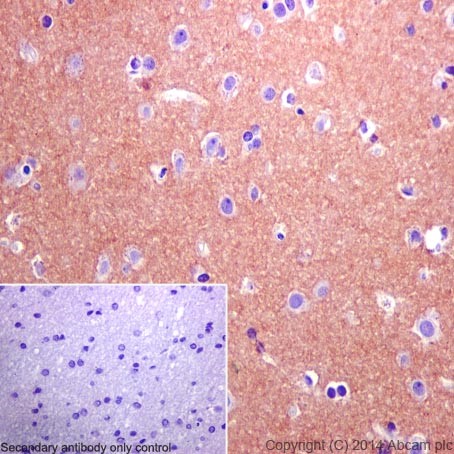
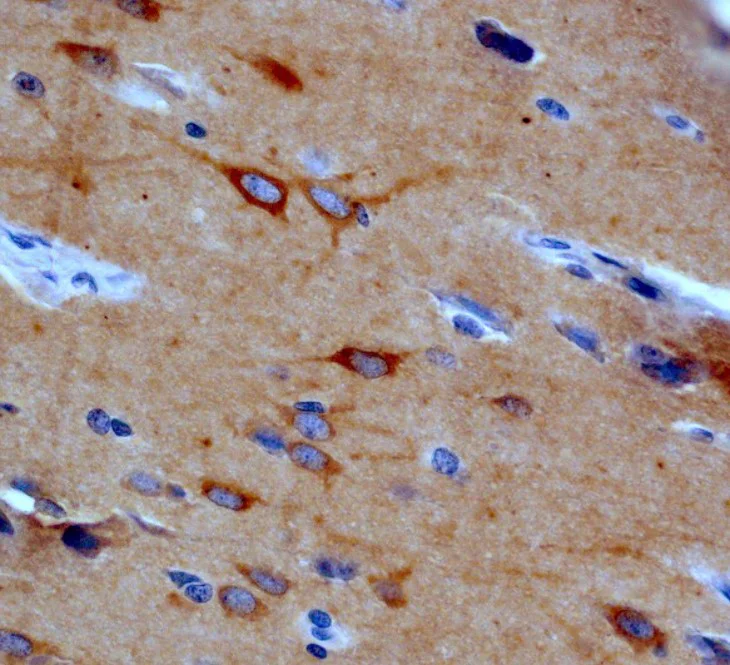
Immunohistochemistry (Formalin/PFA-fixed paraffin-embedded sections) - Anti-Kv4.2/KCND2 antibody [EP982Y] - BSA and Azide free (AB284688)
  • IHC-P

Lab

Immunohistochemistry (Formalin/PFA-fixed paraffin-embedded sections) - Anti-Kv4.2/KCND2 antibody [EP982Y] - BSA and Azide free (AB284688)

This data was developed using ab46797, the same antibody clone in a different buffer formulation.

Immunohistochemical analysis of paraffin-embedded human cerebrum tissue sections labeling Kv4.2/KCND2 with purified ab46797 at 1/100 dilution. ImmunoHistoProbe one step HRP Polymer (ready to use) was used as the secondary antibody. Sections were counterstained with Hematoxylin.
Antigen retrieval was heat mediated antigen retrieval using citrate buffer, pH 6.0).
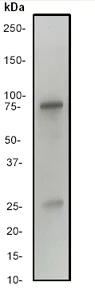
Western blot - Anti-Kv4.2/KCND2 antibody [EP982Y] - BSA and Azide free (AB284688)
  • WB

Unknown

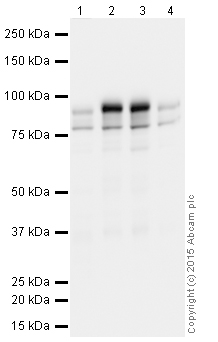
Western blot - Anti-Kv4.2/KCND2 antibody [EP982Y] - BSA and Azide free (AB284688)

This data was developed using ab46797, the same antibody clone in a different buffer formulation.

All lanes:

Western blot - Anti-Kv4.2/KCND2 antibody [EP982Y] - BSA and Azide free (ab284688) at 1/1000 dilution

All lanes:

Human brain at 10 µg

Secondary

All lanes:

Goat anti-rabbit HRP at 1/2000 dilution

Predicted band size: 71 kDa

Observed band size: 25 kDa,80 kDa

false

Key facts

Host species

Rabbit

Clonality

Monoclonal

Clone number

EP982Y

Isotype

IgG

Carrier free

Yes

Reacts with

Human

Applications

WB, IHC-P

applications

Immunogen

The exact immunogen used to generate this antibody is proprietary information.

Reactivity data

{ "title": "Reactivity Data", "filters": { "stats": ["", "Species", "Dilution Info", "Notes"], "tabs": { "all-applications": {"fullname" : "All Applications", "shortname": "All Applications"}, "ICCIF" : {"fullname" : "Immunocytochemistry/ Immunofluorescence", "shortname":"ICC/IF"}, "IP" : {"fullname" : "Immunoprecipitation", "shortname":"IP"}, "WB" : {"fullname" : "Western blot", "shortname":"WB"}, "IHCP" : {"fullname" : "Immunohistochemistry (Formalin/PFA-fixed paraffin-embedded sections)", "shortname":"IHC-P"} }, "product-promise": { "all": "all", "testedAndGuaranteed": "tested", "guaranteed": "expected", "predicted": "predicted", "notRecommended": "not-recommended" } }, "values": { "Human": { "ICCIF-species-checked": "notRecommended", "ICCIF-species-dilution-info": "", "ICCIF-species-notes": "<p></p>", "IP-species-checked": "notRecommended", "IP-species-dilution-info": "", "IP-species-notes": "<p></p>", "WB-species-checked": "testedAndGuaranteed", "WB-species-dilution-info": "", "WB-species-notes": "<p></p>", "IHCP-species-checked": "testedAndGuaranteed", "IHCP-species-dilution-info": "", "IHCP-species-notes": "<p></p> Perform heat-mediated antigen retrieval with citrate buffer pH 6 before commencing with IHC staining protocol." } } }

Product details

ab284688 is the carrier-free version of ab46797

Patented technology
Our RabMAb® technology is a patented hybridoma-based technology for making rabbit monoclonal antibodies. For details on our patents, please refer to RabMAb® patents.

Conjugation ready
Our carrier-free antibodies are typically supplied in a PBS-only formulation, purified and free of BSA, sodium azide and glycerol. This conjugation-ready format is designed for use with fluorochromes, metal isotopes, oligonucleotides, and enzymes, which makes them ideal for antibody labelling, functional and cell-based assays, flow-based assays (e.g. mass cytometry) and Multiplex Imaging applications.

Use our conjugation kits for antibody conjugates that are ready-to-use in as little as 20 minutes with 1 minute hands-on-time and 100% antibody recovery: available for fluorescent dyes, HRP, biotin and gold.

Compatibility
This product is compatible with the Maxpar® Antibody Labeling Kit from Fluidigm, without the need for antibody preparation. Maxpar® is a trademark of Fluidigm Canada Inc.

Properties and storage information

Form
Liquid
Purification technique
Affinity purification Protein A
Storage buffer
pH: 7.2 - 7.4 Constituents: PBS
Shipped at conditions
Blue Ice
Appropriate short-term storage conditions
+4°C
Appropriate long-term storage conditions
+4°C

Supplementary information

This supplementary information is collated from multiple sources and compiled automatically.

Kv4.2 also known as KCND2 is a voltage-gated potassium channel subunit that plays an important role in controlling the electrical activity of neurons. This protein has a molecular mass of approximately 74 kDa. Kv4.2 is expressed mainly in the brain especially in the hippocampus and cortex regions. The channel regulates the flow of potassium ions across the cell membrane which is essential for maintaining the resting membrane potential and modulating action potentials.
Biological function summary

The Kv4.2 protein contributes to the transient outward potassium current known as I_A. It often associates with other accessory proteins like KChIP and DPP10 to form functional Kv4.2 channel complexes. These complexes are critical in shaping the signal transmission in neurons affecting synaptic plasticity and neuronal excitability. Kv4.2's action impacts the duration and frequency of neuronal firing influencing functions such as memory and learning.

Pathways

Kv4.2 is integral to the regulation of neuronal excitability in the context of signal transduction pathways. One well-studied pathway involves its role in the MAPK/ERK signaling cascade where Kv4.2 undergoes phosphorylation events that fine-tune its activity. This pathway includes proteins like ERK which interacts with Kv4.2 to affect how neurons respond to synaptic inputs. Kv4.2 is also interconnected with CaMKII signaling which modulates its trafficking and expression in neurons.

Alterations in Kv4.2 expression or function relate to neurological conditions such as epilepsy and spinocerebellar ataxia. In epilepsy abnormal Kv4.2 channel activity can lead to hyperexcitability of neurons contributing to seizure development. Interconnections with proteins like Nav1.1 influence these pathological conditions as they also regulate neuronal excitability. Furthermore mutations in Kv4.2 can disrupt normal neuronal signaling which could be implicated in spinocerebellar ataxia contributing to the range of motor coordination symptoms seen in these patients.

Product protocols

For this product, it's our understanding that no specific protocols are required. You can visit:

Target data

Voltage-gated potassium channel that mediates transmembrane potassium transport in excitable membranes, primarily in the brain. Mediates the major part of the dendritic A-type current I(SA) in brain neurons (By similarity). This current is activated at membrane potentials that are below the threshold for action potentials. It regulates neuronal excitability, prolongs the latency before the first spike in a series of action potentials, regulates the frequency of repetitive action potential firing, shortens the duration of action potentials and regulates the back-propagation of action potentials from the neuronal cell body to the dendrites. Contributes to the regulation of the circadian rhythm of action potential firing in suprachiasmatic nucleus neurons, which regulates the circadian rhythm of locomotor activity (By similarity). Functions downstream of the metabotropic glutamate receptor GRM5 and plays a role in neuronal excitability and in nociception mediated by activation of GRM5 (By similarity). Mediates the transient outward current I(to) in rodent heart left ventricle apex cells, but not in human heart, where this current is mediated by another family member. Forms tetrameric potassium-selective channels through which potassium ions pass in accordance with their electrochemical gradient (PubMed : 10551270, PubMed : 11507158, PubMed : 14623880, PubMed : 14695263, PubMed : 14980201, PubMed : 15454437, PubMed : 16934482, PubMed : 19171772, PubMed : 24501278, PubMed : 24811166, PubMed : 34552243, PubMed : 35597238). The channel alternates between opened and closed conformations in response to the voltage difference across the membrane (PubMed : 11507158). Can form functional homotetrameric channels and heterotetrameric channels that contain variable proportions of KCND2 and KCND3; channel properties depend on the type of pore-forming alpha subunits that are part of the channel. In vivo, membranes probably contain a mixture of heteromeric potassium channel complexes. Interaction with specific isoforms of the regulatory subunits KCNIP1, KCNIP2, KCNIP3 or KCNIP4 strongly increases expression at the cell surface and thereby increases channel activity; it modulates the kinetics of channel activation and inactivation, shifts the threshold for channel activation to more negative voltage values, shifts the threshold for inactivation to less negative voltages and accelerates recovery after inactivation (PubMed : 14623880, PubMed : 14980201, PubMed : 15454437, PubMed : 19171772, PubMed : 24501278, PubMed : 24811166). Likewise, interaction with DPP6 or DPP10 promotes expression at the cell membrane and regulates both channel characteristics and activity (By similarity). Upon depolarization, the channel goes from a resting closed state (C state) to an activated but non-conducting state (C* state), from there, the channel may either inactivate (I state) or open (O state) (PubMed : 35597238).
See full target information KCND2

Alternative Names

KIAA1044, KCND2, A-type voltage-gated potassium channel KCND2, Potassium voltage-gated channel subfamily D member 2, Voltage-gated potassium channel subunit Kv4.2

Product promise

We are committed to supporting your work with high-quality reagents, and we're here for you every step of the way. In the unlikely event that one of our products does not perform as expected, you're protected by our Product Promise.
For full details, please see our Terms & Conditions

Please note: All products are 'FOR RESEARCH USE ONLY. NOT FOR USE IN DIAGNOSTIC OR THERAPEUTIC PROCEDURES'.

For licensing inquiries, please contact partnerships@abcam.com