JavaScript is disabled in your browser. Please enable JavaScript to view this website.
AB169772

Anti-LINGO3 antibody [EPR9635]

Be the first to review this product! Submit a review

|

(2 Publications )
Rabbit Recombinant Monoclonal LINGO3 antibody. Suitable for IP, WB, ICC/IF, Flow Cyt (Intra) and reacts with Human, Mouse, Rat samples. Cited in 2 publications.
4 Images
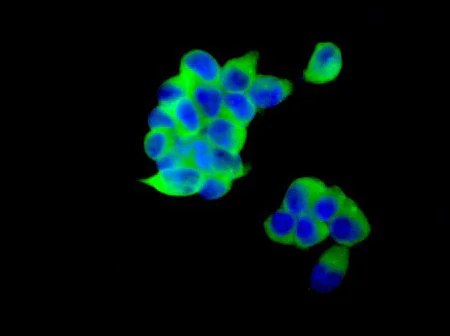
Immunocytochemistry/ Immunofluorescence - Anti-LINGO3 antibody [EPR9635] (AB169772)
  • ICC/IF

Unknown

Immunocytochemistry/ Immunofluorescence - Anti-LINGO3 antibody [EPR9635] (AB169772)

Immunofluorescent analysis of 293T cells labeling LINGO3 with ab169772 at 1/250 dilution (green). DAPI nuclear staining (blue).
Flow Cytometry (Intracellular) - Anti-LINGO3 antibody [EPR9635] (AB169772)
  • Flow Cyt (Intra)

Unknown

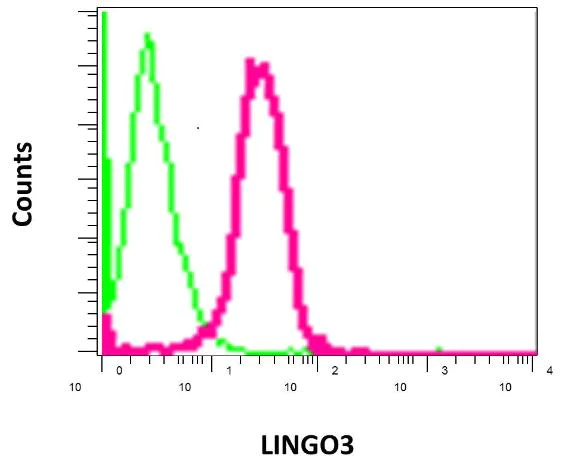
Flow Cytometry (Intracellular) - Anti-LINGO3 antibody [EPR9635] (AB169772)

Intracellular Flow Cytometry analysis of permeabilized SH-SY5Y cells labeling LINGO3 with ab169772 at 1/100 dilution (red) compared to a rabbit IgG negative control (green).
Immunoprecipitation - Anti-LINGO3 antibody [EPR9635] (AB169772)
  • IP

Unknown

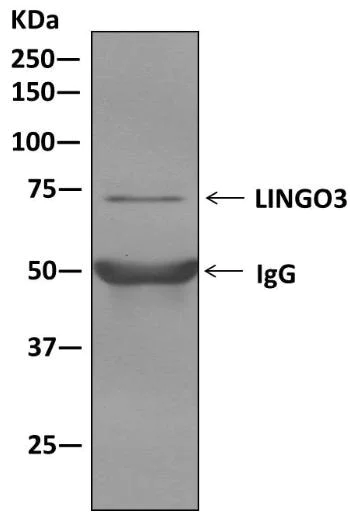
Immunoprecipitation - Anti-LINGO3 antibody [EPR9635] (AB169772)

Western blot analysis on immunoprecipitation pellet from SH-SY5Y cell lysate using ab169772.

All lanes:

Immunoprecipitation - Anti-LINGO3 antibody [EPR9635] (ab169772)

Predicted band size: 65 kDa

false
Western blot - Anti-LINGO3 antibody [EPR9635] (AB169772)
  • WB

Unknown

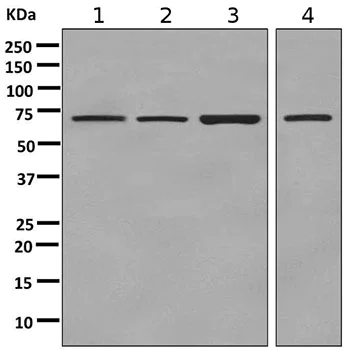
Western blot - Anti-LINGO3 antibody [EPR9635] (AB169772)

All lanes:

Western blot - Anti-LINGO3 antibody [EPR9635] (ab169772) at 1/1000 dilution

Lane 1:

SH-SY5Y cell lysate at 10 µg

Lane 2:

U87-MG cell lysate at 10 µg

Lane 3:

293T cell lysate at 10 µg

Lane 4:

NCI-H460 cell lysate at 10 µg

Secondary

All lanes:

HRP labelled goat anti-rabbit at 1/2000 dilution

Predicted band size: 65 kDa

false

  • Carrier free

    Anti-LINGO3 antibody [EPR9635] - BSA and Azide free

Key facts

Host species

Rabbit

Clonality

Monoclonal

Clone number

EPR9635

Isotype

IgG

Carrier free

No

Reacts with

Human

Applications

IP, Flow Cyt (Intra), ICC/IF, WB

applications

Immunogen

The exact immunogen used to generate this antibody is proprietary information.

Reactivity data

{ "title": "Reactivity Data", "filters": { "stats": ["", "Species", "Dilution Info", "Notes"], "tabs": { "all-applications": {"fullname" : "All Applications", "shortname": "All Applications"}, "IP" : {"fullname" : "Immunoprecipitation", "shortname":"IP"}, "WB" : {"fullname" : "Western blot", "shortname":"WB"}, "IHCP" : {"fullname" : "Immunohistochemistry (Formalin/PFA-fixed paraffin-embedded sections)", "shortname":"IHC-P"}, "ICCIF" : {"fullname" : "Immunocytochemistry/ Immunofluorescence", "shortname":"ICC/IF"}, "FlowCytIntra" : {"fullname" : "Flow Cytometry (Intracellular)", "shortname":"Flow Cyt (Intra)"} }, "product-promise": { "all": "all", "testedAndGuaranteed": "tested", "guaranteed": "expected", "predicted": "predicted", "notRecommended": "not-recommended" } }, "values": { "Human": { "IP-species-checked": "testedAndGuaranteed", "IP-species-dilution-info": "1/10 - 1/100", "IP-species-notes": "<p></p>", "WB-species-checked": "testedAndGuaranteed", "WB-species-dilution-info": "1/1000 - 1/5000", "WB-species-notes": "<p></p>", "IHCP-species-checked": "notRecommended", "IHCP-species-dilution-info": "", "IHCP-species-notes": "<p></p>", "ICCIF-species-checked": "testedAndGuaranteed", "ICCIF-species-dilution-info": "1/250 - 1/500", "ICCIF-species-notes": "<p></p>", "FlowCytIntra-species-checked": "testedAndGuaranteed", "FlowCytIntra-species-dilution-info": "1/100 - 1/500", "FlowCytIntra-species-notes": "<p><a href='/en-us/products/primary-antibodies/rabbit-igg-monoclonal-epr25a-isotype-control-ab172730'>ab172730</a> - Rabbit monoclonal IgG, is suitable for use as an isotype control with this antibody.</p>" }, "Mouse": { "IP-species-checked": "predicted", "IP-species-dilution-info": "", "IP-species-notes": "", "WB-species-checked": "guaranteed", "WB-species-dilution-info": "", "WB-species-notes": "<p></p>", "IHCP-species-checked": "notRecommended", "IHCP-species-dilution-info": "", "IHCP-species-notes": "", "ICCIF-species-checked": "predicted", "ICCIF-species-dilution-info": "", "ICCIF-species-notes": "", "FlowCytIntra-species-checked": "predicted", "FlowCytIntra-species-dilution-info": "", "FlowCytIntra-species-notes": "" }, "Rat": { "IP-species-checked": "predicted", "IP-species-dilution-info": "", "IP-species-notes": "", "WB-species-checked": "guaranteed", "WB-species-dilution-info": "", "WB-species-notes": "<p></p>", "IHCP-species-checked": "notRecommended", "IHCP-species-dilution-info": "", "IHCP-species-notes": "", "ICCIF-species-checked": "predicted", "ICCIF-species-dilution-info": "", "ICCIF-species-notes": "", "FlowCytIntra-species-checked": "predicted", "FlowCytIntra-species-dilution-info": "", "FlowCytIntra-species-notes": "" } } }

Product details

Patented technology
Our RabMAb® technology is a patented hybridoma-based technology for making rabbit monoclonal antibodies. For details on our patents, please refer to RabMAb® patents.

What are the advantages of a recombinant monoclonal antibody?
This product is a recombinant monoclonal antibody, which offers several advantages including:

  • - High batch-to-batch consistency and reproducibility
  • - Improved sensitivity and specificity
  • - Long-term security of supply
  • - Animal-free batch production

For more information, read more on recombinant antibodies.

Properties and storage information

Form
Liquid
Purification technique
Affinity purification Protein A
Storage buffer
pH: 7.2 - 7.4 Preservative: 0.01% Sodium azide Constituents: PBS, 40% Glycerol (glycerin, glycerine), 0.05% BSA
Shipped at conditions
Conditional Ambient
Appropriate short-term storage duration
1-2 weeks
Appropriate short-term storage conditions
+4°C
Appropriate long-term storage conditions
-20°C
Aliquoting information
Upon delivery aliquot

Supplementary information

This supplementary information is collated from multiple sources and compiled automatically.

The protein LINGO3 also known as Leucine-Rich Repeat and Ig Domain-Containing contributes to regulating neuronal survival and function. LINGO3 has a molecular mass of approximately 87 kDa and shows expression mostly in the central nervous system. It belongs to the LINGO family which includes several proteins that share overlapping functions in the nervous system.
Biological function summary

LINGO3 plays a significant role in the development and maintenance of neuronal circuits. It often partakes in protein complexes that influence nerve growth and guidance. Its action affects cellular functions such as differentiation and axonal growth contributing to the proper configuration of neural networks.

Pathways

LINGO3 engages with mechanisms involved in neuronal signal transduction and myelination. It operates within the axon guidance pathway and the Nogo receptor pathway. In these pathways proteins such as RTN4 (also known as Nogo) interact with LINGO3 to modulate neuronal growth and inhibition of neurite outgrowth.

LINGO3's activity could connect with multiple sclerosis and neurodegenerative conditions. The dysregulation of LINGO3 affects axonal integrity and remyelination processes which are important in the progression of these disorders. LINGO3 relates to proteins like Nogo and MAG which are pivotal in neuropathological conditions impacting myelin stability and repair.

Product protocols

For this product, it's our understanding that no specific protocols are required. You can visit:

Target data

See full target information LINGO3

Alternative Names

LERN2, LRRN6B, LINGO3, Leucine-rich repeat and immunoglobulin-like domain-containing nogo receptor-interacting protein 3, Leucine-rich repeat neuronal protein 2, Leucine-rich repeat neuronal protein 6B

Publications (2)

Recent publications for all applications. Explore the full listand refine your search

Iranian journal of public health 53:2260-2270 PubMed39544858

2024

Promotes Osteogenic Differentiation and Calcification of Valvular Interstitial Cells by Targeting in Calcific Aortic Valve Disease.

Applications

Unspecified application

Species

Unspecified reactive species

Yan Gu,Rongjin Chen,Jianxiang Song,Zhan Shi,Jixiang Wu,Huiwen Chang,Conghu Yuan,Woda Shi,Yajun Zhang

FASEB journal : official publication of the Federation of American Societies for Experimental Biology 34:13641-13653 PubMed32862444

2020

LINGO family receptors are differentially expressed in the mouse brain and form native multimeric complexes.

Applications

Unspecified application

Species

Unspecified reactive species

Anthony Guillemain,Yousra Laouarem,Laetitia Cobret,Dora Štefok,Wanyin Chen,Solal Bloch,Amina Zahaf,Lauren Blot,Flora Reverchon,Thierry Normand,Martine Decoville,Catherine Grillon,Elisabeth Traiffort,Séverine Morisset-Lopez
View all publications

Product promise

We are committed to supporting your work with high-quality reagents, and we're here for you every step of the way. In the unlikely event that one of our products does not perform as expected, you're protected by our Product Promise.
For full details, please see our Terms & Conditions

Please note: All products are 'FOR RESEARCH USE ONLY. NOT FOR USE IN DIAGNOSTIC OR THERAPEUTIC PROCEDURES'.

For licensing inquiries, please contact partnerships@abcam.com