Anti-LMO 4 antibody [20F8]
- BOND RX™ Validated
- Recombinant
- What is this?
Be the first to review this product! Submit a review
|
(1 Publication)
- IHC-P
Supplier Data
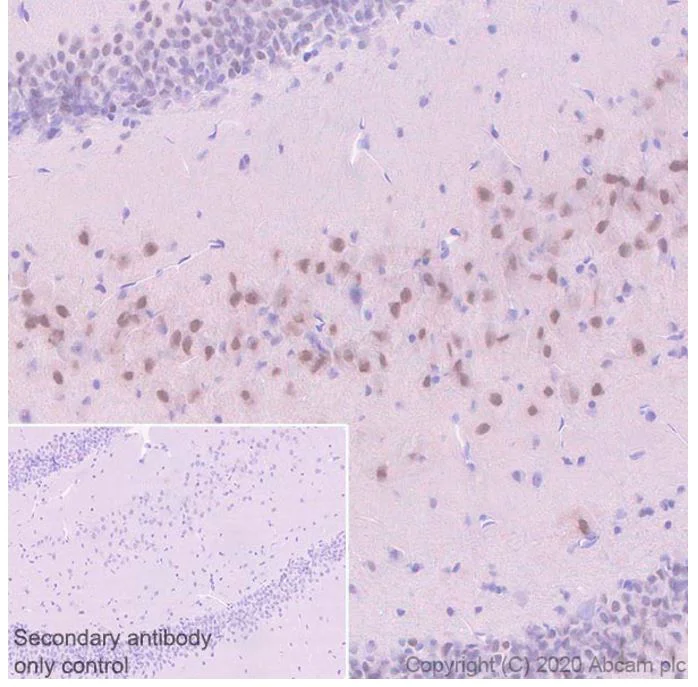
Immunohistochemistry (Formalin/PFA-fixed paraffin-embedded sections) - Anti-LMO 4 antibody [20F8] (AB243139)
Immunohistochemical analysis of paraffin-embedded rat hippocampus tissue labeling LMO 4 with ab243139 at 1/1000 dilution, followed by ready to use Goat Anti-Rat IgG H&L (HRP polymer) (ab214882). Positive staining on rat hippocampus tissue is observed. The section was incubated with ab243139 for 30 mins at RT. The immunostaining staining was performed on a Leica Biosystems BOND® RX instrument. Counterstained with hematoxylin. Secondary antibody only control : Used PBS instead of primary antibody, followed by ready to use Goat Anti-Rat IgG H&L (HRP polymer) (ab214882). Heat mediated antigen retrieval with Tris-EDTA buffer (pH 9.0, epitope retrieval solution 2) for 20 mins.
- IHC-P
Supplier Data
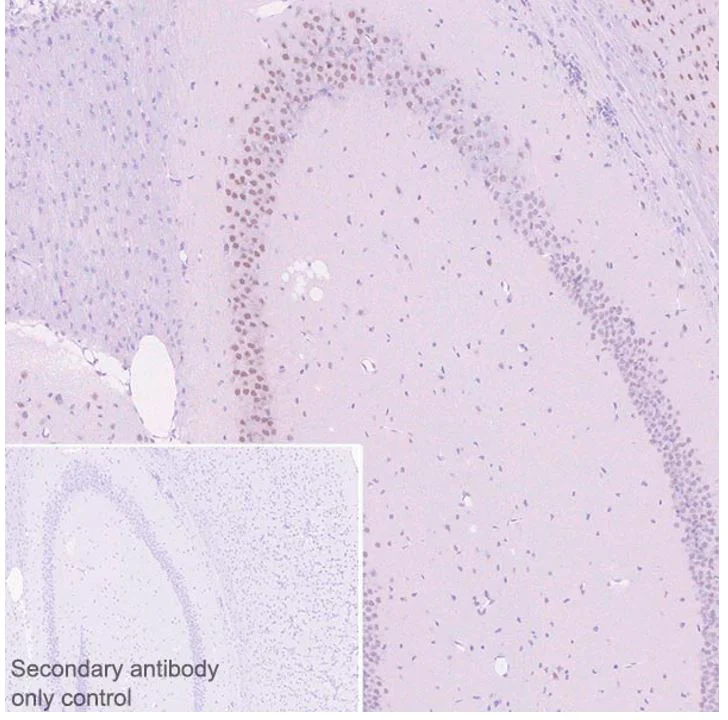
Immunohistochemistry (Formalin/PFA-fixed paraffin-embedded sections) - Anti-LMO 4 antibody [20F8] (AB243139)
Immunohistochemical analysis of paraffin-embedded mouse hippocampus tissue labeling LMO 4 with ab243139 at 1/1000 dilution, followed by ready to use Goat Anti-Rat IgG H&L (HRP polymer) (ab214882). Positive staining on mouse hippocampus tissue is observed. The section was incubated with ab243139 for 30 mins at RT. The immunostaining staining was performed on a Leica Biosystems BOND® RX instrument. Counterstained with hematoxylin. Secondary antibody only control : Used PBS instead of primary antibody, followed by ready to use Goat Anti-Rat IgG H&L (HRP polymer) (ab214882). Heat mediated antigen retrieval with Tris-EDTA buffer (pH 9.0, epitope retrieval solution 2) for 20 mins.
- WB
Supplier Data
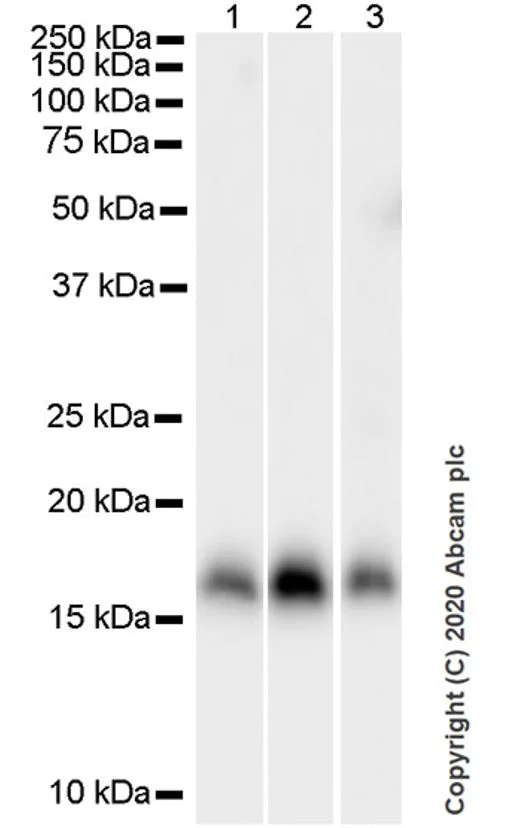
Western blot - Anti-LMO 4 antibody [20F8] (AB243139)
Blocking/Dilution buffer : 5% NFDM/TBST.
Exposure times : Lane 1,2 : 15 secs; Lane 3 : 3 secs
All lanes:
Western blot - Anti-LMO 4 antibody [20F8] (ab243139) at 1.354 µg/mL
Lane 1:
Wild-type HAP1 whole cell lysate at 20 µg
Lane 2:
T47D (human ductal breast epithelial tumor epithelial cell), whole cell lysate at 20 µg
Lane 3:
Mouse embryo tissue lysate at 20 µg
Secondary
All lanes:
Western blot - Goat Anti-Rat IgG H&L (HRP) (<a href='/en-us/products/secondary-antibodies/goat-rat-igg-h-l-hrp-ab205720'>ab205720</a>) at 1/5000 dilution
false
Related conjugates and formulations (1)
-
Anti-LMO 4 antibody [20F8] - BSA and Azide free
Complementary Products
Primary Antibodies
AB309139
Anti-CUX1+CUX2 antibody [EPR26509-154]
BOND RX™ Validated|20ul selling size|RabMAb|Recombinant
- 5
- 2
Primary Antibodies
AB240636
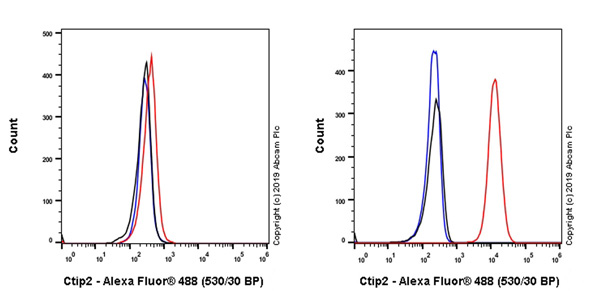
Anti-Ctip2 antibody [EPR23120-25]
BOND RX™ Validated|RabMAb|Recombinant|20ul selling size
- 5
- 1
Reactivity data
Product details
What are the advantages of a recombinant monoclonal antibody?
This product is a recombinant monoclonal antibody, which offers several advantages including:
- - High batch-to-batch consistency and reproducibility
- - Improved sensitivity and specificity
- - Long-term security of supply
- - Animal-free batch production
For more information, read more on recombinant antibodies.
Want a custom formulation?
This antibody clone is manufactured by Abcam. If you require a custom buffer formulation or conjugation for your experiments, please contact orders@abcam.com
Properties and storage information
Form
Purification technique
Storage buffer
Shipped at conditions
Appropriate short-term storage duration
Appropriate short-term storage conditions
Appropriate long-term storage conditions
Aliquoting information
Storage information
Supplementary information
This supplementary information is collated from multiple sources and compiled automatically.
Biological function summary
LMO4 serves as a transcriptional regulator in multiple cell types. It forms complexes with other co-regulators and transcription factors. For instance LMO4 interacts with LDB1 (LIM domain-binding protein 1) and SSDP1 (Single-stranded DNA-binding protein 1) which are part of a larger transcriptional complex. Through these interactions LMO4 influences the expression of genes critical for tissue development and cellular differentiation highlighting its diverse biological functions.
Pathways
LMO4 participates in signaling pathways like the BMP (Bone Morphogenetic Protein) and ER (Estrogen Receptor) pathways. In BMP signaling it associates with SMAD proteins to modulate gene transcription. Within the ER pathway LMO4 interacts with co-activators such as SRC family proteins impacting estrogen-responsive gene expression. This shows that LMO4 can integrate into pathways influencing cell growth and differentiation.
Product protocols
- Visit the General protocols
- Visit the Troubleshooting
Target data
Alternative Names
Publications (1)
Recent publications for all applications. Explore the full listand refine your search
American journal of nephrology 55:345-360 PubMed38330925
2024
Applications
Unspecified application
Species
Unspecified reactive species
Product promise
Please note: All products are 'FOR RESEARCH USE ONLY. NOT FOR USE IN DIAGNOSTIC OR THERAPEUTIC PROCEDURES'.
For licensing inquiries, please contact partnerships@abcam.com