Anti-MARK2 antibody [EPR8553]
- RabMAb
- Recombinant
- KO Validated
- What is this?
4
(1 Review)
|
(8 Publications )
- Flow Cyt (Intra)
Unknown
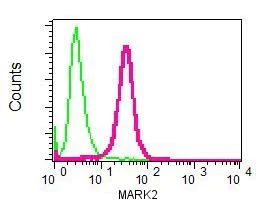
Flow Cytometry (Intracellular) - Anti-MARK2 antibody [EPR8553] (AB133724)
Intracellular Flow Cytometry analysis of permeabilized Raji cells staining MARK2, using ab133724 at a 1/100 dilution (red) or a control rabbit IgG antibody (green).

- WB
Lab
Western blot - Anti-MARK2 antibody [EPR8553] (AB133724)
Lane 1 : Wild-type HAP1 cell lysate (20 μg)
Lane 2 : MARK2 knockout HAP1 cell lysate (20 μg)
Lane 3 : K562 cell lysate (20 μg)
Lane 4 : Raw264.7 cell lysate (20 μg)
Lanes 1 - 4 : Merged signal (red and green). Green - ab133724 observed at 75 kDa. Red - loading control, ab8245, observed at 37 kDa.
ab133724 was shown to recognize MARK2 when MARK2 knockout samples were used, along with additional cross-reactive bands. Wild-type and MARK2 knockout samples were subjected to SDS-PAGE. ab133724 and ab8245 (loading control to GAPDH) were diluted 1/1000 and 1/10000 respectively and incubated overnight at 4°C. Blots were developed with Goat anti-Rabbit IgG H&L (IRDye® 800CW) preadsorbed (ab216773) and Goat anti-Mouse IgG H&L (IRDye® 680RD) preadsorbed (ab216776) secondary antibodies at 1/10000 dilution for 1 hour at room temperature before imaging.
All lanes:
Western blot - Anti-MARK2 antibody [EPR8553] (ab133724)
Predicted band size: 88 kDa
false
- WB
Unknown
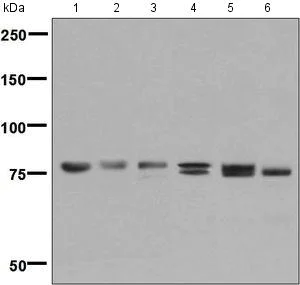
Western blot - Anti-MARK2 antibody [EPR8553] (AB133724)
All lanes:
Western blot - Anti-MARK2 antibody [EPR8553] (ab133724) at 1/1000 dilution
Lane 1:
RAW 264.7 cell lysate at 10 µg
Lane 2:
NIH/3T3 cell lysate at 10 µg
Lane 3:
Neuro-2a cell lysate at 10 µg
Lane 4:
Jurkat cell lysate at 10 µg
Lane 5:
Raji cell lysate at 10 µg
Lane 6:
U-87 MG (Human glioblastoma-astrocytoma epithelial cell line) cell lysate at 10 µg
Secondary
All lanes:
Standard HRP labelled goat anti-rabbit at 1/2000 dilution
Predicted band size: 88 kDa
true
- OI-RD Scanning
Unknown
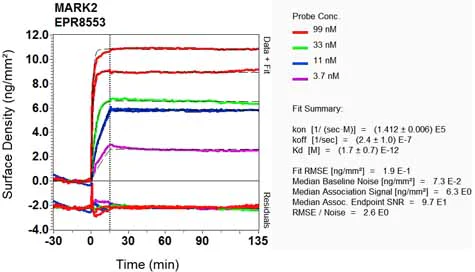
OI-RD Scanning - Anti-MARK2 antibody [EPR8553] (AB133724)
We have systematically measured KD (the equilibrium dissociation constant between the antibody and its antigen), of more than 840 recombinant antibodies to assess not only their individual KD values but also to see the average affinity of antibody. Based on the comparison with published literature values for mouse monoclonal antibodies, Recombinant antibodies appear to be on average 1-2 order of magnitude higher affinity.
Related conjugates and formulations (1)
-
Anti-MARK2 antibody [EPR8553] - BSA and Azide free
Alternative Products


Complementary Products
Primary Antibodies
AB183734
RabMAb|Recombinant|Lab Essentials|20ul selling size

- 5
- 24

Primary Antibodies
AB108629
Anti-TUBA1B antibody [EPR1333] - Loading Control
20ul selling size|BOND RX™ Validated|RabMAb|Recombinant|Lab Essentials

- 0
- 0
Reactivity data
Product details
Patented technology
Our RabMAb® technology is a patented hybridoma-based technology for making rabbit monoclonal antibodies. For details on our patents, please refer to RabMAb® patents.
What are the advantages of a recombinant monoclonal antibody?
This product is a recombinant monoclonal antibody, which offers several advantages including:
- - High batch-to-batch consistency and reproducibility
- - Improved sensitivity and specificity
- - Long-term security of supply
- - Animal-free batch production
For more information, read more on recombinant antibodies.
Properties and storage information
Form
Purification technique
Storage buffer
Shipped at conditions
Appropriate short-term storage conditions
Appropriate long-term storage conditions
Storage information
Product protocols
- Visit the General protocols
- Visit the Troubleshooting
Target data
Alternative Names
Publications (8)
Recent publications for all applications. Explore the full listand refine your search
eLife 14: PubMed40333320
2025
Applications
Unspecified application
Species
Unspecified reactive species
Journal of inflammation research 17:7261-7274 PubMed39429850
2024
Applications
Unspecified application
Species
Unspecified reactive species
Cancer discovery 14:2471-2488 PubMed39058094
2024
Applications
Unspecified application
Species
Unspecified reactive species
STAR protocols 2:100430 PubMed33870231
2021
Applications
Unspecified application
Species
Unspecified reactive species
Cancer research 81:2470-2480 PubMed33685991
2021
Applications
Unspecified application
Species
Unspecified reactive species
American journal of translational research 12:1807-1823 PubMed32509178
2020
Applications
Unspecified application
Species
Unspecified reactive species
Journal of bone oncology 23:100290 PubMed32368441
2020
Applications
Unspecified application
Species
Unspecified reactive species
Developmental cell 49:590-604.e9 PubMed31080060
2019
Applications
Unspecified application
Species
Unspecified reactive species
Product promise
Please note: All products are 'FOR RESEARCH USE ONLY. NOT FOR USE IN DIAGNOSTIC OR THERAPEUTIC PROCEDURES'.
For licensing inquiries, please contact partnerships@abcam.com