Anti-mGluR1 antibody
5
(15 Reviews)
|
(19 Publications )
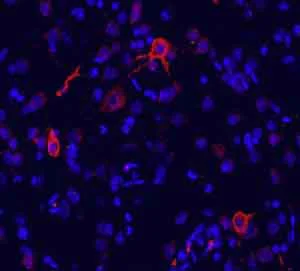
- ICC/IF
Unknown
Immunocytochemistry/ Immunofluorescence - Anti-mGluR1 antibody (AB82211)
Immunofluorescence labeling of mGluR1 in rat brain (cingulate cortex). Using ab82211 (red color). DAPI was used to counter-stain cell nuclei (blue color). Working dilution is 1/100-1/500.
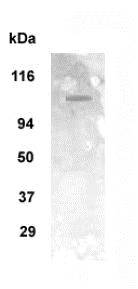
- WB
Unknown
Western blot - Anti-mGluR1 antibody (AB82211)
All lanes:
Western blot - Anti-mGluR1 antibody (ab82211) at 1/1000 dilution
All lanes:
human brain lysate at 20 µg
Secondary
All lanes:
AP-conjugated secondary at 1/5000 dilution
Predicted band size: 132 kDa
Observed band size: 110 kDa
false
Alternative Products


Complementary Products
Primary Antibodies
AB76316
Anti-Metabotropic Glutamate Receptor 5 antibody [EPR2425Y]
BOND RX™ Validated|RabMAb|Recombinant|20ul selling size

- 5
- 6
Primary Antibodies
AB150387
Anti-Metabotropic Glutamate Receptor 2 + 3 / MGLUR2 + MGLUR3 antibody [EPR8975]
20ul selling size|BOND RX™ Validated|RabMAb|Recombinant

- 5
- 2


Reactivity data
Properties and storage information
Form
Purification technique
Storage buffer
Shipped at conditions
Appropriate short-term storage conditions
Appropriate long-term storage conditions
Aliquoting information
Storage information
Supplementary information
This supplementary information is collated from multiple sources and compiled automatically.
Biological function summary
MGluR1 contributes to synaptic plasticity a critical process for learning and memory. It forms part of a signaling complex that interacts with several other proteins including Homer proteins which facilitate the link to intracellular calcium release channels. The receptor's activation leads to a cascade of intracellular events including the mobilization of calcium and activation of various kinases. These processes subsequently affect long-term potentiation and depression which are key for adaptable and responsive neural circuits.
Pathways
MGluR1 operates within important signaling pathways such as the phosphoinositide pathway and the MAPK/ERK pathway. In the phosphoinositide pathway it activates phospholipase C which results in the production of inositol trisphosphate and diacylglycerol second messengers that regulate calcium release and protein kinase C activation respectively. Within the MAPK/ERK pathway mGluR1 activation contributes to gene expression changes through ERK activation influencing cellular responses and adaptations. Proteins such as calcium-calmodulin and GRK2 are related to mGluR1 within these pathways impacting receptor sensitivity and function.
Product protocols
- Visit the General protocols
- Visit the Troubleshooting
Target data
Alternative Names
Publications (19)
Recent publications for all applications. Explore the full list and refine your search
The Journal of pharmacology and experimental therapeutics 383:208-216 PubMed36153003
2022
Applications
Unspecified application
Species
Unspecified reactive species
Neural regeneration research 18:594-602 PubMed36018183
2022
Applications
Unspecified application
Species
Unspecified reactive species
Neuropharmacology 217:109204 PubMed35931212
2022
Applications
Unspecified application
Species
Unspecified reactive species
Scientific reports 12:9142 PubMed35650390
2022
Applications
Unspecified application
Species
Unspecified reactive species
Frontiers in neuroscience 15:741214 PubMed34675769
2021
Applications
Unspecified application
Species
Unspecified reactive species
The European journal of neuroscience 54:6382-6396 PubMed34481424
2021
Applications
Unspecified application
Species
Unspecified reactive species
Cells 10: PubMed34065662
2021
Applications
Unspecified application
Species
Unspecified reactive species
The Journal of clinical investigation 130:6555-6570 PubMed32841213
2020
Applications
Unspecified application
Species
Unspecified reactive species
Progress in neuro-psychopharmacology & biological psychiatry 104:110033 PubMed32640261
2020
Applications
Unspecified application
Species
Unspecified reactive species
Frontiers in physiology 11:401 PubMed32536873
2020
Applications
Unspecified application
Species
Unspecified reactive species
Product promise
Please note: All products are 'FOR RESEARCH USE ONLY. NOT FOR USE IN DIAGNOSTIC OR THERAPEUTIC PROCEDURES'.
For licensing inquiries, please contact partnerships@abcam.com