JavaScript is disabled in your browser. Please enable JavaScript to view this website.
AB38930

Anti-MMP10 antibody

4

(3 Reviews)

|

(10 Publications )
Rabbit Polyclonal MMP10 antibody. Suitable for IHC-P and reacts with Human samples. Cited in 10 publications. Immunogen corresponding to Synthetic Peptide within Human MMP10.
1 Images
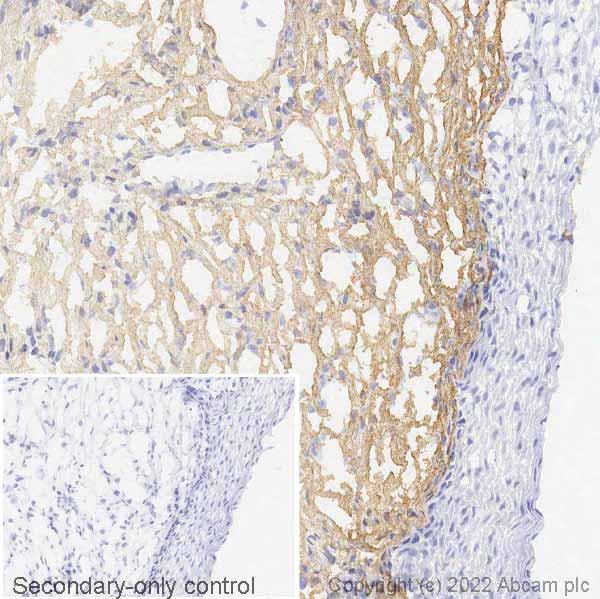
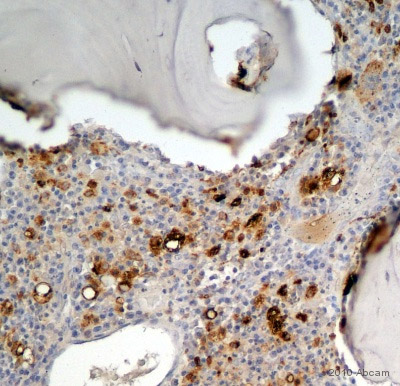
Immunohistochemistry (Formalin/PFA-fixed paraffin-embedded sections) - Anti-MMP10 antibody (AB38930)
  • IHC-P

Unknown

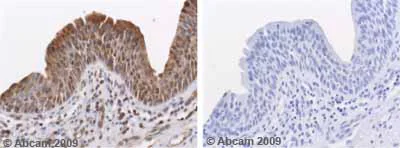
Immunohistochemistry (Formalin/PFA-fixed paraffin-embedded sections) - Anti-MMP10 antibody (AB38930)

ab38930 staining Human normal trachea. Staining is localised to the cytoplasm.
Left panel : with primary antibody at 2 ug/ml. Right panel : isotype control.
Sections were stained using an automated system DAKO Autostainer Plus , at room temperature : sections were rehydrated and antigen retrieved with the Dako 3 in 1 AR buffers citrate pH 6.0 in a DAKO PT Link. Slides were peroxidase blocked in 3% H2O2 in methanol for 10 mins. They were then blocked with Dako Protein block for 10 minutes (containing casein 0.25% in PBS) then incubated with primary antibody for 20 min and detected with Dako envision flex amplification kit for 30 minutes. Colorimetric detection was completed with Diaminobenzidine for 5 minutes. Slides were counterstained with Haematoxylin and coverslipped under DePeX. Please note that for manual staining we recommend to optimize the primary antibody concentration and incubation time (overnight incubation), and amplification may be required.

Key facts

Host species

Rabbit

Clonality

Polyclonal

Isotype

IgG

Carrier free

No

Reacts with

Human

Applications

IHC-P

applications

Immunogen

Synthetic Peptide within Human MMP10. The exact immunogen used to generate this antibody is proprietary information.

P09238

Specificity

The antibody binds to the hinge region of MMP10. The antibody binds to Stromelysin 2, but does not cross react with the other MMP family members (MMP1, MMP2, MMP3, etc.). The antibody also recognizes the cleaved active enzyme and will also bind to the non-reduced protein.

Reactivity data

{ "title": "Reactivity Data", "filters": { "stats": ["", "Species", "Dilution Info", "Notes"], "tabs": { "all-applications": {"fullname" : "All Applications", "shortname": "All Applications"}, "IHCP" : {"fullname" : "Immunohistochemistry (Formalin/PFA-fixed paraffin-embedded sections)", "shortname":"IHC-P"} }, "product-promise": { "all": "all", "testedAndGuaranteed": "tested", "guaranteed": "expected", "predicted": "predicted", "notRecommended": "not-recommended" } }, "values": { "Human": { "IHCP-species-checked": "testedAndGuaranteed", "IHCP-species-dilution-info": "2 µg/mL", "IHCP-species-notes": "<p></p> Perform heat-mediated antigen retrieval before commencing with IHC staining protocol." } } }

Properties and storage information

Form
Liquid
Purification technique
Affinity purification Immunogen
Storage buffer
Preservative: 0.05% Sodium azide Constituents: 50% Glycerol (glycerin, glycerine)
Shipped at conditions
Blue Ice
Appropriate short-term storage conditions
+4°C
Appropriate long-term storage conditions
-20°C
Aliquoting information
Upon delivery aliquot
Storage information
Avoid freeze / thaw cycle

Supplementary information

This supplementary information is collated from multiple sources and compiled automatically.

MMP10 also known as stromelysin-2 is a member of the matrix metalloproteinase (MMP) family. This protein is involved in the degradation of components of the extracellular matrix. MMP10 weighs around 54 kDa in its native form. It gets expressed in various tissues including the skin lung and reproductive organs and plays a part in processes like tissue remodeling and repair. Unlike other MMPs MMP10 does not usually cleave collagen but breaks down proteins like elastin and gelatin. The Luminex MMP assay is a method used to study this protein's expression and regulation.
Biological function summary

MMP10 impacts the restructuring and turnover of the extracellular matrix in both normal and disease conditions. It does not work alone; it operates synergistically with other MMPs in a complex matrix framework. Within tissues MMP10 modifies the integrity of the extracellular environment affecting cell behaviors such as migration and invasion. It steps in during processes like wound healing and inflammation exemplifying its contribution to cellular repair mechanisms and their regulation.

Pathways

The activity of MMP10 intersects with the MAPK and TGF-beta signaling pathways. MMP10 facilitates these pathways by digesting extracellular matrix barriers which then influences cellular responses. MMP10's function is also linked with other metalloproteinases like MMP1 and MMP3 in the pathways. Its regulation and activation play an important role in maintaining cellular homeostasis and responding to environmental cues.

MMP10 is associated with conditions such as cancer and arthritis. In cancer its role in promoting extracellular matrix breakdown facilitates tumor cell invasion and metastasis. In arthritis MMP10 contributes to joint tissue destruction perpetuating the inflammatory cycle. This protein frequently collaborates with MMP13 in these diseases reflecting its significant part in disease progression and pathology.

Product protocols

For this product, it's our understanding that no specific protocols are required. You can visit:

Target data

Can degrade fibronectin, gelatins of type I, III, IV, and V; weakly collagens III, IV, and V. Activates procollagenase.
See full target information MMP10

Alternative Names

STMY2, MMP10, Stromelysin-2, SL-2, Matrix metalloproteinase-10, Transin-2, MMP-10

Publications (10)

Recent publications for all applications. Explore the full listand refine your search

Cancers 16: PubMed39199688

2024

TLK1>Nek1 Axis Promotes Nuclear Retention and Activation of YAP with Implications for Castration-Resistant Prostate Cancer.

Applications

Unspecified application

Species

Unspecified reactive species

Damilola Olatunde,Arrigo De Benedetti

Nutrients 14: PubMed36014933

2022

Astaxanthin Inhibits Matrix Metalloproteinase Expression by Suppressing PI3K/AKT/mTOR Activation in -Infected Gastric Epithelial Cells.

Applications

Unspecified application

Species

Unspecified reactive species

Jimin Lee,Joo Weon Lim,Hyeyoung Kim

Life (Basel, Switzerland) 11: PubMed34947929

2021

Deficiency of MMP-10 Aggravates the Diseased Phenotype of Aged Dystrophic Mice.

Applications

Unspecified application

Species

Unspecified reactive species

Arantxa Baraibar-Churio,Míriam Bobadilla,Florencio J D Machado,Neira Sáinz,Carmen Roncal,Gloria Abizanda,Felipe Prósper,Josune Orbe,Ana Pérez-Ruiz

Cancer cell international 20:155 PubMed32410883

2020

Long non-coding RNA OIP5-AS1 suppresses multiple myeloma progression by sponging miR-27a-3p to activate TSC1 expression.

Applications

Unspecified application

Species

Unspecified reactive species

Yong Wang,Haibao Wang,Jianwei Ruan,Wenbiao Zheng,Zeyu Yang,Weiwei Pan

Diagnostics (Basel, Switzerland) 10: PubMed31905599

2019

Prognostic Significance of Lymphocyte Infiltration and a Stromal Immunostaining of a Bladder Cancer Associated Diagnostic Panel in Urothelial Carcinoma.

Applications

Unspecified application

Species

Unspecified reactive species

Hideki Furuya,Owen T M Chan,Kanani Hokutan,Yutaro Tsukikawa,Keanu Chee,Landon Kozai,Keith S Chan,Yunfeng Dai,Regan S Wong,Charles J Rosser

American journal of respiratory cell and molecular biology 56:223-232 PubMed27654284

2016

Early Secretory Antigenic Target-6 Drives Matrix Metalloproteinase-10 Gene Expression and Secretion in Tuberculosis.

Applications

WB

Species

Human

Sara Brilha,Tarangini Sathyamoorthy,Laura H Stuttaford,Naomi F Walker,Robert J Wilkinson,Shivani Singh,Rachel C Moores,Paul T Elkington,Jon S Friedland

PloS one 10:e0126859 PubMed25978399

2015

Increased expression of angiogenic and inflammatory proteins in the vitreous of patients with ischemic central retinal vein occlusion.

Applications

IHC

Species

Unspecified reactive species

Christoph Ehlken,Bastian Grundel,Daniel Michels,Bernd Junker,Andreas Stahl,Günther Schlunck,Lutz L Hansen,Nicolas Feltgen,Gottfried Martin,Hansjürgen T Agostini,Amelie Pielen

Diagnostic pathology 9:200 PubMed25387487

2014

Validation and clinicopathologic associations of a urine-based bladder cancer biomarker signature.

Applications

IHC

Species

Human

Ge Zhang,Evan Gomes-Giacoia,Yunfeng Dai,Adrienne Lawton,Makito Miyake,Hideki Furuya,Steve Goodison,Charles J Rosser

Liver international : official journal of the International Association for the Study of the Liver 34:e257-70 PubMed24119197

2013

Matrix metalloproteinase-10 expression is induced during hepatic injury and plays a fundamental role in liver tissue repair.

Applications

Unspecified application

Species

Unspecified reactive species

Oihane Garcia-Irigoyen,Simone Carotti,Maria U Latasa,Iker Uriarte,Maite G Fernández-Barrena,Maria Elizalde,Raquel Urtasun,Umberto Vespasiani-Gentilucci,Sergio Morini,Jesús M Banales,William C Parks,Jose A Rodriguez,Josune Orbe,Jesús Prieto,Jose A Páramo,Carmen Berasain,Matías A Ávila

Oncogene 27:4841-53 PubMed18427549

2008

Matrix metalloproteinase-10 is a critical effector of protein kinase Ciota-Par6alpha-mediated lung cancer.

Applications

IHC-P

Species

Unspecified reactive species

L A Frederick,J A Matthews,L Jamieson,V Justilien,E A Thompson,D C Radisky,A P Fields
View all publications

Product promise

We are committed to supporting your work with high-quality reagents, and we're here for you every step of the way. In the unlikely event that one of our products does not perform as expected, you're protected by our Product Promise.
For full details, please see our Terms & Conditions

Please note: All products are 'FOR RESEARCH USE ONLY. NOT FOR USE IN DIAGNOSTIC OR THERAPEUTIC PROCEDURES'.

For licensing inquiries, please contact partnerships@abcam.com