JavaScript is disabled in your browser. Please enable JavaScript to view this website.
AB79393

Anti-MTCO2 antibody [EPR3314]

5

(2 Reviews)

|

(50 Publications )

Rabbit Recombinant Monoclonal MTCO2 antibody. Suitable for IP, WB, ICC/IF, Flow Cyt (Intra), IHC-P and reacts with Human samples. Cited in 50 publications.
3 Images
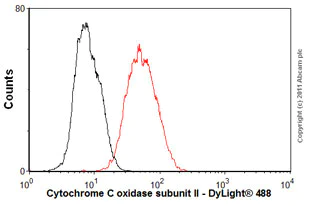
Flow Cytometry (Intracellular) - Anti-MTCO2 antibody [EPR3314] (AB79393)
  • Flow Cyt (Intra)

Unknown

Flow Cytometry (Intracellular) - Anti-MTCO2 antibody [EPR3314] (AB79393)

Overlay histogram showing HepG2 cells stained with ab79393 (red line). The cells were fixed with 4% paraformaldehyde (10 min) and then permeabilized with 0.1% PBS-Tween for 20 min. The cells were then incubated in 1x PBS / 10% normal goat serum / 0.3M glycine to block non-specific protein-protein interactions followed by the antibody (ab79393, 1/50 dilution) for 30 min at 22°C. The secondary antibody used was DyLight® 488 goat anti-rabbit IgG (H+L) (ab96899) at 1/500 dilution for 30 min at 22°C. Isotype control antibody (black line) was rabbit IgG (monoclonal) (1μg/1x106 cells) used under the same conditions. Acquisition of >5,000 events was performed.
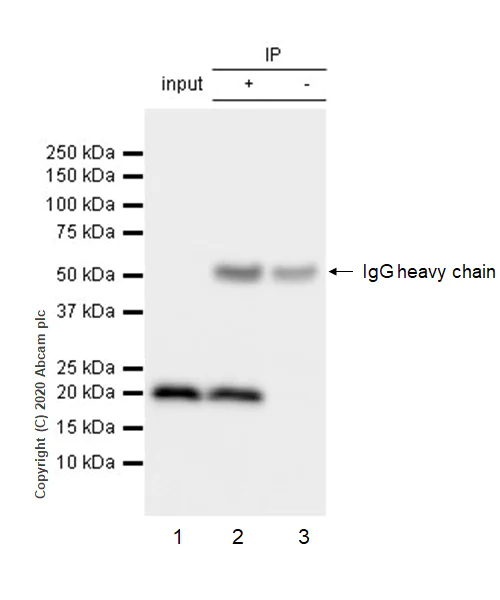
Immunoprecipitation - Anti-MTCO2 antibody [EPR3314] (AB79393)
  • IP

Lab

Immunoprecipitation - Anti-MTCO2 antibody [EPR3314] (AB79393)

Purified ab79393 at 1/50 dilution (2μg) immunoprecipitating MTCO2 in HeLa whole cell lysate.
Lane 1 (input) : HeLa (Human cervix adenocarcinoma epithelial cell) whole cell lysate 10μg
Lane 2 (+) : ab79393 + HeLa whole cell lysate.
Lane 3 (-) : Rabbit monoclonal IgG (ab172730) instead of ab79393 in HeLa whole cell lysate.
VeriBlot for IP Detection Reagent (HRP) (ab131366) (1/1000 dilution) was used for Western blotting.
Blocking Buffer and concentration : 5% NFDM/TBST.
Diluting buffer and concentration : 5% NFDM/TBST.
Observed band size : 21 kDa

All lanes:

Immunoprecipitation - Anti-MTCO2 antibody [EPR3314] (ab79393)

Predicted band size: 25 kDa

false
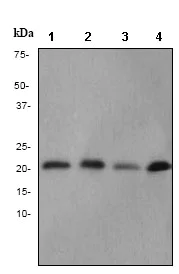
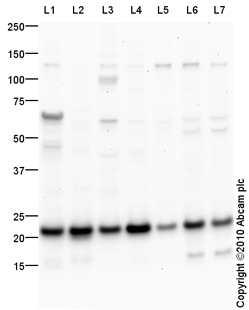
Western blot - Anti-MTCO2 antibody [EPR3314] (AB79393)
  • WB

Unknown

Western blot - Anti-MTCO2 antibody [EPR3314] (AB79393)

All lanes:

Western blot - Anti-MTCO2 antibody [EPR3314] (ab79393) at 1/10000 dilution

Lane 1:

K562 cell lysate at 10 µg

Lane 2:

MCF7 cell lysate at 10 µg

Lane 3:

THP1 cell lysate at 10 µg

Lane 4:

HeLa cell lysate at 10 µg

Secondary

All lanes:

goat anti-rabbit HRP at 1/2000 dilution

Predicted band size: 25 kDa

Observed band size: 21 kDa

false

  • Carrier free

    Anti-MTCO2 antibody [EPR3314] - BSA and Azide free

  • 665 Alexa Fluor® 647

    Alexa Fluor® 647 Anti-MTCO2 antibody [EPR3314]

  • HRP

    HRP Anti-MTCO2 antibody [EPR3314]

Key facts

Host species

Rabbit

Clonality

Monoclonal

Clone number

EPR3314

Isotype

IgG

Carrier free

No

Reacts with

Human

Applications

WB, ICC/IF, Flow Cyt (Intra), IHC-P, IP

applications

Immunogen

The exact immunogen used to generate this antibody is proprietary information.

Reactivity data

{ "title": "Reactivity Data", "filters": { "stats": ["", "Species", "Dilution Info", "Notes"], "tabs": { "all-applications": {"fullname" : "All Applications", "shortname": "All Applications"}, "IP" : {"fullname" : "Immunoprecipitation", "shortname":"IP"}, "WB" : {"fullname" : "Western blot", "shortname":"WB"}, "ICCIF" : {"fullname" : "Immunocytochemistry/ Immunofluorescence", "shortname":"ICC/IF"}, "FlowCytIntra" : {"fullname" : "Flow Cytometry (Intracellular)", "shortname":"Flow Cyt (Intra)"}, "IHCP" : {"fullname" : "Immunohistochemistry (Formalin/PFA-fixed paraffin-embedded sections)", "shortname":"IHC-P"} }, "product-promise": { "all": "all", "testedAndGuaranteed": "tested", "guaranteed": "expected", "predicted": "predicted", "notRecommended": "not-recommended" } }, "values": { "Human": { "IP-species-checked": "testedAndGuaranteed", "IP-species-dilution-info": "1/50", "IP-species-notes": "<p></p>", "WB-species-checked": "testedAndGuaranteed", "WB-species-dilution-info": "1/5000 - 1/10000", "WB-species-notes": "<p></p>", "ICCIF-species-checked": "testedAndGuaranteed", "ICCIF-species-dilution-info": "5 µg/mL", "ICCIF-species-notes": "<p></p>", "FlowCytIntra-species-checked": "testedAndGuaranteed", "FlowCytIntra-species-dilution-info": "1/60", "FlowCytIntra-species-notes": "<p><a href='/en-us/products/primary-antibodies/rabbit-igg-monoclonal-epr25a-isotype-control-ab172730'>ab172730</a> - Rabbit monoclonal IgG, is suitable for use as an isotype control with this antibody.</p>", "IHCP-species-checked": "testedAndGuaranteed", "IHCP-species-dilution-info": "1/100 - 1/250", "IHCP-species-notes": "<p></p> Perform heat-mediated antigen retrieval with Tris/EDTA buffer pH 9.0 before commencing with IHC staining protocol." } } }

Product details

Species reactivity
Mouse, Rat: We have preliminary internal testing data to indicate this antibody may not react with these species.
Please contact us for more information.

Patented technology
Our RabMAb® technology is a patented hybridoma-based technology for making rabbit monoclonal antibodies. For details on our patents, please refer to RabMAb® patents.

What are the advantages of a recombinant monoclonal antibody?
This product is a recombinant monoclonal antibody, which offers several advantages including:

  • - High batch-to-batch consistency and reproducibility
  • - Improved sensitivity and specificity
  • - Long-term security of supply
  • - Animal-free batch production

For more information, read more on recombinant antibodies.

Properties and storage information

Form
Liquid
Purity
Tissue culture supernatant
Storage buffer
pH: 7.2 - 7.4 Preservative: 0.01% Sodium azide Constituents: PBS, 40% Glycerol (glycerin, glycerine), 0.05% BSA
Shipped at conditions
Conditional Ambient
Appropriate short-term storage duration
1-2 weeks
Appropriate short-term storage conditions
+4°C
Appropriate long-term storage conditions
-20°C
Aliquoting information
Upon delivery aliquot
Storage information
Stable for 12 months at -20°C

Supplementary information

This supplementary information is collated from multiple sources and compiled automatically.

'MTCO2' also known as 'mt-co2' or 'mtco2e' is a mitochondrial gene that encodes for a component of the cytochrome c oxidase complex referred to as Complex IV in the electron transport chain. The protein plays a mechanical role in facilitating electron transfer within mitochondria an essential process in cellular respiration. MTCO2 is predominantly expressed in tissues with high energy demands such as muscle and neurons. The known mass of the MTCO2 protein is approximately 25 kDa. It sits in the mitochondrial inner membrane where it contributes to creating the proton gradient driving ATP synthesis.
Biological function summary

MTCO2 (or cytochrome c oxidase subunit II) serves as an important player in aerobic respiration. It is part of the cytochrome c oxidase complex which forms the last enzyme complex of the electron transport chain. As part of this complex MTCO2 facilitates the transfer of electrons from cytochrome c to oxygen resulting in the reduction of oxygen to water. This electron transfer is paired with proton translocation across the mitochondrial membrane which is critical for ATP production.

Pathways

MTCO2 contributes significantly to the oxidative phosphorylation pathway which is essential for ATP production in eukaryotic cells. It directly interacts with other components of the mitochondrial electron transport chain like cytochrome c and NADH dehydrogenase which are critical for maintaining the flow of electrons and the integrity of the energy production process. Another pathway it is part of is the apoptosis pathway regulated by non-lethal stress conditions where controlled release of cytochrome c can trigger programmed cell death.

MTCO2 mutations and dysfunctions have been linked with mitochondrial disorders especially those affecting energy-demanding tissues leading to conditions such as mitochondrial myopathy and Leber's hereditary optic neuropathy. These disorders result from compromised oxidative phosphorylation leading to inadequate energy supply. The dysfunction of cytochrome c oxidase which contains the MTCO2 subunit is a central aspect of these diseases often tying this protein to other complexes within the electron transport chain that also underpin mitochondrial diseases.

Product protocols

For this product, it's our understanding that no specific protocols are required. You can visit:

Target data

Component of the cytochrome c oxidase, the last enzyme in the mitochondrial electron transport chain which drives oxidative phosphorylation. The respiratory chain contains 3 multisubunit complexes succinate dehydrogenase (complex II, CII), ubiquinol-cytochrome c oxidoreductase (cytochrome b-c1 complex, complex III, CIII) and cytochrome c oxidase (complex IV, CIV), that cooperate to transfer electrons derived from NADH and succinate to molecular oxygen, creating an electrochemical gradient over the inner membrane that drives transmembrane transport and the ATP synthase. Cytochrome c oxidase is the component of the respiratory chain that catalyzes the reduction of oxygen to water. Electrons originating from reduced cytochrome c in the intermembrane space (IMS) are transferred via the dinuclear copper A center (CU(A)) of subunit 2 and heme A of subunit 1 to the active site in subunit 1, a binuclear center (BNC) formed by heme A3 and copper B (CU(B)). The BNC reduces molecular oxygen to 2 water molecules using 4 electrons from cytochrome c in the IMS and 4 protons from the mitochondrial matrix.
See full target information MT-CO2

Alternative Names

COII, COX2, COXII, MTCO2, MT-CO2, Cytochrome c oxidase subunit 2, Cytochrome c oxidase polypeptide II

Publications (50)

Recent publications for all applications. Explore the full list and refine your search

International journal of biological sciences 21:5393-5410 PubMed40959270

2025

Altered Heme and Redox Homeostasis Underpin Late-onset Alzheimer's Disease.

Applications

Unspecified application

Species

Unspecified reactive species

Adedamola Saidi Soladogun,Chantal Vidal,Maria Del Carmen Chacon Castro,Heng Du,Li Zhang

International journal of molecular sciences 26: PubMed40362193

2025

Mitochondrial Oxidative Phosphorylation Alterations in Placental Tissues from Early- and Late-Onset Preeclampsia.

Applications

Unspecified application

Species

Unspecified reactive species

Theresa Lehenauer,Heidi Jaksch-Bogensperger,Sara Huber,Daniel Weghuber,Thorsten Fischer,Johannes A Mayr,Barbara Kofler,Bettina Neumayer,Daniel Gharehbaghi,Michaela Duggan-Peer,Maximilian Brandstetter,Claudius Fazelnia,René G Feichtinger

Antioxidants (Basel, Switzerland) 14: PubMed40002401

2025

Polydatin and Nicotinamide Prevent Iron Accumulation and Lipid Peroxidation in Cellular Models of Mitochondrial Diseases.

Applications

Unspecified application

Species

Unspecified reactive species

Paula Cilleros-Holgado,David Gómez-Fernández,Rocío Piñero-Pérez,José Manuel Romero-Domínguez,Diana Reche-López,Mónica Álvarez-Córdoba,Ana Romero-González,Alejandra López-Cabrera,Marta Castro De Oliveira,Andrés Rodríguez-Sacristán,Susana González-Granero,José Manuel García-Verdugo,José Antonio Sánchez-Alcázar

International journal of molecular sciences 26: PubMed39941083

2025

Biotin Induces Inactive Chromosome X Reactivation and Corrects Physiopathological Alterations in Beta-Propeller-Protein-Associated Neurodegeneration.

Applications

Unspecified application

Species

Unspecified reactive species

Diana Reche-López,Ana Romero-González,Mónica Álvarez-Córdoba,Alejandra Suárez-Carrillo,Paula Cilleros-Holgado,Rocío Piñero-Pérez,David Gómez-Fernández,José Manuel Romero-Domínguez,Alejandra López-Cabrera,Susana González-Granero,José Manuel García-Verdugo,José A Sánchez-Alcázar

Advanced science (Weinheim, Baden-Wurttemberg, Germany) 12:e2408599 PubMed39656941

2024

Enhanced Oxidative Phosphorylation Driven by TACO1 Mitochondrial Translocation Promotes Stemness and Cisplatin Resistance in Bladder Cancer.

Applications

Unspecified application

Species

Unspecified reactive species

Minhua Deng,Zhaohui Zhou,Jiawei Chen,Xiangdong Li,Zefu Liu,Jingwei Ye,Wensu Wei,Ning Wang,Yulu Peng,Xin Luo,Lijuan Jiang,Fangjian Zhou,Xianchong Zheng,Zhuowei Liu

iScience 27:110185 PubMed39015150

2024

Supernumerary proteins of the human mitochondrial ribosomal small subunit are integral for assembly and translation.

Applications

Unspecified application

Species

Unspecified reactive species

Taru Hilander,Ryan Awadhpersad,Geoffray Monteuuis,Krystyna L Broda,Max Pohjanpelto,Elizabeth Pyman,Sachin Kumar Singh,Tuula A Nyman,Isabelle Crevel,Robert W Taylor,Ann Saada,Diego Balboa,Brendan J Battersby,Christopher B Jackson,Christopher J Carroll

Acta pharmaceutica Sinica. B 14:2153-2176 PubMed38799623

2024

5-Heudelotinone alleviates experimental colitis by shaping the immune system and enhancing the intestinal barrier in a gut microbiota-dependent manner.

Applications

Unspecified application

Species

Unspecified reactive species

Qing Meng,Jianshuang Guo,Ke Lv,Yang Liu,Jin Zhang,Mingyue Li,Xirui Cheng,Shenghua Chen,Xiaoguang Huo,Quan Zhang,Yue Chen,Jing Li

Nature communications 15:4195 PubMed38760351

2024

Ferritinophagy mediates adaptive resistance to EGFR tyrosine kinase inhibitors in non-small cell lung cancer.

Applications

Unspecified application

Species

Unspecified reactive species

Hui Wang,Qianfan Hu,Yuzhong Chen,Xing Huang,Yipeng Feng,Yuanjian Shi,Rutao Li,Xuewen Yin,Xuming Song,Yingkuan Liang,Te Zhang,Lin Xu,Gaochao Dong,Feng Jiang

Molecular cancer research : MCR 22:197-208 PubMed37878010

2023

Mitochondrial Translocase TOMM22 Is Overexpressed in Pancreatic Cancer and Promotes Aggressive Growth by Modulating Mitochondrial Protein Import and Function.

Applications

Unspecified application

Species

Unspecified reactive species

Mary Oluwadamilola Haastrup,Kunwar Somesh Vikramdeo,Shashi Anand,Mohammad Aslam Khan,James Elliot Carter,Seema Singh,Ajay Pratap Singh,Santanu Dasgupta

International journal of molecular sciences 24: PubMed37569523

2023

Treprostinil Reconstitutes Mitochondrial Organisation and Structure in Idiopathic Pulmonary Fibrosis Cells.

Applications

Unspecified application

Species

Unspecified reactive species

Lei Fang,Wei-Chih Chen,Peter Jaksch,Antonio Molino,Alessandro Saglia,Michael Roth,Christopher Lambers
View all publications

Product promise

We are committed to supporting your work with high-quality reagents, and we're here for you every step of the way. In the unlikely event that one of our products does not perform as expected, you're protected by our Product Promise.
For full details, please see our Terms & Conditions

Please note: All products are 'FOR RESEARCH USE ONLY. NOT FOR USE IN DIAGNOSTIC OR THERAPEUTIC PROCEDURES'.

For licensing inquiries, please contact partnerships@abcam.com