Anti-Muscarinic Acetylcholine Receptor 2/CM2 antibody [31-1D1]
3
(7 Reviews)
|
(16 Publications )
- IHC-P
Unknown
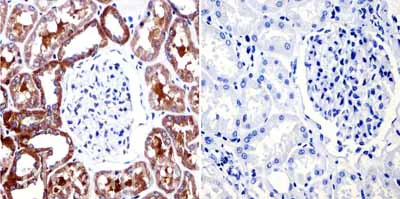
Immunohistochemistry (Formalin/PFA-fixed paraffin-embedded sections) - Anti-Muscarinic Acetylcholine Receptor 2/CM2 antibody [31-1D1] (AB2805)
Immunohistochemistry was performed on normal biopsies of deparaffinized human kidney tissue. To expose target proteins heat induced antigen retrieval was performed using 10mM sodium citrate (pH6.0) buffer and microwaved for 8-15 minutes. Following antigen retrieval tissues were blocked in 3% BSA-PBS for 30 minutes at room temperature. Tissues were then probed at a dilution of 1 : 20 with a Mouse monoclonal antibody recognizing Muscarinic Acetylcholine Receptor 2/CM2 (ab2805) or without primary antibody (negative control) overnight at 4°C in a humidified chamber. Tissues were washed extensively with PBST and endogenous peroxidase activity was quenched with a peroxidase suppressor. Detection was performed using a biotin-conjugated secondary antibody and SA-HRP followed by colorimetric detection using DAB. Tissues were counterstained with hematoxylin and prepped for mounting.
- ICC/IF
Lab
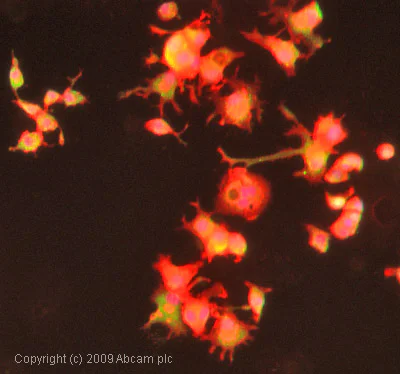
Immunocytochemistry/ Immunofluorescence - Anti-Muscarinic Acetylcholine Receptor 2/CM2 antibody [31-1D1] (AB2805)
ICC/IF image of ab2805 stained PC12 cells. The cells were 4% PFA fixed (10 min) and then incubated in 1%BSA / 10% normal goat serum / 0.3M glycine in 0.1% PBS-Tween for 1h to permeabilise the cells and block non-specific protein-protein interactions. The cells were then incubated with the antibody (ab2805, 5µg/ml) overnight at +4°C. The secondary antibody (green) was Alexa Fluor® 488 goat anti-mouse IgG (H+L) used at a 1/1000 dilution for 1h. Alexa Fluor® 594 WGA was used to label plasma membranes (red) at a 1/200 dilution for 1h. DAPI was used to stain the cell nuclei (blue) at a concentration of 1.43µM.
Alternative Products
Complementary Products
Primary Antibodies
AB32570
Anti-PDGFR alpha + PDGFR beta antibody [Y92] - C-terminal
20ul selling size|BOND RX™ Validated|RabMAb|Recombinant|KO Validated

- 4
- 31
Primary Antibodies
AB183734
RabMAb|Recombinant|Lab Essentials|20ul selling size
- 5
- 24
Primary Antibodies
AB124964
Anti-alpha smooth muscle Actin antibody [EPR5368]
BOND RX™ Validated|RabMAb|Recombinant|KO Validated|20ul selling size

- 5
- 19
Reactivity data
Properties and storage information
Form
Purification technique
Storage buffer
Shipped at conditions
Appropriate short-term storage duration
Appropriate short-term storage conditions
Appropriate long-term storage conditions
Aliquoting information
Storage information
Supplementary information
This supplementary information is collated from multiple sources and compiled automatically.
Biological function summary
Muscarinic acetylcholine receptors perform diverse functions participating in the regulation of autonomic nervous system responses. M2 receptors are not part of a large protein complex but function closely with other GPCRs to maintain homeostasis. They modulate the activity of various ion channels contributing to their role in cardiac physiological processes. Anti-muscarinic antibodies can specifically target M2 for therapeutic interventions which further helps in dissecting their biological functionality.
Pathways
M2 receptors play essential roles in both the autonomic nervous system and the cardiovascular system. They are involved in the cholinergic signaling pathway which modulates heart rate by influencing ion channel activity and reducing intracellular cAMP levels. Their interaction with proteins like G-proteins and ion channels such as Kir3.1 underlines their importance in these pathways. M2 muscarinic receptors are closely linked with other muscarinic receptors showing a collaborative action in signaling cascades.
Product protocols
- Visit the General protocols
- Visit the Troubleshooting
Target data
Additional targets
Alternative Names
Publications (16)
Recent publications for all applications. Explore the full listand refine your search
Cell death discovery 11:170 PubMed40222967
2025
Applications
Unspecified application
Species
Unspecified reactive species
Heliyon 10:e36207 PubMed39253121
2024
Applications
Unspecified application
Species
Unspecified reactive species
Frontiers in cardiovascular medicine 9:934906 PubMed36187006
2022
Applications
Unspecified application
Species
Unspecified reactive species
Journal of cellular physiology 236:6581-6596 PubMed33615478
2021
Applications
Unspecified application
Species
Unspecified reactive species
BMC urology 19:62 PubMed31288793
2019
Applications
Unspecified application
Species
Unspecified reactive species
Theranostics 9:4241-4254 PubMed31281545
2019
Applications
Unspecified application
Species
Unspecified reactive species
Cardiology research and practice 2019:8271871 PubMed30863630
2019
Applications
Unspecified application
Species
Unspecified reactive species
Neuroscience bulletin 35:67-78 PubMed30318562
2018
Applications
Unspecified application
Species
Unspecified reactive species
Peptides 111:132-141 PubMed29969648
2018
Applications
Unspecified application
Species
Unspecified reactive species
Journal of neuroscience methods 304:11-23 PubMed29660368
2018
Applications
Flow Cyt
Species
Rat
Product promise
Please note: All products are 'FOR RESEARCH USE ONLY. NOT FOR USE IN DIAGNOSTIC OR THERAPEUTIC PROCEDURES'.
For licensing inquiries, please contact partnerships@abcam.com