JavaScript is disabled in your browser. Please enable JavaScript to view this website.
AB103924

Anti-Myogenin antibody

4

(1 Review)

|

(4 Publications )
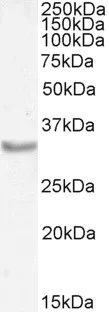
Goat Polyclonal Myogenin antibody. Suitable for WB and reacts with Mouse samples. Cited in 4 publications. Immunogen corresponding to Synthetic Peptide within Human MYOG aa 150 to C-terminus.
1 Images
Western blot - Anti-Myogenin antibody (AB103924)
  • WB

Supplier Data

Western blot - Anti-Myogenin antibody (AB103924)

All lanes:

Western blot - Anti-Myogenin antibody (ab103924) at 2 µg/mL

All lanes:

Mouse Skeletal Muscle lysate in RIPA buffer at 35 µg

Predicted band size: 25 kDa

Observed band size: 38 kDa

true

Key facts

Host species

Goat

Clonality

Polyclonal

Isotype

IgG

Carrier free

No

Reacts with

Mouse

Applications

WB

applications

Immunogen

Synthetic Peptide within Human MYOG aa 150 to C-terminus. The exact immunogen used to generate this antibody is proprietary information.

P15173

Reactivity data

{ "title": "Reactivity Data", "filters": { "stats": ["", "Species", "Dilution Info", "Notes"], "tabs": { "all-applications": {"fullname" : "All Applications", "shortname": "All Applications"}, "WB" : {"fullname" : "Western blot", "shortname":"WB"} }, "product-promise": { "all": "all", "testedAndGuaranteed": "tested", "guaranteed": "expected", "predicted": "predicted", "notRecommended": "not-recommended" } }, "values": { "Human": { "WB-species-checked": "predicted", "WB-species-dilution-info": "", "WB-species-notes": "" }, "Mouse": { "WB-species-checked": "testedAndGuaranteed", "WB-species-dilution-info": "2-4 µg/mL", "WB-species-notes": "<p>A 1 hour primary incubation is recommended for this product.</p>" }, "Rat": { "WB-species-checked": "predicted", "WB-species-dilution-info": "", "WB-species-notes": "" }, "Cow": { "WB-species-checked": "predicted", "WB-species-dilution-info": "", "WB-species-notes": "" }, "Dog": { "WB-species-checked": "predicted", "WB-species-dilution-info": "", "WB-species-notes": "" }, "Goat": { "WB-species-checked": "predicted", "WB-species-dilution-info": "", "WB-species-notes": "" }, "Pig": { "WB-species-checked": "predicted", "WB-species-dilution-info": "", "WB-species-notes": "" }, "Rabbit": { "WB-species-checked": "predicted", "WB-species-dilution-info": "", "WB-species-notes": "" }, "Sheep": { "WB-species-checked": "predicted", "WB-species-dilution-info": "", "WB-species-notes": "" } } }

Properties and storage information

Form
Liquid
Purification technique
Affinity purification Immunogen
Purification notes
ab103924 was purified from goat serum by ammonium sulphate precipitation followed by antigen affinity chromatography using the immunizing peptide.
Storage buffer
pH: 7.3 Preservative: 0.02% Sodium azide Constituents: Tris buffered saline, 0.5% BSA
Shipped at conditions
Blue Ice
Appropriate short-term storage conditions
+4°C
Appropriate long-term storage conditions
-20°C
Aliquoting information
Upon delivery aliquot
Storage information
Avoid freeze / thaw cycle

Supplementary information

This supplementary information is collated from multiple sources and compiled automatically.

Myogenin also known as MYOG is a muscle-specific transcription factor that plays an important role in the regulation of muscle differentiation and development. It belongs to the MyoD family of basic helix-loop-helix proteins. Myogenin has a molecular weight of approximately 34 to 39 kDa. It is typically expressed in skeletal muscle tissues aiding in the transition from proliferating myoblasts to differentiated myotubes. Immunohistochemistry (IHC) methods often use myogenin antibodies like the 'myogenin anticuerpo' and 'F5D' to identify myogenin expression within tissue samples facilitating the understanding of muscle tissue organization and development.
Biological function summary

Myogenin functions in controlling the transcription of muscle-specific genes that are essential during myogenesis. This transcription factor forms heterodimers with E-proteins becoming part of DNA-binding complexes that activate the transcription of muscle-specific genes. Myogenin's presence is critical during muscle cell fusion and maturation signifying its importance in proper muscle tissue formation and maintenance. Myogenin staining is often used as a technique to study muscle differentiation in various experimental settings.

Pathways

Myogenin is integrated into the myogenic regulatory network where it activates genes involved in muscle fiber maturation. It participates in the MyoD regulatory pathway working alongside other myogenic regulatory factors like MyoD Myf5 and MRF4. These proteins create a coordinated network ensuring efficient muscle cell differentiation and growth. The cross-talk between myogenin and these factors highlights its role in the intricate web of gene regulation necessary for muscle development.

The altered expression or mutation of the myogenin gene has potential implications in muscular dystrophies and myopathies. For instance disruptions in myogenin activity can lead to impaired muscle repair and regeneration contributing to the pathology of conditions such as rhabdomyosarcoma. Within these contexts myogenin associates with other proteins like MyoD whose expression might also be altered further accentuating the disruption in normal muscle differentiation processes during disease states.

Product protocols

For this product, it's our understanding that no specific protocols are required. You can visit:

Target data

Acts as a transcriptional activator that promotes transcription of muscle-specific target genes and plays a role in muscle differentiation, cell cycle exit and muscle atrophy. Essential for the development of functional embryonic skeletal fiber muscle differentiation. However is dispensable for postnatal skeletal muscle growth; phosphorylation by CAMK2G inhibits its transcriptional activity in respons to muscle activity. Required for the recruitment of the FACT complex to muscle-specific promoter regions, thus promoting gene expression initiation. During terminal myoblast differentiation, plays a role as a strong activator of transcription at loci with an open chromatin structure previously initiated by MYOD1. Together with MYF5 and MYOD1, co-occupies muscle-specific gene promoter core regions during myogenesis. Also cooperates with myocyte-specific enhancer factor MEF2D and BRG1-dependent recruitment of SWI/SNF chromatin-remodeling enzymes to alter chromatin structure at myogenic late gene promoters. Facilitates cell cycle exit during terminal muscle differentiation through the up-regulation of miR-20a expression, which in turn represses genes involved in cell cycle progression. Binds to the E-box containing (E1) promoter region of the miR-20a gene. Also plays a role in preventing reversal of muscle cell differentiation. Contributes to the atrophy-related gene expression in adult denervated muscles. Induces fibroblasts to differentiate into myoblasts (By similarity).
See full target information MYOG

Alternative Names

BHLHC3, MYF4, MYOG, Myogenin, Class C basic helix-loop-helix protein 3, Myogenic factor 4, bHLHc3, Myf-4

Publications (4)

Recent publications for all applications. Explore the full listand refine your search

Journal of cachexia, sarcopenia and muscle 16:e13708 PubMed39887939

2025

Defective Cystic Fibrosis Transmembrane Conductance Regulator Accelerates Skeletal Muscle Aging by Impairing Autophagy/Myogenesis.

Applications

Unspecified application

Species

Unspecified reactive species

Ziyi Chen,Jiankun Xu,Peijie Hu,Wanting Du,Junjiang Chen,Xiaotian Zhang,Wei Zhou,Jiayang Gao,Yuantao Zhang,Bingyang Dai,Guangshuai Nie,Jun Hu,Liangbin Zhou,Shunxiang Xu,Hisao Chang Chan,Wing-Hoi Cheung,Ye Chun Ruan,Ling Qin

Epigenetics 17:1686-1700 PubMed35348434

2022

Circ promotes myoblast proliferation and inhibits differentiation by sponging to release .

Applications

Unspecified application

Species

Unspecified reactive species

Jian Wang,Yifan Wen,Jiawei Xu,Binglin Yue,Jialin Zhong,Li Zheng,Chuzhao Lei,Hong Chen,Yongzhen Huang

Tissue engineering. Part A 26:167-177 PubMed31469044

2019

A Comparison of Ovine Facial and Limb Muscle as a Primary Cell Source for Engineered Skeletal Muscle.

Applications

Unspecified application

Species

Unspecified reactive species

Brittany L Rodriguez,Matthew H Nguyen,Rachel E Armstrong,Emmanuel E Vega-Soto,Phillip M Polkowski,Lisa M Larkin

Journal of cellular physiology 233:350-362 PubMed28256014

2017

Transcription factor EGR1 promotes differentiation of bovine skeletal muscle satellite cells by regulating MyoG gene expression.

Applications

Unspecified application

Species

Unspecified reactive species

WeiWei Zhang,HuiLi Tong,ZiHeng Zhang,ShuLi Shao,Dan Liu,ShuFeng Li,YunQin Yan
View all publications

Product promise

We are committed to supporting your work with high-quality reagents, and we're here for you every step of the way. In the unlikely event that one of our products does not perform as expected, you're protected by our Product Promise.
For full details, please see our Terms & Conditions

Please note: All products are 'FOR RESEARCH USE ONLY. NOT FOR USE IN DIAGNOSTIC OR THERAPEUTIC PROCEDURES'.

For licensing inquiries, please contact partnerships@abcam.com