Anti-n-Myc/MYCN antibody [EPR18982-13]
- RabMAb
- Recombinant
- What is this?
Be the first to review this product! Submit a review
|
(2 Publications )
- IP
Supplier Data
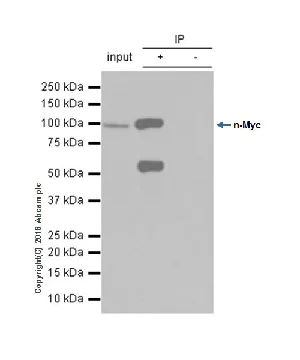
Immunoprecipitation - Anti-n-Myc/MYCN antibody [EPR18982-13] (AB189528)
n-Myc/MYCN was immunoprecipitated from 2μg of HEK-293 (Human epithelial cell line from embryonic kidney) whole cell lysates with ab194094 at 1/40 dilution.
Western blot was performed from the immunoprecipitate using ab189528 at 1/1000 dilution.
VeriBlot for IP Detection Reagent (HRP) (ab131366), was used for detection at 1/10000 dilution.
Lane 1 : HEK-293 whole cell lysate transfected with GFP-tagged n-Myc/MYCN construct, 10ug (Input).
Lane 2 : ab189528 IP in HEK-293 whole cell lysate transfected with GFP-tagged n-Myc/MYCN construct.
Lane 3 : Rabbit IgG, monoclonal [EPR25A] - Isotype Control (ab172730) instead of ab189528 IP in HEK-293 whole cell lysate transfected with GFP-tagged n-Myc/MYCN construct.
Blocking and dilution buffer and concentration : 5% NFDM/TBST.
Exposure time : 30 seconds.
ab189528 immuno-precipitated the overexpressed n-Myc/MYCN-GFP (~100 kDa) in the transfected HEK-293 lysate and an additional 50 kDa off-target band. The overexpressed n-Myc/MYCN-GFP was recognized by ab290 (anti-GFP antibody, IP #2) and ab16898 (anti-n-Myc/MYCN antibody, IP #3).
All lanes:
Immunoprecipitation - Anti-n-Myc/MYCN antibody [EPR18982-13] (ab189528)
Predicted band size: 50 kDa,57 kDa
Observed band size: 50 kDa
false
Exposure time: 30s
- IP
Supplier Data
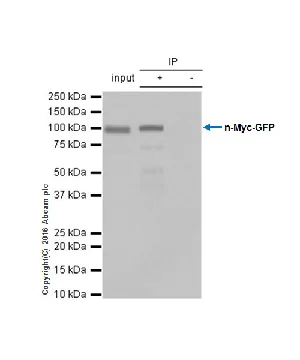
Immunoprecipitation - Anti-n-Myc/MYCN antibody [EPR18982-13] (AB189528)
n-Myc/MYCN was immunoprecipitated from 2μg of HEK-293 (Human epithelial cell line from embryonic kidney) whole cell lysates with ab189528 at 1/40 dilution.
Western blot was performed from the immunoprecipitate using ab290 at 1/2000 dilution.
VeriBlot for IP Detection Reagent (HRP) (ab131366), was used for detection at 1/1000 dilution.
Lane 1 : HEK-293 whole cell lysate transfected with n-Myc/MYCN, 10ug (Input).
Lane 2 : ab189528 IP in HEK-293 whole cell lysate transfected with GFP-tagged n-Myc/MYCN construct.
Lane 3 : Rabbit IgG, monoclonal [EPR25A] - Isotype Control (ab172730) instead of ab189528 IP in HEK-293 whole cell lysate transfected with GFP-tagged n-Myc/MYCN construct.
Blocking and dilution buffer and concentration : 5% NFDM/TBST.
Exposure time : 30 seconds.
All lanes:
Immunoprecipitation - Anti-n-Myc/MYCN antibody [EPR18982-13] (ab189528)
Predicted band size: 50 kDa
false
- IP
Supplier Data
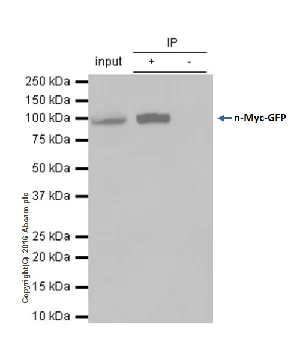
Immunoprecipitation - Anti-n-Myc/MYCN antibody [EPR18982-13] (AB189528)
n-Myc/MYCN was immunoprecipitated from 2μg of HEK-293 (Human epithelial cell line from embryonic kidney) whole cell lysates with ab189528 at 1/40 dilution.
Western blot was performed from the immunoprecipitate using ab16898 at 1/1000 dilution.
Goat Anti-Mouse IgG (H+L) Peroxidase Conjugate, was used as secondary antibody at 1/10000 dilution.
Lane 1 : HEK-293 whole cell lysate transfected with GFP-tagged n-Myc/MYCN construct, 10ug (Input).
Lane 2 : ab189528 IP in HEK-293 whole cell lysate transfected with GFP-tagged n-Myc/MYCN construct.
Lane 3 : Rabbit IgG, monoclonal [EPR25A] - Isotype Control (ab172730) instead of ab189528 IP in HEK-293 whole cell lysate transfected with GFP-tagged n-Myc/MYCN construct.
Blocking and dilution buffer and concentration : 5% NFDM/TBST.
Exposure time : 1 second.
All lanes:
Immunoprecipitation - Anti-n-Myc/MYCN antibody [EPR18982-13] (ab189528)
Predicted band size: 50 kDa
false
- WB
Supplier Data
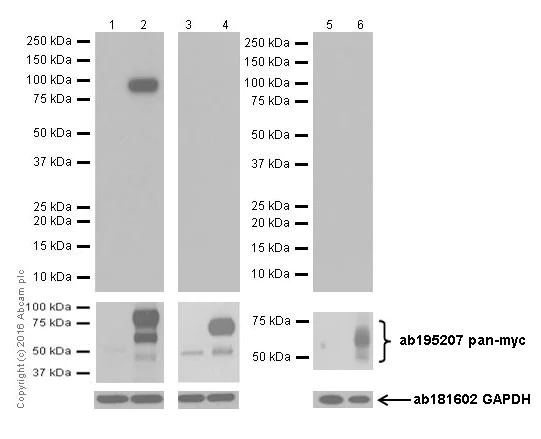
Western blot - Anti-n-Myc/MYCN antibody [EPR18982-13] (AB189528)
Blocking/Dilution buffer : 5% NFDM/TBST.
n-Myc/MYCN is tagged with GFP, therefore its expected MW is 83 kD under these conditions.
All lanes:
Western blot - Anti-n-Myc/MYCN antibody [EPR18982-13] (ab189528) at 1/1000 dilution
Lanes 1, 3 and 5:
Untransfected HEK-293 (Human epithelial cell line from embryonic kidney) whole cell lysate (control) at 20 µg
Lane 2:
HEK-293 (Human epithelial cell line from embryonic kidney) whole cell lysate transfected with n-Myc/MYCN with GFP-tag at 20 µg
Lane 4:
HEK-293 (Human epithelial cell line from embryonic kidney) whole cell lysate transfected with l-Myc with GST-tag at 20 µg
Lane 6:
HEK-293 (Human epithelial cell line from embryonic kidney) whole cell lysate transfected with c-Myc with His-tag at 20 µg
Secondary
All lanes:
Western blot - Goat Anti-Rabbit IgG H&L (HRP) (<a href='/en-us/products/secondary-antibodies/goat-rabbit-igg-h-l-hrp-ab97051'>ab97051</a>) at 1/100000 dilution
Predicted band size: 50 kDa
Observed band size: 83 kDa
false
Exposure time: 3min
Related conjugates and formulations (1)
-
Anti-n-Myc/MYCN antibody [EPR18982-13] - BSA and Azide free
Alternative Products


Primary Antibodies
AB227822
Anti-n-Myc/MYCN antibody [EPR18982-8R-3] - ChIP Grade
20ul selling size|RabMAb|Recombinant

- 0
- 0
Primary Antibodies
AB236459
Anti-n-Myc/MYCN antibody [EPR18982-8R-3] - BSA and Azide free
RabMAb|Recombinant

- 0
- 0
Complementary Products
Sample Prep & Detection Kits
AB201795
Biotinylation Kit / Biotin Conjugation Kit (Fast, Type A) - Lightning-Link®

- 0
- 0
Primary Antibodies
AB32072
Anti-c-Myc antibody [Y69] - ChIP Grade
BOND RX™ Validated|KO Validated|RabMAb|Recombinant|Lab Essentials|20ul selling size|Advanced Validation

- 4
- 56

Primary Antibodies
AB16663
20ul selling size|BOND RX™ Validated|RabMAb|Recombinant|KO Validated|Lab Essentials

- 4
- 23
Reactivity data
Product details
Patented technology
Our RabMAb® technology is a patented hybridoma-based technology for making rabbit monoclonal antibodies. For details on our patents, please refer to RabMAb® patents.
What are the advantages of a recombinant monoclonal antibody?
This product is a recombinant monoclonal antibody, which offers several advantages including:
- - High batch-to-batch consistency and reproducibility
- - Improved sensitivity and specificity
- - Long-term security of supply
- - Animal-free batch production
For more information, read more on recombinant antibodies.
Properties and storage information
Form
Purification technique
Storage buffer
Shipped at conditions
Appropriate short-term storage duration
Appropriate short-term storage conditions
Appropriate long-term storage conditions
Aliquoting information
Storage information
Supplementary information
This supplementary information is collated from multiple sources and compiled automatically.
Biological function summary
N-Myc/MYCN functions in gene regulation by binding to E-box sequences in DNA facilitating transcription of genes essential for cellular growth and metabolism. n-Myc often forms a heterodimer with the MAX protein which enhances its DNA-binding capacity and transcriptional activity. This activity influences processes like apoptosis cell differentiation and cell cycle progression. The ncm mouse model a genetically engineered mouse with MYCN overexpression demonstrates the effects of deregulated n-Myc expression.
Pathways
MYCN significantly impacts the p53 signaling pathway and the Wnt signaling pathway. In the p53 signaling pathway n-Myc interacts with p53 and MDM2 regulating cell cycle checkpoints and apoptosis. In the Wnt pathway MYCN interplays with molecules like β-catenin to influence cell division and differentiation. These interactions highlight the role of n-Myc in maintaining cellular homeostasis and response to external signals that affect growth and division.
Product protocols
- Visit the General protocols
- Visit the Troubleshooting
Target data
Alternative Names
Publications (2)
Recent publications for all applications. Explore the full listand refine your search
Materials today. Bio 34:102242 PubMed40917511
2025
Applications
Unspecified application
Species
Unspecified reactive species
Aging 14:5464-5477 PubMed35802536
2022
Applications
Unspecified application
Species
Unspecified reactive species
Product promise
Please note: All products are 'FOR RESEARCH USE ONLY. NOT FOR USE IN DIAGNOSTIC OR THERAPEUTIC PROCEDURES'.
For licensing inquiries, please contact partnerships@abcam.com