Anti-NAPSIN A antibody [EPR6257]
- RabMAb
- Recombinant
- What is this?
Be the first to review this product! Submit a review
|
(4 Publications )
- IHC-P
Unknown
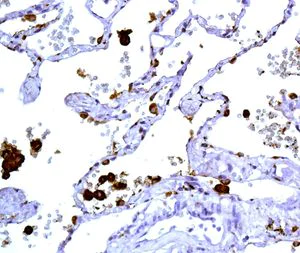
Immunohistochemistry (Formalin/PFA-fixed paraffin-embedded sections) - Anti-NAPSIN A antibody [EPR6257] (AB129189)
Immunohistochemistry (Formalin/PFA-fixed paraffin-embedded sections) analysis of human lung tissue labelling NAPSIN A with unpurified ab129189 at a dilution of 1/100.
Perform heat mediated antigen retrieval before commencing with IHC staining protocol.
- IHC-P
Lab
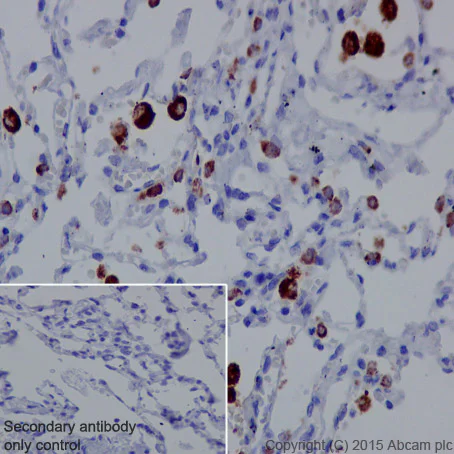
Immunohistochemistry (Formalin/PFA-fixed paraffin-embedded sections) - Anti-NAPSIN A antibody [EPR6257] (AB129189)
Immunohistochemistry (Formalin/PFA-fixed paraffin-embedded sections) analysis of human lung tissue labelling NAPSIN A with purified ab129189 at a dilution of 1/500. Heat mediated antigen retrieval was performed using Tris/EDTA buffer pH 9. ab97051 a HRP-conjugated goat anti-rabbit IgG (H+L) was used as the secondary antibody (1/500). Negative control using PBS instead of primary antibody. Counterstained with hematoxylin.
- WB
Lab
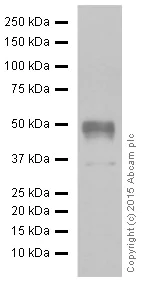
Western blot - Anti-NAPSIN A antibody [EPR6257] (AB129189)
Blocking and dilution buffer : 5% NFDM /TBST.
All lanes:
Western blot - Anti-NAPSIN A antibody [EPR6257] (ab129189) at 1/5000 dilution
All lanes:
Human lung adenocarcinoma tissue lysate at 20 µg
Secondary
All lanes:
HRP-conjugated goat anti-rabbit IgG (specific to the non-reduced form of IgG) at 1/1000 dilution
Predicted band size: 45 kDa
Observed band size: 50 kDa
false
- WB
Unknown
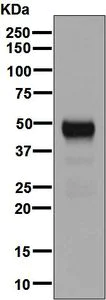
Western blot - Anti-NAPSIN A antibody [EPR6257] (AB129189)
All lanes:
Western blot - Anti-NAPSIN A antibody [EPR6257] (ab129189) at 1/1000 dilution
All lanes:
Human lung adenocarcinoma lysate at 10 µg
Secondary
All lanes:
HRP-conjugated goat anti-rabbit IgG at 1/2000 dilution
Predicted band size: 45 kDa
false
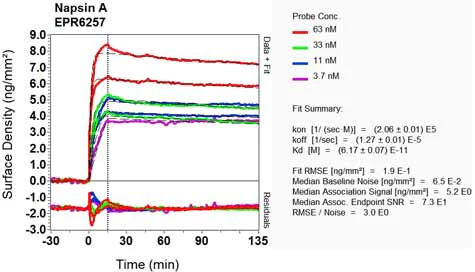
- OI-RD Scanning
Unknown
OI-RD Scanning - Anti-NAPSIN A antibody [EPR6257] (AB129189)
We have systematically measured KD (the equilibrium dissociation constant between the antibody and its antigen), of more than 840 recombinant antibodies to assess not only their individual KD values but also to see the average affinity of antibody. Based on the comparison with published literature values for mouse monoclonal antibodies, Recombinant antibodies appear to be on average 1-2 order of magnitude higher affinity.
Related conjugates and formulations (8)
-
Anti-NAPSIN A antibody [EPR6257] - BSA and Azide free
-
660 APC
APC Anti-NAPSIN A antibody [EPR6257]
-
519 Alexa Fluor® 488
Alexa Fluor® 488 Anti-NAPSIN A antibody [EPR6257]
-
565 Alexa Fluor® 555
Alexa Fluor® 555 Anti-NAPSIN A antibody [EPR6257]
-
617 Alexa Fluor® 594
Alexa Fluor® 594 Anti-NAPSIN A antibody [EPR6257]
-
665 Alexa Fluor® 647
Alexa Fluor® 647 Anti-NAPSIN A antibody [EPR6257]
-
775 Alexa Fluor® 750
Alexa Fluor® 750 Anti-NAPSIN A antibody [EPR6257]
-
578 PE
PE Anti-NAPSIN A antibody [EPR6257]
Alternative Products

Primary Antibodies
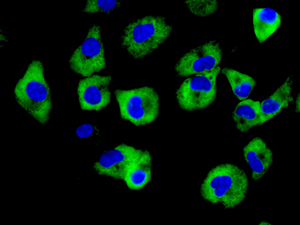
AB133249
Anti-NAPSIN A antibody [EPR6252]
20ul selling size|RabMAb|Recombinant
- 0
- 0
Complementary Products
Primary Antibodies
AB76013
Anti-TTF1/Nkx2-1 antibody [EP1584Y]
RabMAb|Recombinant|20ul selling size

- 5
- 18
Primary Antibodies
AB181598
Anti-Cytokeratin 7 antibody [EPR17078] - Cytoskeleton Marker
20ul selling size|KO Validated|RabMAb|Recombinant|Lab Essentials

- 5
- 13
Primary Antibodies
AB76126
Anti-Cytokeratin 20 antibody [EPR1622Y] - Cytoskeleton Marker
RabMAb|Recombinant|Lab Essentials|20ul selling size

- 5
- 17
Primary Antibodies
AB16667
BOND RX™ Validated|KO Validated|RabMAb|Advanced Validation|Recombinant|20ul selling size

- 5
- 133
Reactivity data
Product details
Species reactivity
Mouse, Rat: We have preliminary internal testing data to indicate this antibody may not react with these species.
Please contact us for more information.
Patented technology
Our RabMAb® technology is a patented hybridoma-based technology for making rabbit monoclonal antibodies. For details on our patents, please refer to RabMAb® patents.
What are the advantages of a recombinant monoclonal antibody?
This product is a recombinant monoclonal antibody, which offers several advantages including:
- - High batch-to-batch consistency and reproducibility
- - Improved sensitivity and specificity
- - Long-term security of supply
- - Animal-free batch production
For more information, read more on recombinant antibodies.
Properties and storage information
Form
Purification technique
Storage buffer
Shipped at conditions
Appropriate short-term storage duration
Appropriate short-term storage conditions
Appropriate long-term storage conditions
Aliquoting information
Storage information
Supplementary information
This supplementary information is collated from multiple sources and compiled automatically.
Biological function summary
Napsin A functions in the maturation of pulmonary surfactant proteins which are essential for normal lung function. Napsin A cleaves surfactant protein B an important component of the surfactant system in alveolar air spaces allowing proper lung mechanics. While napsin A operates in concert with other enzymes it does not form part of a larger complex. Its role impacts cellular processes related to respiratory physiology and contributes to the regulation of protein breakdown within the cell.
Pathways
Napsin A is involved in respiratory and proteolytic pathways influencing lung physiology and systemic protein metabolism. One important pathway is the surfactant metabolism pathway which ensures adequate surfactant levels for maintaining lung function. Napsin A is related to surfactant proteins like surfactant protein B through this pathway facilitating their activation and processing.
Product protocols
- Visit the General protocols
- Visit the Troubleshooting
Target data
Alternative Names
Publications (4)
Recent publications for all applications. Explore the full listand refine your search
Allergologia et immunopathologia 52:46-52 PubMed38970264
2024
Applications
Unspecified application
Species
Unspecified reactive species
Cell reports. Medicine 4:100911 PubMed36657446
2023
Applications
Unspecified application
Species
Unspecified reactive species
Cancer cell 40:754-767.e6 PubMed35820397
2022
Applications
Unspecified application
Species
Unspecified reactive species
Cancer cell 33:450-462.e10 PubMed29533785
2018
Applications
Unspecified application
Species
Unspecified reactive species
Product promise
Please note: All products are 'FOR RESEARCH USE ONLY. NOT FOR USE IN DIAGNOSTIC OR THERAPEUTIC PROCEDURES'.
For licensing inquiries, please contact partnerships@abcam.com