JavaScript is disabled in your browser. Please enable JavaScript to view this website.
AB222071

Anti-NCOA4 antibody

Be the first to review this product! Submit a review

|

(2 Publications )

Rabbit Polyclonal NCOA4 antibody. Suitable for ICC/IF and reacts with Human samples. Cited in 2 publications. Immunogen corresponding to Recombinant Fragment Protein within Human NCOA4 aa 500 to C-terminus.
1 Images
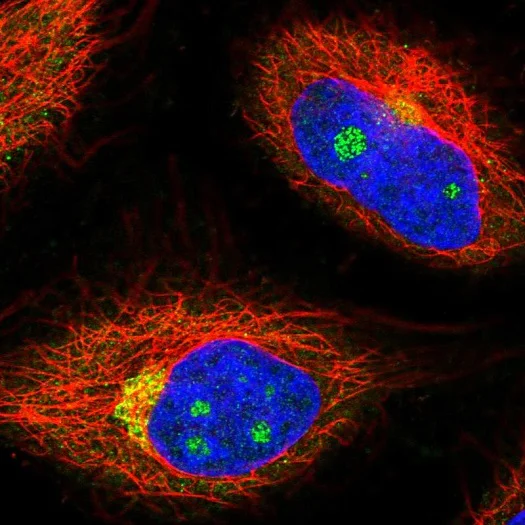
Immunocytochemistry/ Immunofluorescence - Anti-NCOA4 antibody (AB222071)
  • ICC/IF

Supplier Data

Immunocytochemistry/ Immunofluorescence - Anti-NCOA4 antibody (AB222071)

PFA-fixed, Triton X-100 permeabilized HeLa (human epithelial cell line from cervix adenocarcinoma) cells stained for NCOA4 (green) using ab222071 at 4 μg/ml in ICC/IF.

Key facts

Host species

Rabbit

Clonality

Polyclonal

Isotype

IgG

Carrier free

No

Reacts with

Human

Applications

ICC/IF

applications

Immunogen

Recombinant Fragment Protein within Human NCOA4 aa 500 to C-terminus. The exact immunogen used to generate this antibody is proprietary information.

Q13772

Reactivity data

{ "title": "Reactivity Data", "filters": { "stats": ["", "Species", "Dilution Info", "Notes"], "tabs": { "all-applications": {"fullname" : "All Applications", "shortname": "All Applications"}, "ICCIF" : {"fullname" : "Immunocytochemistry/ Immunofluorescence", "shortname":"ICC/IF"} }, "product-promise": { "all": "all", "testedAndGuaranteed": "tested", "guaranteed": "expected", "predicted": "predicted", "notRecommended": "not-recommended" } }, "values": { "Human": { "ICCIF-species-checked": "testedAndGuaranteed", "ICCIF-species-dilution-info": "0.25-2 µg/mL", "ICCIF-species-notes": "<p>Fixation/Permeabilization: PFA/Triton X-100.</p>" } } }

Properties and storage information

Form
Liquid
Purification technique
Affinity purification Immunogen
Storage buffer
pH: 7.2 Preservative: 0.02% Sodium azide Constituents: PBS, 40% Glycerol (glycerin, glycerine)
Shipped at conditions
Blue Ice
Appropriate short-term storage duration
1-2 weeks
Appropriate short-term storage conditions
+4°C
Appropriate long-term storage conditions
-20°C
Aliquoting information
Upon delivery aliquot
Storage information
Avoid freeze / thaw cycle

Supplementary information

This supplementary information is collated from multiple sources and compiled automatically.

The nuclear receptor coactivator 4 (NCOA4) also previously known as androgen receptor-associated protein 70 (ARA70) plays a critical role in cellular activities. It engages with nuclear receptors to enhance transcriptional activities. The molecular weight of NCOA4 is approximately 70 kDa. Scientists have observed its expression in various tissues including prostate and thyroid indicating its diverse functional capacity.
Biological function summary

NCOA4 modulates cellular iron homeostasis which is essential for cell survival and proliferation. It accomplishes this by mediating the autophagic degradation of ferritin a protein that stores iron through ferritinophagy. As part of the ferritinophagy complex NCOA4 works alongside other autophagic machinery to regulate iron bioavailability and mitigate oxidative stress maintaining cellular health and function.

Pathways

NCOA4 significantly influences the iron metabolism pathway an important component in maintaining iron balance within cells. The interaction with proteins such as ferritin highlights its role in facilitating iron release and utilization. Furthermore NCOA4 intersects with the autophagy pathway where it coordinates with autophagic proteins like LC3 to ensure proper iron recycling emphasizing its integration in cellular nutrient management.

Dysregulation of NCOA4 has links to neurodegenerative diseases like Parkinson’s disease where iron dysmetabolism plays a part in neuronal damage. Aberrant NCOA4 activity also relates to certain cancers as iron levels influence tumor growth. In these contexts NCOA4's interaction with proteins like p62 an important autophagy adaptor becomes critical highlighting its influence in disease progression and potential as a therapeutic target.

Product protocols

For this product, it's our understanding that no specific protocols are required. You can visit:

Target data

Cargo receptor for the autophagic turnover of the iron-binding ferritin complex, playing a central role in iron homeostasis (PubMed : 25327288, PubMed : 26436293). Acts as an adapter for delivery of ferritin to lysosomes and autophagic degradation of ferritin, a process named ferritinophagy (PubMed : 25327288, PubMed : 26436293). Targets the iron-binding ferritin complex to autolysosomes following starvation or iron depletion (PubMed : 25327288). Ensures efficient erythropoiesis, possibly by regulating hemin-induced erythroid differentiation (PubMed : 26436293). In some studies, has been shown to enhance the androgen receptor AR transcriptional activity as well as acting as ligand-independent coactivator of the peroxisome proliferator-activated receptor (PPAR) gamma (PubMed : 10347167, PubMed : 8643607). Another study shows only weak behavior as a coactivator for the androgen receptor and no alteration of the ligand responsiveness of the AR (PubMed : 10517667). Binds to DNA replication origins, binding is not restricted to sites of active transcription and may likely be independent from the nuclear receptor transcriptional coactivator function (PubMed : 24910095). May inhibit activation of DNA replication origins, possibly by obstructing DNA unwinding via interaction with the MCM2-7 complex (PubMed : 24910095).
See full target information NCOA4

Alternative Names

ARA70, ELE1, RFG, NCOA4, Nuclear receptor coactivator 4, NCoA-4, Androgen receptor coactivator 70 kDa protein, Androgen receptor-associated protein of 70 kDa, Ferritin cargo receptor NCOA4, Ret-activating protein ELE1, 70 kDa AR-activator, 70 kDa androgen receptor coactivator

Publications (2)

Recent publications for all applications. Explore the full listand refine your search

Journal of orthopaedic surgery and research 18:384 PubMed37231521

2023

CPEB2 enhances cell growth and angiogenesis by upregulating ARPC5 mRNA stability in multiple myeloma.

Applications

Unspecified application

Species

Unspecified reactive species

Piaorong Zeng,Fujue Wang,Xingxing Long,Yixiong Cao,Feng Wen,Junjun Li,Zeyu Luo

Antioxidants (Basel, Switzerland) 11: PubMed35204181

2022

Vulnerability of Triple-Negative Breast Cancer to Saponin Formosanin C-Induced Ferroptosis.

Applications

Unspecified application

Species

Unspecified reactive species

Hsin-Chih Chen,Han-Hsuan Tang,Wei-Hsiang Hsu,Shan-Ying Wu,Wen-Hsing Cheng,Bao-Yuan Wang,Chun-Li Su
View all publications

Product promise

We are committed to supporting your work with high-quality reagents, and we're here for you every step of the way. In the unlikely event that one of our products does not perform as expected, you're protected by our Product Promise.
For full details, please see our Terms & Conditions

Please note: All products are 'FOR RESEARCH USE ONLY. NOT FOR USE IN DIAGNOSTIC OR THERAPEUTIC PROCEDURES'.

For licensing inquiries, please contact partnerships@abcam.com