JavaScript is disabled in your browser. Please enable JavaScript to view this website.
AB183082

Anti-Neurofascin antibody

Be the first to review this product! Submit a review

|

(1 Publication)

Rabbit Polyclonal NFASC antibody. Suitable for IHC-P, WB and reacts with Human samples. Cited in 1 publication. Immunogen corresponding to Synthetic Peptide within Human NFASC aa 1200 to C-terminus.
2 Images
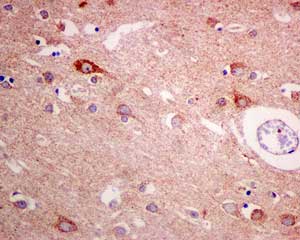
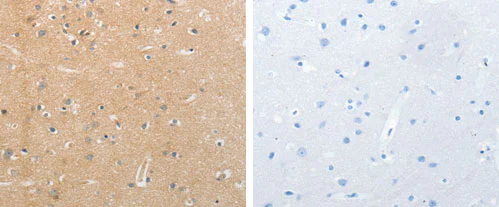
Immunohistochemistry (Formalin/PFA-fixed paraffin-embedded sections) - Anti-Neurofascin antibody (AB183082)
  • IHC-P

Supplier Data

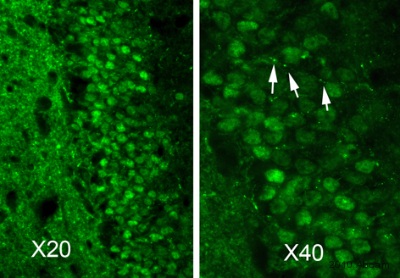
Immunohistochemistry (Formalin/PFA-fixed paraffin-embedded sections) - Anti-Neurofascin antibody (AB183082)

Immunohistochemical analysis of paraffin-embedded Human brain tissue labeling Neurofascin with ab183082 at 1/30 dilution. The image on the right is treated with the immunizing peptide.
Western blot - Anti-Neurofascin antibody (AB183082)
  • WB

Supplier Data

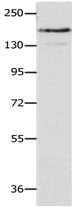
Western blot - Anti-Neurofascin antibody (AB183082)

All lanes:

Western blot - Anti-Neurofascin antibody (ab183082) at 1/400 dilution

All lanes:

Human lung tissue lysate at 40 µg

Secondary

All lanes:

Goat anti Rabbit IgG - H&L (HRP) at 1/5000 dilution

Predicted band size: 150 kDa

true

Exposure time: 1min

Key facts

Host species

Rabbit

Clonality

Polyclonal

Isotype

IgG

Carrier free

No

Reacts with

Human

Applications

WB, IHC-P

applications

Immunogen

Synthetic Peptide within Human NFASC aa 1200 to C-terminus. The exact immunogen used to generate this antibody is proprietary information.

O94856

Reactivity data

{ "title": "Reactivity Data", "filters": { "stats": ["", "Species", "Dilution Info", "Notes"], "tabs": { "all-applications": {"fullname" : "All Applications", "shortname": "All Applications"}, "IHCP" : {"fullname" : "Immunohistochemistry (Formalin/PFA-fixed paraffin-embedded sections)", "shortname":"IHC-P"}, "WB" : {"fullname" : "Western blot", "shortname":"WB"} }, "product-promise": { "all": "all", "testedAndGuaranteed": "tested", "guaranteed": "expected", "predicted": "predicted", "notRecommended": "not-recommended" } }, "values": { "Human": { "IHCP-species-checked": "testedAndGuaranteed", "IHCP-species-dilution-info": "1/25 - 1/100", "IHCP-species-notes": "<p></p> Perform heat-mediated antigen retrieval with citrate buffer pH 6 before commencing with IHC staining protocol.", "WB-species-checked": "testedAndGuaranteed", "WB-species-dilution-info": "1/200 - 1/1000", "WB-species-notes": "<p></p>" }, "Chicken": { "IHCP-species-checked": "predicted", "IHCP-species-dilution-info": "", "IHCP-species-notes": "", "WB-species-checked": "predicted", "WB-species-dilution-info": "", "WB-species-notes": "" } } }

Properties and storage information

Form
Liquid
Purification technique
Affinity purification Immunogen
Storage buffer
pH: 7.4 Preservative: 0.05% Sodium azide Constituents: PBS, 50% Glycerol (glycerin, glycerine)
Shipped at conditions
Blue Ice
Appropriate short-term storage duration
1-2 weeks
Appropriate short-term storage conditions
+4°C
Appropriate long-term storage conditions
-20°C
Aliquoting information
Upon delivery aliquot
Storage information
Avoid freeze / thaw cycle

Supplementary information

This supplementary information is collated from multiple sources and compiled automatically.

Neurofascin also known as NFASC is a cell adhesion molecule with significant roles in the nervous system. It has various isoforms with Neurofascin-186 and Neurofascin-155 being the most studied. The molecular mass of Neurofascin is approximately 135 kDa. This protein is expressed in the nervous system particularly at nodes of Ranvier and paranodal regions as well as in the initial segment of axons. Neurofascin contributes to organizing and maintaining the axonal domains essential for neural signal transmission.
Biological function summary

This neural protein plays an integral role in developing and securing the nervous system's structural organization. Neurofascin helps form the nodes of Ranvier which are critical for saltatory conduction enhancing rapid and efficient nerve impulse transmission. It also interacts with other proteins such as Ankyrin G and Contactin to maintain the stability and function of neuronal domains. Through these interactions Neurofascin facilitates the proper conduction and coordination of electrical signals along neurons.

Pathways

Neurofascin is essential for neural signal transmission and maintenance pathways. It prominently participates in the axon guidance and myelination pathways working alongside proteins like Caspr (Contactin-associated protein) and Ankyrin B. These pathways ensure the growth and maintenance of myelin sheaths supporting nerve insulation and efficient signal relay. Neurofascin's interaction with these proteins reinforces the nodes of Ranvier's organization promoting stable and rapid signal conduction in the peripheral and central nervous systems.

Research links Neurofascin with autoimmune neuropathies like Guillain-Barré syndrome and multiple sclerosis. These conditions involve the immune-mediated destruction of myelin leading to severe motor and sensory deficits. Neurofascin acts as a target in some autoimmune responses where antibodies may mistakenly attack the protein disrupting neural conduction. Connections between Neurofascin and other proteins like Contactin and Ankyrin G highlight the complex interactions that can lead to pathological states when disrupted. Developing therapies targeting Neurofascin-related pathways holds potential for mitigating these disorders' impacts on neuronal functions.

Product protocols

For this product, it's our understanding that no specific protocols are required. You can visit:

Target data

Cell adhesion, ankyrin-binding protein which may be involved in neurite extension, axonal guidance, synaptogenesis, myelination and neuron-glial cell interactions.
See full target information NFASC

Alternative Names

KIAA0756, NFASC, Neurofascin

Publications (1)

Recent publications for all applications. Explore the full listand refine your search

Cells 13: PubMed39451222

2024

Decreased Circulating Gonadotropin-Releasing Hormone Associated with Keratoconus.

Applications

Unspecified application

Species

Unspecified reactive species

Paulina Escandon,Alexander J Choi,Steve Mabry,Sarah E Nicholas,Rebecca L Cunningham,Liam Redden,David A Murphy,Kamran M Riaz,Tina B McKay,Dimitrios Karamichos
View all publications

Product promise

We are committed to supporting your work with high-quality reagents, and we're here for you every step of the way. In the unlikely event that one of our products does not perform as expected, you're protected by our Product Promise.
For full details, please see our Terms & Conditions

Please note: All products are 'FOR RESEARCH USE ONLY. NOT FOR USE IN DIAGNOSTIC OR THERAPEUTIC PROCEDURES'.

For licensing inquiries, please contact partnerships@abcam.com