Anti-Neuroligin 2 antibody [EPR28230-17] - BSA and Azide free
- BOND RX™ Validated
- RabMAb
- Recombinant
- What is this?
Be the first to review this product! Submit a review
|
(0 Publication)
- IHC-P
Supplier Data
Immunohistochemistry (Formalin/PFA-fixed paraffin-embedded sections) - Anti-Neuroligin 2 antibody [EPR28230-17] - BSA and Azide free (AB315095)
This data was developed using ab315094, the same antibody clone in a different buffer formulation.
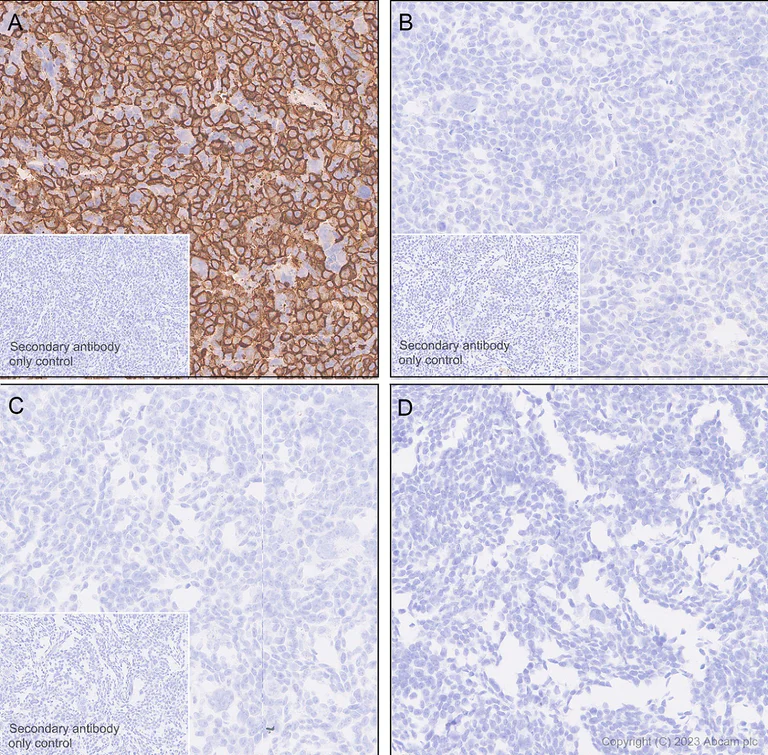
Immunohistochemical analysis of paraffin-embedded : (A) HEK-293T (human embryonic kidney epithelial cell) transfected with a mouse NLGN2 expression vector containing a his tag. (B) HEK-293T cells transfected with a mouse NLGN1 expression vector containing a his tag. (C) HEK-293T cells transfected with a mouse NLGN3 expression vector containing a his tag. (D) HEK-293T cells transfected with empty vector containing a his tag. tissue labeling Neuroligin 2 with ab315094 at 1/2000 (0.26 ug/ml) dilution, followed by a ready to use LeicaDS9800 (Bond™ Polymer Refine Detection).
Positive staining on (A) HEK-293T cells transfected with a mouse NLGN2 expression vector containing a his tag, no staining on (B) HEK-293T cells transfected with a mouse NLGN1 expression vector containing a his tag, and (C) HEK-293T cells transfected with a mouse NLGN3 expression vector containing a his tag, and (D) HEK-293T cells transfected with empty vector containing a his tag.The section was incubated with ab315094 for 30 mins at room temperature.The immunostaining was performed on a Leica Biosystems BOND® RX instrument Counterstained with Hematoxylin.
Secondary antibody only control : Secondary antibody is a ready to use LeicaDS9800 (Bond™ Polymer Refine Detection).
Heat mediated antigen retrieval was performed with Tris-EDTA buffer (pH 9.0, Epitope Retrieval Solution2) for 20 mins
- IHC-P
Supplier Data
Immunohistochemistry (Formalin/PFA-fixed paraffin-embedded sections) - Anti-Neuroligin 2 antibody [EPR28230-17] - BSA and Azide free (AB315095)
This data was developed using ab315094, the same antibody clone in a different buffer formulation.
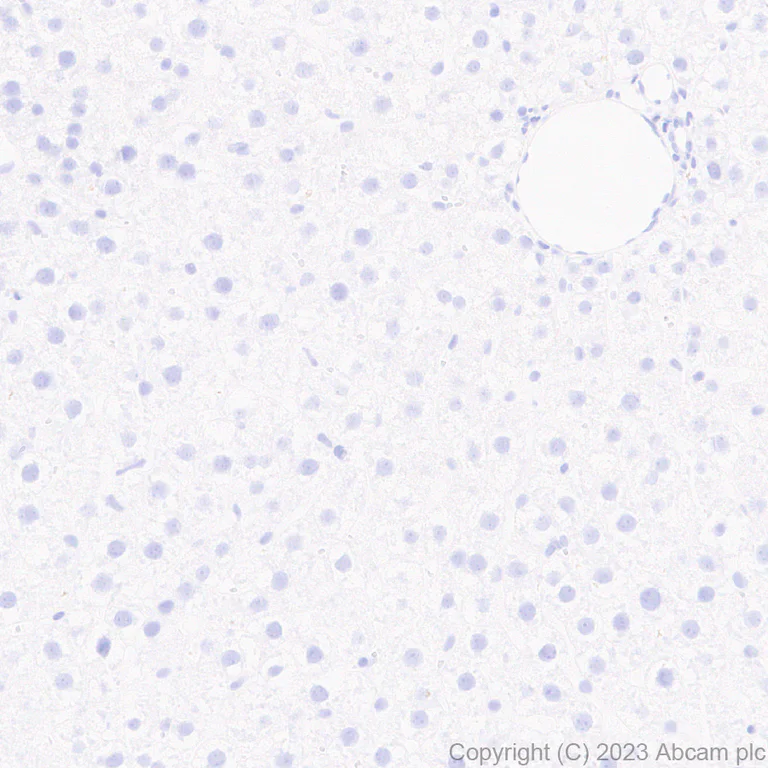
Immunohistochemical analysis of paraffin-embedded Rat liver tissue labeling Neuroligin 2 with ab315094 at 1/2000 (0.26 ug/ml) dilution, followed by a ready to use LeicaDS9800 (Bond™ Polymer Refine Detection).
Negative control : no staining on rat liver.The section was incubated with ab315094 for 30 mins at room temperature.The immunostaining was performed on a Leica Biosystems BOND® RX instrument Counterstained with Hematoxylin.
Secondary antibody only control : Secondary antibody is a ready to use LeicaDS9800 (Bond™ Polymer Refine Detection).
Heat mediated antigen retrieval was performed with Tris-EDTA buffer (pH 9.0, Epitope Retrieval Solution2) for 20 mins
- IHC-P
Supplier Data
Immunohistochemistry (Formalin/PFA-fixed paraffin-embedded sections) - Anti-Neuroligin 2 antibody [EPR28230-17] - BSA and Azide free (AB315095)
This data was developed using ab315094, the same antibody clone in a different buffer formulation.
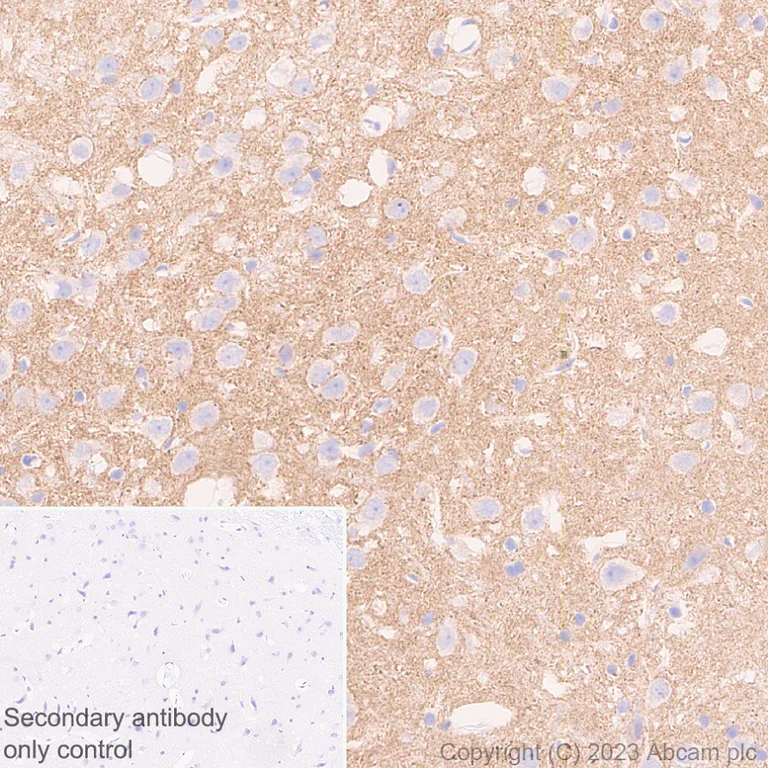
Immunohistochemical analysis of paraffin-embedded Rat cerebrum tissue labeling Neuroligin 2 with ab315094 at 1/2000 (0.26 ug/ml) dilution, followed by a ready to use LeicaDS9800 (Bond™ Polymer Refine Detection).
Positive staining on rat cerebrum (PMID : 16982420).The section was incubated with ab315094 for 30 mins at room temperature.The immunostaining was performed on a Leica Biosystems BOND® RX instrument Counterstained with Hematoxylin.
Secondary antibody only control : Secondary antibody is a ready to use LeicaDS9800 (Bond™ Polymer Refine Detection).
Heat mediated antigen retrieval was performed with Tris-EDTA buffer (pH 9.0, Epitope Retrieval Solution2) for 20 mins
- IHC-P
Supplier Data
Immunohistochemistry (Formalin/PFA-fixed paraffin-embedded sections) - Anti-Neuroligin 2 antibody [EPR28230-17] - BSA and Azide free (AB315095)
This data was developed using ab315094, the same antibody clone in a different buffer formulation.
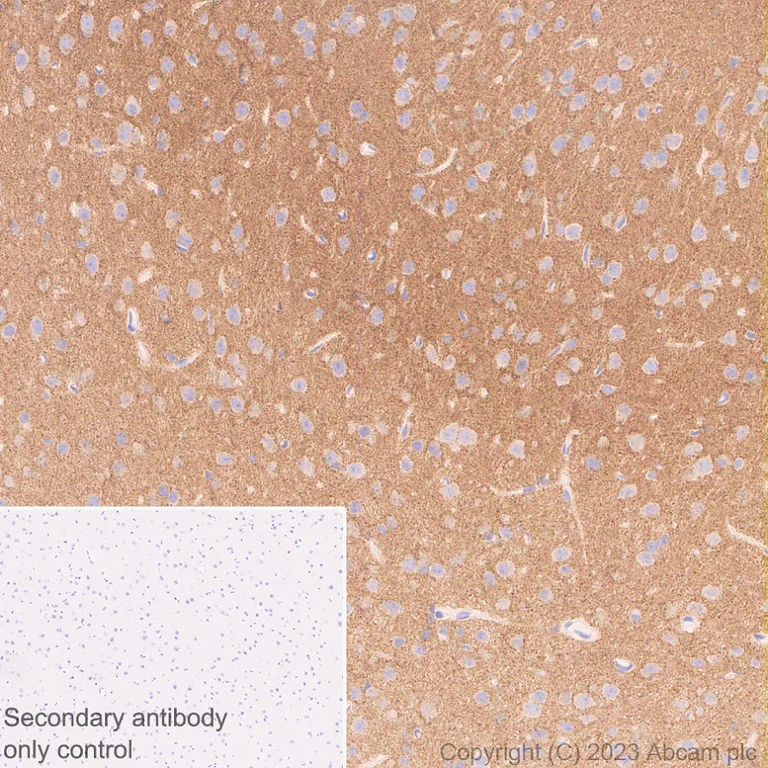
Immunohistochemical analysis of paraffin-embedded Mouse cerebrum tissue labeling Neuroligin 2 with ab315094 at 1/2000 (0.26 ug/ml) dilution, followed by a ready to use LeicaDS9800 (Bond™ Polymer Refine Detection).
Positive staining on mouse cerebrum (PMID : 19926856).The section was incubated with ab315094 for 30 mins at room temperature.The immunostaining was performed on a Leica Biosystems BOND® RX instrument Counterstained with Hematoxylin.
Secondary antibody only control : Secondary antibody is a ready to use LeicaDS9800 (Bond™ Polymer Refine Detection).
Heat mediated antigen retrieval was performed with Tris-EDTA buffer (pH 9.0, Epitope Retrieval Solution2) for 20 mins
- IHC-P
Supplier Data
Immunohistochemistry (Formalin/PFA-fixed paraffin-embedded sections) - Anti-Neuroligin 2 antibody [EPR28230-17] - BSA and Azide free (AB315095)
This data was developed using ab315094, the same antibody clone in a different buffer formulation.
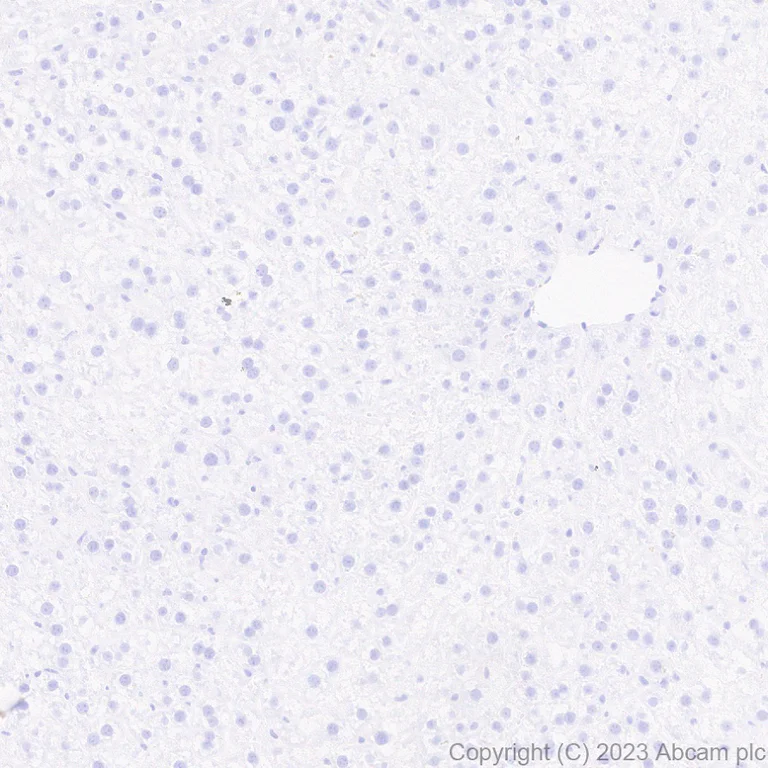
Immunohistochemical analysis of paraffin-embedded Mouse liver tissue labeling Neuroligin 2 with ab315094 at 1/2000 (0.26 ug/ml) dilution, followed by a ready to use LeicaDS9800 (Bond™ Polymer Refine Detection).
Negative control : no staining on mouse liver.The section was incubated with ab315094 for 30 mins at room temperature.The immunostaining was performed on a Leica Biosystems BOND® RX instrument Counterstained with Hematoxylin.
Secondary antibody only control : Secondary antibody is a ready to use LeicaDS9800 (Bond™ Polymer Refine Detection).
Heat mediated antigen retrieval was performed with Tris-EDTA buffer (pH 9.0, Epitope Retrieval Solution2) for 20 mins
- IP
Supplier Data
Immunoprecipitation - Anti-Neuroligin 2 antibody [EPR28230-17] - BSA and Azide free (AB315095)
This data was developed using ab315094, the same antibody clone in a different buffer formulation.
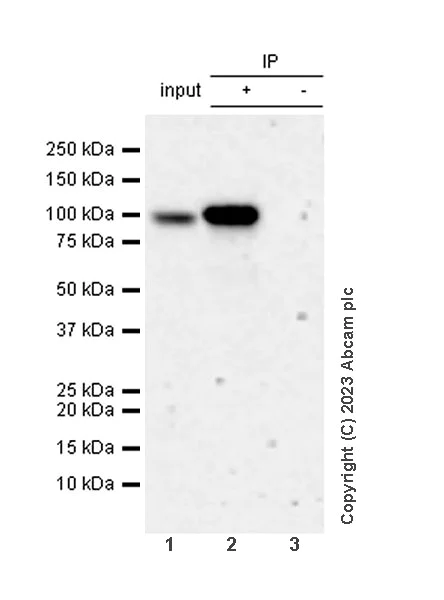
Neuroligin 2 was immunoprecipitated from 0.35 mg Mouse brain tissue lysate with ab315094 at 1/30 dilution (2ug in 0.35mg lysates). Western blot was performed on the immunoprecipitate using ab315094 at 1/1000 dilution. VeriBlot for IP secondary antibody(HRP)(ab131366) was used at 1/5000 dilution.
Lane 1 : Mouse brain tissue lysate
Lane 2 : ab315094 IP in Mouse brain tissue lysate
Lane 3 : Rabbit monoclonal IgG (ab172730) instead of ab315094 in mouse brain tissue lysate
Blocking and dilution buffer and concentration : 5% NFDM/TBST.
All lanes:
Immunoprecipitation - Anti-Neuroligin 2 antibody [EPR28230-17] (<a href='/en-us/products/primary-antibodies/neuroligin-2-antibody-epr28230-17-ab315094'>ab315094</a>) at 1/30 dilution
All lanes:
Mouse brain tissue lysate
Secondary
All lanes:
Immunoprecipitation - VeriBlot for IP Detection Reagent (HRP) (<a href='/en-us/products/reagents/veriblot-for-ip-detection-reagent-hrp-ab131366'>ab131366</a>) at 1/5000 dilution
false
Exposure time: 180s
- WB
Supplier Data
Western blot - Anti-Neuroligin 2 antibody [EPR28230-17] - BSA and Azide free (AB315095)
This data was developed using ab315094, the same antibody clone in a different buffer formulation.
Blocking and diluting buffer and concentration : 5% NFDM/TBST.
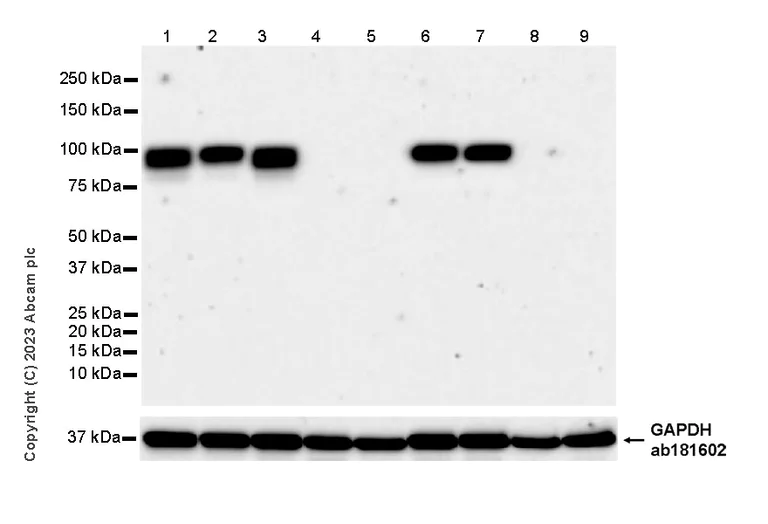
Negative control : liver, kidney (PMID : 10718198, 8576240, 18434543).
Samples are non-boiled as boiling may cause protein aggregation.
In Western blot, Anti-GAPDH antibody [EPR16891] - Loading Control (ab181602) staining at 1/200000 dilution.
All lanes:
Western blot - Anti-Neuroligin 2 antibody [EPR28230-17] (<a href='/en-us/products/primary-antibodies/neuroligin-2-antibody-epr28230-17-ab315094'>ab315094</a>) at 1/1000 dilution
Lane 1:
Mouse brain tissue lysate at 20 µg
Lane 2:
Mouse hippocampus tissue lysate at 20 µg
Lane 3:
Mouse cerebellum tissue lysate at 20 µg
Lane 4:
Mouse liver tissue lysate at 20 µg
Lane 5:
Mouse kidney tissue lysate at 20 µg
Lane 6:
Rat brain tissue lysate at 20 µg
Lane 7:
Rat hippocampus tissue lysate at 20 µg
Lane 8:
Rat kidney tissue lysate at 20 µg
Lane 9:
Rat liver tissue lysate at 20 µg
Secondary
All lanes:
Western blot - Goat Anti-Rabbit IgG H&L (HRP) (<a href='/en-us/products/secondary-antibodies/goat-rabbit-igg-h-l-hrp-ab97051'>ab97051</a>) at 1/100000 dilution
Observed band size: 91 kDa,36 kDa
false
Exposure time: 81s
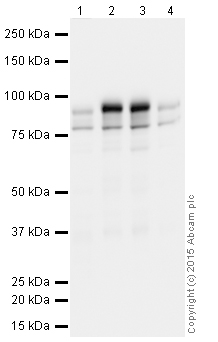
- WB
Supplier Data
Western blot - Anti-Neuroligin 2 antibody [EPR28230-17] - BSA and Azide free (AB315095)
This data was developed using ab315094, the same antibody clone in a different buffer formulation.
Blocking and diluting buffer and concentration : 5% NFDM/TBST.
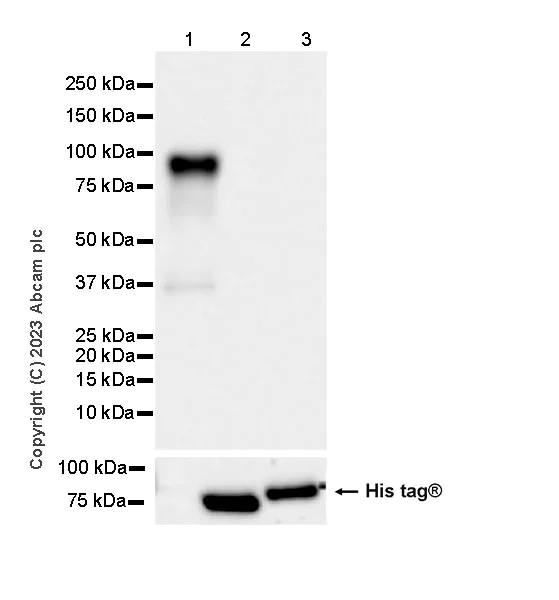
This antibody does not cross-react with mouse Neuroligin 3 and Neuroligin 1.
In Western blot, Anti-His tag® antibody staining at 1/5000 dilution.
All lanes:
Western blot - Anti-Neuroligin 2 antibody [EPR28230-17] (<a href='/en-us/products/primary-antibodies/neuroligin-2-antibody-epr28230-17-ab315094'>ab315094</a>) at 1/1000 dilution
Lane 1:
Purified mouse Neuroligin 2 recombinant protein at 20 ng
Lane 2:
Purified His-tagged mouse Neuroligin 1 recombinant protein at 20 ng
Lane 3:
Purified His-tagged mouse Neuroligin 3 recombinant protein at 20 ng
Secondary
All lanes:
Western blot - Goat Anti-Rabbit IgG H&L (HRP) (<a href='/en-us/products/secondary-antibodies/goat-rabbit-igg-h-l-hrp-ab97051'>ab97051</a>) at 1/100000 dilution
Observed band size: 91 kDa
false
Exposure time: 7.75s
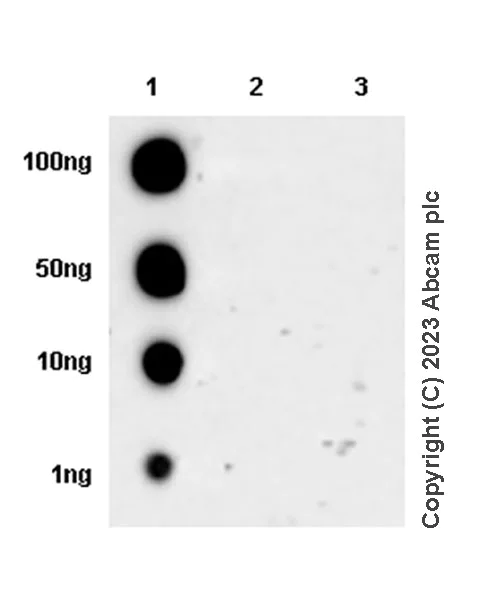
- Dot
Supplier Data
Dot Blot - Anti-Neuroligin 2 antibody [EPR28230-17] - BSA and Azide free (AB315095)
This data was developed using ab315094, the same antibody clone in a different buffer formulation.
Dot blot analysis of Neuroligin 2 using ab315094 at 1 : 1000 (0.519 ug/ml) followed by a Goat Anti-Rabbit IgG, (H+L), Peroxidase conjugated (ab97051) at 1 : 100,000 dilution.
Exposure time : 180 Seconds.
Blocking and diluting buffer and concentration : 5% NFDM/TBST.
This antibody does not cross-react with mouse Neuroligin 3 and Neuroligin 1.
Related conjugates and formulations (1)
-
Anti-Neuroligin 2 antibody [EPR28230-17]
Complementary Products
Primary Antibodies
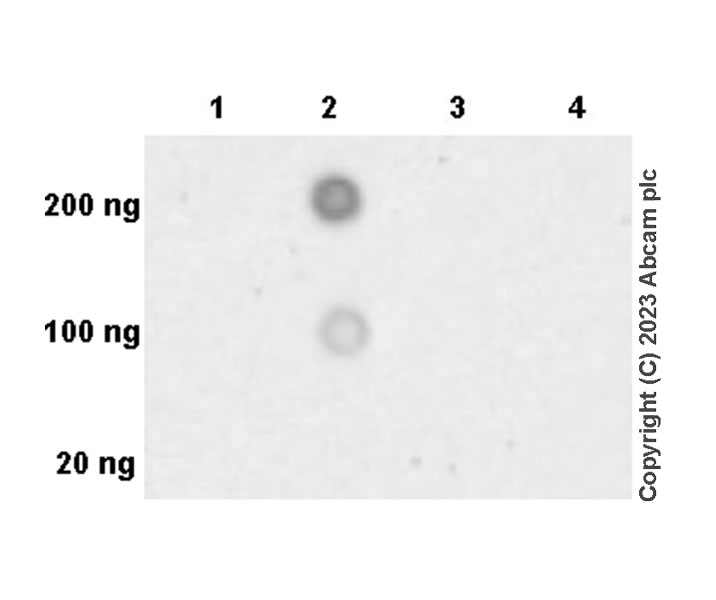
AB308452
Anti-Neuroligin 1 antibody [EPR27213-94] - BSA and Azide free
RabMAb|Recombinant
- 0
- 0
Primary Antibodies
AB177154
Anti-Gephyrin antibody [EPR12651(B)]
RabMAb|Recombinant|KO Validated
- 0
- 0
Primary Antibodies
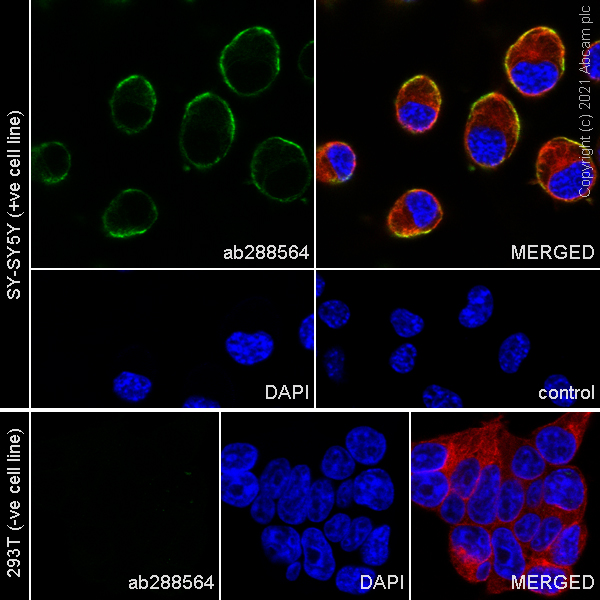
AB288564
Anti-GABA A Receptor gamma 2/GABRG2 antibody [EPR25325-5]
20ul selling size|RabMAb|Recombinant|Trial Size
- 0
- 0
Primary Antibodies
AB192757
Anti-PSD95 antibody [K28/43] - Synaptic Marker
BOND RX™ Validated|Lab Essentials
- 0
- 0
Reactivity data
Product details
ab315095 is the carrier-free version of ab315094.
Patented technology
Our RabMAb® technology is a patented hybridoma-based technology for making rabbit monoclonal antibodies. For details on our patents, please refer to RabMAb® patents.
What are the advantages of a recombinant monoclonal antibody?
This product is a recombinant monoclonal antibody, which offers several advantages including:
- - High batch-to-batch consistency and reproducibility
- - Improved sensitivity and specificity
- - Long-term security of supply
- - Animal-free batch production
For more information, read more on recombinant antibodies.
Conjugation ready
Our carrier-free antibodies are typically supplied in a PBS-only formulation, purified and free of BSA, sodium azide and glycerol. This conjugation-ready format is designed for use with fluorochromes, metal isotopes, oligonucleotides, and enzymes, which makes them ideal for antibody labelling, functional and cell-based assays, flow-based assays (e.g. mass cytometry) and Multiplex Imaging applications.
Use our conjugation kits for antibody conjugates that are ready-to-use in as little as 20 minutes with 1 minute hands-on-time and 100% antibody recovery: available for fluorescent dyes, HRP, biotin and gold.
Compatibility
This product is compatible with the Maxpar® Antibody Labeling Kit from Fluidigm, without the need for antibody preparation. Maxpar® is a trademark of Fluidigm Canada Inc.
Properties and storage information
Form
Purification technique
Storage buffer
Shipped at conditions
Appropriate short-term storage conditions
Appropriate long-term storage conditions
Supplementary information
This supplementary information is collated from multiple sources and compiled automatically.
Biological function summary
This synaptic adhesion protein plays a part in the formation of synapses and the modulation of synaptic strength. Neuroligin 2 forms a trans-synaptic complex with neurexins on the presynaptic side which helps to stabilize synapses by mediating cell-cell interactions. This interaction is important for maintaining balance between excitatory and inhibitory signals in the brain which contributes to normal brain function and neuronal communication.
Pathways
Neuroligin 2 functions as an integral part of synaptic signaling and neural network activity. It is connected to synaptic pathways that govern synapse assembly which involves other proteins like PSD-95. In particular its interaction with neurexins plays a role in the formation of the inhibitory synapses pathway which regulates inhibitory neurotransmission. Through these pathways Neuroligin 2 influences how neurons communicate and process information within neural circuits.
Product protocols
- Visit the General protocols
- Visit the Troubleshooting
Target data
Alternative Names
Product promise
Please note: All products are 'FOR RESEARCH USE ONLY. NOT FOR USE IN DIAGNOSTIC OR THERAPEUTIC PROCEDURES'.
For licensing inquiries, please contact partnerships@abcam.com