Anti-Neutrophil antibody [7/4]
5
(1 Review)
|
(41 Publications )
- Over 30 publications
- Trusted since 2007
- Flow Cyt
Unknown
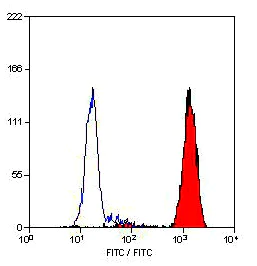
Flow Cytometry - Anti-Neutrophil antibody [7/4] (AB53457)
Staining of mouse peripheral blood granulocytes with Rat anti mouse neutrophil (ab53457).
- IHC
CiteAb
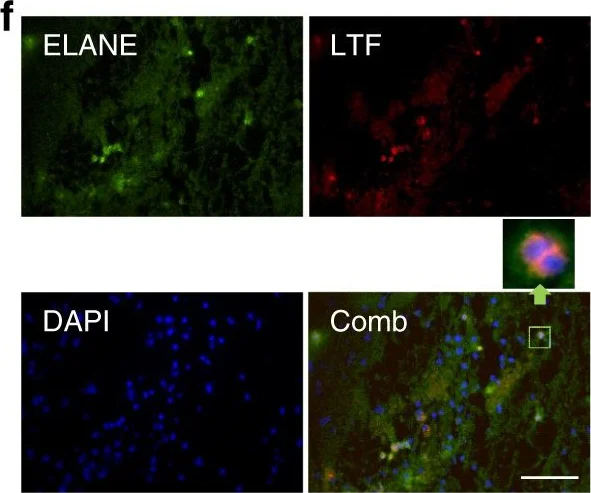
Immunohistochemistry - Anti-Neutrophil antibody [7/4] (AB53457)
Immunohistochemistry-immunofluorescence using Anti-Neutrophil antibody [7/4]Anti-Neutrophil antibody [7/4], ab53457. Publication image from Zhao, X. et al., 2017, Nat Commun, 28928459. Legend direct from paper.
IL-27 induces LTF in PMNs. a Photomicrograph of representative LTF, immunostaining (green) in normal mouse BM-PMNs. The nuclei are stained with DAPI (red). b, c MFI of LTF, staining per cell was determined in BM-PMNs by flow cytometry, with T cells and monocytes serving as negative controls. Analyzed cells were from mice treated with saline or rIL-27 (50 ng/kg, i.v., at 30 min, 24 h, 42 h after ICH) and harvested at 48 h after the ICH. d Photomicrograph of representative LTF staining (green) in peripheral blood mature PMNs. The nuclei were stained with DAPI. Scale bar = 10 µM. e Bar graph of LTF, protein content (established with ELISA) in peripheral blood PMNs in naïve rats, and rats 48 h after ICH with and without treatment with rIL-27 (50 ng/kg, i.v., at 30 min, 24 h, 42 h after ICH). Data are expressed as mean ± SEM (n = 5). *p ≤ 0.05, vs. naïve rat, **p ≤ 0.05, vs. naïve rats and rats after ICH without IL-27 treatment. The p-value was established using one-way ANOVA followed by Newman–Keuls post-test. f Immunofluorescence of LTF, (red) and neutrophil elastase, ELANE (green) in a mouse brain at hematoma-affected area at 24 h after ICH. The nuclei were labeled with DAPI (blue). Scale bar = 50 µm. The insertion window highlighted the co-localization of LTF, with ELANE+ neutrophil. g LTF, protein in the ICH-affected rat brains (harvested from animals perfused with saline to flash intravascular cells), in the same animals as in e, and established using Western blot (n = 5)
Alternative Products

Complementary Products
Primary Antibodies
AB300421
Anti-F4/80 antibody [EPR26545-166]
BOND RX™ Validated|Recombinant|Lab Essentials|20ul selling size|RabMAb|Advanced Validation

- 5
- 3
Primary Antibodies
AB238132
Anti-Ly6g antibody [EPR22909-135]
BOND RX™ Validated|RabMAb|Recombinant|Lab Essentials|20ul selling size

- 3
- 2
Primary Antibodies
AB178846
Anti-Iba1 antibody [EPR16588] - Microglia marker
20ul selling size|BOND RX™ Validated|RabMAb|Recombinant|Lab Essentials

- 5
- 50
Primary Antibodies
AB124964
Anti-alpha smooth muscle Actin antibody [EPR5368]
BOND RX™ Validated|RabMAb|Recombinant|KO Validated|20ul selling size

- 5
- 19
Reactivity data
Product details
Anti-Neutrophil antibody [7/4] (ab53457) is a rat monoclonal antibody and is validated for use in Western Blot (WB), Flow Cytometry (Flow Cyt), Immunohistochemistry (IHC-P), Immunohistochemistry (IHC-Fr), Immunocytochemistry/immunofluorescence (ICC/IF) in Mouse samples.
Trusted by the scientific community
Anti-Neutrophil [7/4] (ab53457) was first used in a scientific publication in 2007 and has been cited over 30 times in peer-reviewed journals.
Other related products
We have a range of other formats of antibody clone [7/4] also available for your convenience: ab150437, Carrier free - ab248989, FITC - ab53453
Properties and storage information
Form
Purification technique
Purification notes
Storage buffer
Shipped at conditions
Appropriate short-term storage duration
Appropriate short-term storage conditions
Appropriate long-term storage conditions
Storage information
Supplementary information
This supplementary information is collated from multiple sources and compiled automatically.
Biological function summary
Neutrophils play a central role in innate immunity by engulfing and destroying pathogens through phagocytosis. They exist as part of a network with other immune cells and contribute to the release of enzymes and reactive oxygen species to combat infection. Neutrophils can also secrete granules containing antimicrobial substances. Their activity is coordinated with other components of the immune system to provide an immediate response to infections and tissue injuries.
Pathways
Neutrophils participate actively in inflammatory and immune responses. They are important in pathways like the leukocyte adhesion cascade and the oxidative burst pathway. These pathways involve interactions with proteins such as integrins and NADPH oxidase which help neutrophils adhere to endothelium and generate reactive oxygen species respectively. These interactions permit neutrophils to migrate to sites of inflammation and eliminate invading pathogens efficiently.
Product protocols
- Visit the General protocols
- Visit the Troubleshooting
Target data
Alternative Names
Publications (41)
Recent publications for all applications. Explore the full listand refine your search
Molecular medicine (Cambridge, Mass.) 31:304 PubMed41023796
2025
Applications
Unspecified application
Species
Unspecified reactive species
Bioactive materials 44:474-487 PubMed39559426
2024
Applications
Unspecified application
Species
Unspecified reactive species
JHEP reports : innovation in hepatology 6:101019 PubMed38455470
2024
Applications
Unspecified application
Species
Unspecified reactive species
Cell reports 43:113876 PubMed38446669
2024
Applications
Unspecified application
Species
Unspecified reactive species
STAR protocols 3:101357 PubMed35634359
2022
Applications
Unspecified application
Species
Unspecified reactive species
Human molecular genetics 31:2121-2136 PubMed35043953
2022
Applications
Unspecified application
Species
Unspecified reactive species
Stroke 52:3374-3384 PubMed34404234
2021
Applications
Unspecified application
Species
Unspecified reactive species
Cell reports 35:108962 PubMed33826892
2021
Applications
Unspecified application
Species
Unspecified reactive species
Journal of photochemistry and photobiology. B, Bio 213:112072 PubMed33181431
2020
Applications
Unspecified application
Species
Unspecified reactive species
International journal of molecular sciences 21: PubMed32872405
2020
Applications
Unspecified application
Species
Unspecified reactive species
Product promise
Please note: All products are 'FOR RESEARCH USE ONLY. NOT FOR USE IN DIAGNOSTIC OR THERAPEUTIC PROCEDURES'.
For licensing inquiries, please contact partnerships@abcam.com