JavaScript is disabled in your browser. Please enable JavaScript to view this website.
AB268089

Anti-NME2 antibody [CPTC-NME2-2]

Be the first to review this product! Submit a review

|

(1 Publication)

Mouse Monoclonal NME2 antibody. Suitable for WB, Protein Array, IHC-P and reacts with Human, Recombinant full length protein - Human samples. Cited in 1 publication. Immunogen corresponding to Recombinant Full Length Protein corresponding to Human NME2.

View Alternative Names

NDK2, NM23B, NME2, Nucleoside diphosphate kinase B, NDP kinase B, NDPK B, C-myc purine-binding transcription factor PUF, Histidine protein kinase NDKB, Nucleoside diphoshate kinase 2, nm23-H2
2 Images
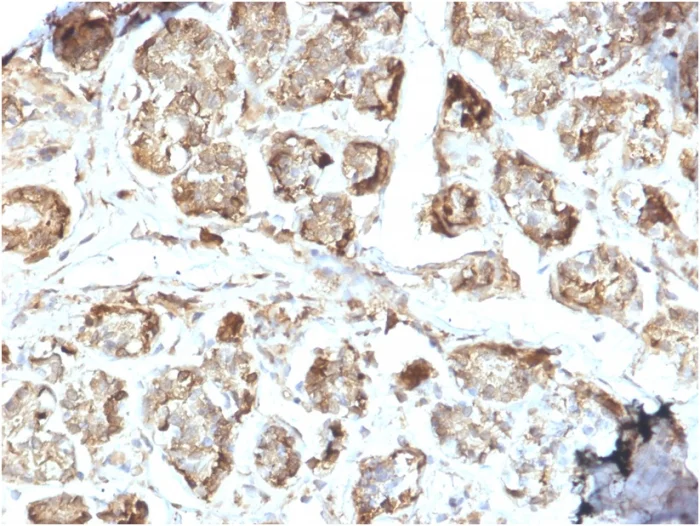
Immunohistochemistry (Formalin/PFA-fixed paraffin-embedded sections) - Anti-NME2 antibody [CPTC-NME2-2] (AB268089)
  • IHC-P

Unknown

Immunohistochemistry (Formalin/PFA-fixed paraffin-embedded sections) - Anti-NME2 antibody [CPTC-NME2-2] (AB268089)

Formalin-fixed, paraffin-embedded human breast carcinoma tissue stained for NME2 using ab268089 at 2 μg/ml in immunohistochemical analysis.
Protein Array - Anti-NME2 antibody [CPTC-NME2-2] (AB268089)
  • Protein Array

Unknown

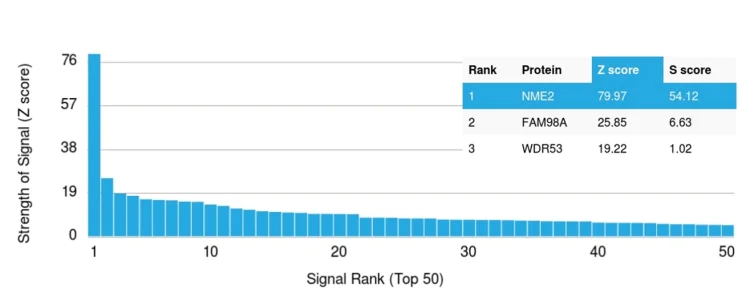
Protein Array - Anti-NME2 antibody [CPTC-NME2-2] (AB268089)

Protein Array containing more than 19,000 full-length human proteins using ab268089. Z- and S- Score : The Z-score represents the strength of a signal that a monoclonal antibody (MAb) (in combination with a fluorescently-tagged anti-IgG secondary antibody) produces when binding to a particular protein on the HuProtTM array. Z-scores are described in units of standard deviations (SD's) above the mean value of all signals generated on that array. If targets on HuProtTM are arranged in descending order of the Z-score, the S-score is the difference (also in units of SD's) between the Z-score. S-score therefore represents the relative target specificity of a MAb to its intended target. A MAb is considered to specific to its intended target, if the MAb has an S-score of at least 2.5. For example, if a MAb binds to protein X with a Z-score of 43 and to protein Y with a Z-score of 14, then the S-score for the binding of that MAb to protein X is equal to 29.

Key facts

Host species

Mouse

Clonality

Monoclonal

Clone number

CPTC-NME2-2

Isotype

IgG2a

Light chain type

kappa

Carrier free

No

Reacts with

Human

Applications

IHC-P, WB, Protein Array

applications

Immunogen

Recombinant Full Length Protein corresponding to Human NME2.

P22392

Reactivity data

{ "title": "Reactivity Data", "filters": { "stats": ["", "Species", "Dilution Info", "Notes"], "tabs": { "all-applications": {"fullname" : "All Applications", "shortname": "All Applications"}, "WB" : {"fullname" : "Western blot", "shortname":"WB"}, "ProteinArray" : {"fullname" : "Protein Array", "shortname":"Protein Array"}, "IHCP" : {"fullname" : "Immunohistochemistry (Formalin/PFA-fixed paraffin-embedded sections)", "shortname":"IHC-P"} }, "product-promise": { "all": "all", "testedAndGuaranteed": "tested", "guaranteed": "expected", "predicted": "predicted", "notRecommended": "not-recommended" } }, "values": { "Human": { "WB-species-checked": "testedAndGuaranteed", "WB-species-dilution-info": "1-2 µg/mL", "WB-species-notes": "<p></p>", "ProteinArray-species-checked": "guaranteed", "ProteinArray-species-dilution-info": "", "ProteinArray-species-notes": "", "IHCP-species-checked": "testedAndGuaranteed", "IHCP-species-dilution-info": "1-2 µg/mL", "IHCP-species-notes": "<p></p> Perform heat-mediated antigen retrieval with Tris/EDTA buffer pH 9.0 before commencing with IHC staining protocol." }, "Recombinant full length protein - Human": { "WB-species-checked": "notRecommended", "WB-species-dilution-info": "", "WB-species-notes": "", "ProteinArray-species-checked": "testedAndGuaranteed", "ProteinArray-species-dilution-info": "", "ProteinArray-species-notes": "<p></p>", "IHCP-species-checked": "notRecommended", "IHCP-species-dilution-info": "", "IHCP-species-notes": "" } } }

Properties and storage information

Form
Liquid
Purification technique
Affinity purification Protein A/G
Purification notes
Purified from bioreactor concentrate.
Storage buffer
pH: 7.2 - 7.4 Preservative: 0.05% Sodium azide Constituents: PBS, 0.05% BSA
Shipped at conditions
Blue Ice
Appropriate short-term storage duration
1-2 weeks
Appropriate short-term storage conditions
+4°C
Appropriate long-term storage conditions
-20°C
Aliquoting information
Upon delivery aliquot
Storage information
Avoid freeze / thaw cycle

Supplementary information

This supplementary information is collated from multiple sources and compiled automatically.

NME2 also known as NM23-H2 is a nucleoside diphosphate kinase that is involved in the synthesis of nucleoside triphosphates. With a mass of approximately 17 kDa it plays a role in the energetic metabolism of cells. NME2 is widely expressed in various tissues including the liver heart and brain. Its expression levels indicate its importance in maintaining regular cellular functions.
Biological function summary

NME2 participates in the regulation of transcription and cellular differentiation. It acts within the context of protein complexes which influence DNA-binding activities required for transcriptional control. NME2 also has roles in the regulation of cell proliferation differentiation and signaling. These activities demonstrate the protein's significance in maintaining normal physiological processes.

Pathways

NME2 is active in the MAPK/ERK signaling pathway significant in cell growth and differentiation. It interacts with other proteins like ERK2 to modulate downstream signaling cascades. This protein also features in the GTP nucleotide biosynthesis pathway where it cooperates with other kinases for nucleotide metabolism highlighting its important role in cell cycle regulation.

Mutations or altered expression of NME2 link with various cancers including breast and colon cancer. This connection emphasizes its potential role as a biomarker or therapeutic target. The protein also associates with other oncogenes like NME1 together contributing to the metastatic potential of cancer cells. NME2's involvement in chronic conditions like cancer confirms its importance in pathological states where it may influence disease progression or serve as a clinical marker.

Product protocols

For this product, it's our understanding that no specific protocols are required. You can visit:

Target data

Catalyzes the transfer of a gamma-phosphoryl group from a nucleoside triphosphate, mainly ATP, to a nucleoside diphosphate via a ping-pong mechanism involving a phosphohistidine intermediate, therefore contributing to the nucleoside triphosphate homeostasis (PubMed : 11121025, PubMed : 16313181, PubMed : 1851158, PubMed : 25679041). Also functions as a histidine protein kinase by transferring the phosphoryl group from the phosphohistidine intermediate to a histidine residue in target proteins (PubMed : 17157250, PubMed : 20946858). Phosphorylates the GNB1 subunit of heterotrimeric G proteins at 'His-266', generating a high-energy phosphate group that promotes GTP formation and enables receptor-independent activation of heterotrimeric G proteins (By similarity). Also phosphorylates KCNN4 at 'His-358', leading to activation of its intermediate conductance calcium-activated potassium channel activity, Ca(2+) influx, and subsequent activation of B and T cells (PubMed : 17157250). Additionally involved in transcriptional regulation through direct DNA binding and chromatin remodeling (PubMed : 11121025, PubMed : 11694515, PubMed : 19033359, PubMed : 19435876, PubMed : 25679041, PubMed : 8392752). In this context, functions as a single-stranded DNA binding protein that binds and stabilizes the G-quadruplex (G4) structures within the nuclease hypersensitive element (NHE) III(1) region of the MYC gene promoter, facilitating recruitment of additional single-strand DNA binding proteins and activation of MYC transcription (PubMed : 19033359, PubMed : 19435876, PubMed : 25679041, PubMed : 8392752). G4 DNA-binding activity is independent of its nucleoside diphosphate kinase function and recognizes both folded and unfolded G4 structures (PubMed : 25679041). With NME1, may regulate acetyl-CoA (AcCoA) usage between histone acetylation and fatty acid synthesis by targeting AcCoA release at ATP-rich, HAT-associated chromatin regions (By similarity). Also negatively regulates Rho activity by interacting with AKAP13/LBC (PubMed : 15249197).
See full target information NME2

Publications (1)

Recent publications for all applications. Explore the full list and refine your search

Frontiers in cell and developmental biology 12:1490040 PubMed39493348

2024

A differentiation protocol for generating pancreatic delta cells from human pluripotent stem cells.

Applications

Unspecified application

Species

Unspecified reactive species

Tongran Zhang,Nannan Wang,Zhiying Liao,Jingyi Chen,Hao Meng,Haopeng Lin,Tao Xu,Lihua Chen,Ling-Qiang Zhu,Huisheng Liu
View all publications

Product promise

We are committed to supporting your work with high-quality reagents, and we're here for you every step of the way. In the unlikely event that one of our products does not perform as expected, you're protected by our Product Promise.
For full details, please see our Terms & Conditions

Please note: All products are 'FOR RESEARCH USE ONLY. NOT FOR USE IN DIAGNOSTIC OR THERAPEUTIC PROCEDURES'.

For licensing inquiries, please contact partnerships@abcam.com