JavaScript is disabled in your browser. Please enable JavaScript to view this website.
AB77643

Anti-NPEPPS antibody

Be the first to review this product! Submit a review

|

(2 Publications )

Goat Polyclonal NPEPPS antibody. Suitable for WB and reacts with Human samples. Cited in 2 publications. Immunogen corresponding to Synthetic Peptide within Human NPEPPS aa 850 to C-terminus.
1 Images
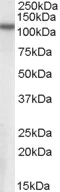
Western blot - Anti-NPEPPS antibody (AB77643)
  • WB

Unknown

Western blot - Anti-NPEPPS antibody (AB77643)

All lanes:

Western blot - Anti-NPEPPS antibody (ab77643) at 0.3 µg/mL

All lanes:

Human cerebral cortex lysate in RIPA buffer at 35 µg

Predicted band size: 103 kDa

Observed band size: 110 kDa

false

Key facts

Host species

Goat

Clonality

Polyclonal

Isotype

IgG

Carrier free

No

Reacts with

Human

Applications

WB

applications

Immunogen

Synthetic Peptide within Human NPEPPS aa 850 to C-terminus. The exact immunogen used to generate this antibody is proprietary information.

P55786

Reactivity data

{ "title": "Reactivity Data", "filters": { "stats": ["", "Species", "Dilution Info", "Notes"], "tabs": { "all-applications": {"fullname" : "All Applications", "shortname": "All Applications"}, "WB" : {"fullname" : "Western blot", "shortname":"WB"} }, "product-promise": { "all": "all", "testedAndGuaranteed": "tested", "guaranteed": "expected", "predicted": "predicted", "notRecommended": "not-recommended" } }, "values": { "Human": { "WB-species-checked": "testedAndGuaranteed", "WB-species-dilution-info": "0.2-0.5 µg/mL", "WB-species-notes": "<p>A 1 hour primary incubation is recommended for this product.</p>" }, "Mouse": { "WB-species-checked": "predicted", "WB-species-dilution-info": "", "WB-species-notes": "" }, "Rat": { "WB-species-checked": "predicted", "WB-species-dilution-info": "", "WB-species-notes": "" }, "Chimpanzee": { "WB-species-checked": "predicted", "WB-species-dilution-info": "", "WB-species-notes": "" }, "Cow": { "WB-species-checked": "predicted", "WB-species-dilution-info": "", "WB-species-notes": "" }, "Dog": { "WB-species-checked": "predicted", "WB-species-dilution-info": "", "WB-species-notes": "" }, "Horse": { "WB-species-checked": "predicted", "WB-species-dilution-info": "", "WB-species-notes": "" }, "Macaque monkey": { "WB-species-checked": "predicted", "WB-species-dilution-info": "", "WB-species-notes": "" } } }

Properties and storage information

Form
Liquid
Purification technique
Affinity purification Immunogen
Purification notes
Purified from goat serum by ammonium sulphate precipitation followed by antigen affinity chromatography using the immunizing peptide.
Storage buffer
pH: 7.3 Preservative: 0.02% Sodium azide Constituents: Tris buffered saline, 0.5% BSA
Shipped at conditions
Blue Ice
Appropriate short-term storage conditions
+4°C
Appropriate long-term storage conditions
-20°C
Aliquoting information
Upon delivery aliquot
Storage information
Avoid freeze / thaw cycle

Supplementary information

This supplementary information is collated from multiple sources and compiled automatically.

NPEPPS also known as aminopeptidase puromycin sensitive or APP is a metalloprotease with an approximate molecular mass of 103 kDa. It functions by catalyzing the cleavage of N-terminal amino acids from peptides which is important for many cellular processes. NPEPPS localizes to both the cytoplasm and nucleus within cells and it shows widespread expression across various tissues especially in the brain heart and liver. Its activity plays an important role in the breakdown and recycling of intracellular proteins.
Biological function summary

NPEPPS influences protein turnover by participating in peptide degradation and processing. The enzyme associates with complexes involved in antigen processing impacting the production of antigenic peptides presented by MHC class I molecules. By regulating peptide availability NPEPPS facilitates immune responses and maintains cellular protein homeostasis. This regulatory effect makes it important for several physiological and cellular functions emphasizing its involvement beyond simple peptide cleavage.

Pathways

The NPEPPS enzyme influences the ubiquitin-proteasome system an essential cellular mechanism for protein degradation. This pathway requires NPEPPS for the final trimming of peptides before they are presented by the immune system. The enzyme's activity also connects to the mTOR signaling pathway which controls cell growth and metabolism. Proteins such as ubiquitin and components of the proteasome interact with NPEPPS linking its mechanical function to larger cellular and metabolic pathways.

NPEPPS has associations with neurodegenerative diseases like Alzheimer's disease and Huntington's disease. Altered enzyme function can affect peptide accumulation potentially contributing to the pathological protein aggregates observed in these diseases. Investigations also show a connection to proteins such as amyloid precursor protein implicating NPEPPS in pathways leading to amyloid plaque formation in Alzheimer's. These interactions highlight the potential impact of NPEPPS in disease mechanisms and as a target for therapeutic intervention.

Product protocols

For this product, it's our understanding that no specific protocols are required. You can visit:

Target data

Aminopeptidase with broad substrate specificity for several peptides. Involved in proteolytic events essential for cell growth and viability. May act as regulator of neuropeptide activity. Plays a role in the antigen-processing pathway for MHC class I molecules. Involved in the N-terminal trimming of cytotoxic T-cell epitope precursors. Digests the poly-Q peptides found in many cellular proteins. Digests tau from normal brain more efficiently than tau from Alzheimer disease brain.
See full target information NPEPPS

Alternative Names

PSA, NPEPPS, Puromycin-sensitive aminopeptidase, Cytosol alanyl aminopeptidase, AAP-S

Publications (2)

Recent publications for all applications. Explore the full list and refine your search

MedComm 5:e506 PubMed38525110

2024

Generation and utilization of endostatin-sensitive cell lines for assessing the biological activity of endostatin.

Applications

Unspecified application

Species

Unspecified reactive species

Xi Qin,Yifang An,Xiang Li,Fang Huang,Yong Zhou,Dening Pei,Hua Bi,Xinchang Shi,Wenhong Fan,Youxue Ding,Shuang Li,Shanhu Li,Junzhi Wang

Fundamental & clinical pharmacology 28:42-52 PubMed22985249

2012

Atorvastatin preconditioning improves the forward blood flow in the no-reflow rats.

Applications

Unspecified application

Species

Unspecified reactive species

Liang Shao,Yong Zhang,Aiqun Ma,Ping Zhang,Dayin Wu,Wenzhu Li,Jue Wang,Kun Liu,Zhaohui Wang
View all publications

Product promise

We are committed to supporting your work with high-quality reagents, and we're here for you every step of the way. In the unlikely event that one of our products does not perform as expected, you're protected by our Product Promise.
For full details, please see our Terms & Conditions

Please note: All products are 'FOR RESEARCH USE ONLY. NOT FOR USE IN DIAGNOSTIC OR THERAPEUTIC PROCEDURES'.

For licensing inquiries, please contact partnerships@abcam.com