JavaScript is disabled in your browser. Please enable JavaScript to view this website.
AB247783

Anti-NR2E1/Tailless/TLX antibody [EPR4491] - BSA and Azide free

Be the first to review this product! Submit a review

|

(0 Publication)
Rabbit Recombinant Monoclonal NR2E1/Tailless/TLX antibody. Carrier free. Suitable for WB and reacts with Human samples.
2 Images
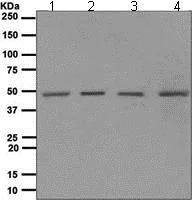
Western blot - Anti-NR2E1/Tailless/TLX antibody [EPR4491] - BSA and Azide free (AB247783)
  • WB

Unknown

Western blot - Anti-NR2E1/Tailless/TLX antibody [EPR4491] - BSA and Azide free (AB247783)

This data was developed using ab109179, the same antibody clone in a different buffer formulation.

All lanes:

Western blot - Anti-NR2E1/Tailless/TLX antibody [EPR4491] (<a href='/en-us/products/primary-antibodies/nr2e1-tailless-tlx-antibody-epr4491-ab109179'>ab109179</a>) at 1/1000 dilution

Lane 1:

Fetal brain lysate at 10 µg

Lane 2:

Human hippocampus lysate at 10 µg

Lane 3:

SH-SY5Y lysate at 10 µg

Lane 4:

Jurkat lysate at 10 µg

Predicted band size: 43 kDa

false
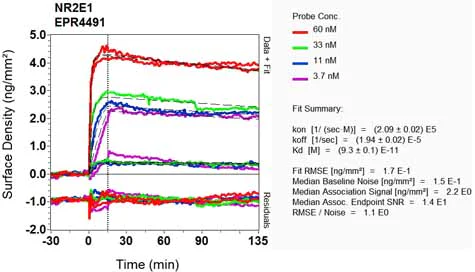
OI-RD Scanning - Anti-NR2E1/Tailless/TLX antibody [EPR4491] - BSA and Azide free (AB247783)
  • OI-RD Scanning

Unknown

OI-RD Scanning - Anti-NR2E1/Tailless/TLX antibody [EPR4491] - BSA and Azide free (AB247783)

We have systematically measured KD (the equilibrium dissociation constant between the antibody and its antigen), of more than 840 recombinant antibodies to assess not only their individual KD values but also to see the average affinity of antibody. Based on the comparison with published literature values for mouse monoclonal antibodies, Recombinant antibodies appear to be on average 1-2 order of magnitude higher affinity.

Key facts

Host species

Rabbit

Clonality

Monoclonal

Clone number

EPR4491

Isotype

IgG

Carrier free

Yes

Reacts with

Human

Applications

WB

applications

Immunogen

The exact immunogen used to generate this antibody is proprietary information.

Reactivity data

{ "title": "Reactivity Data", "filters": { "stats": ["", "Species", "Dilution Info", "Notes"], "tabs": { "all-applications": {"fullname" : "All Applications", "shortname": "All Applications"}, "ICCIF" : {"fullname" : "Immunocytochemistry/ Immunofluorescence", "shortname":"ICC/IF"}, "IP" : {"fullname" : "Immunoprecipitation", "shortname":"IP"}, "FlowCyt" : {"fullname" : "Flow Cytometry", "shortname":"Flow Cyt"}, "WB" : {"fullname" : "Western blot", "shortname":"WB"}, "IHCP" : {"fullname" : "Immunohistochemistry (Formalin/PFA-fixed paraffin-embedded sections)", "shortname":"IHC-P"} }, "product-promise": { "all": "all", "testedAndGuaranteed": "tested", "guaranteed": "expected", "predicted": "predicted", "notRecommended": "not-recommended" } }, "values": { "Human": { "ICCIF-species-checked": "notRecommended", "ICCIF-species-dilution-info": "", "ICCIF-species-notes": "<p></p>", "IP-species-checked": "notRecommended", "IP-species-dilution-info": "", "IP-species-notes": "<p></p>", "FlowCyt-species-checked": "notRecommended", "FlowCyt-species-dilution-info": "", "FlowCyt-species-notes": "<p></p>", "WB-species-checked": "testedAndGuaranteed", "WB-species-dilution-info": "", "WB-species-notes": "<p></p>", "IHCP-species-checked": "notRecommended", "IHCP-species-dilution-info": "", "IHCP-species-notes": "<p></p>" }, "Mouse": { "ICCIF-species-checked": "notRecommended", "ICCIF-species-dilution-info": "", "ICCIF-species-notes": "", "IP-species-checked": "notRecommended", "IP-species-dilution-info": "", "IP-species-notes": "", "FlowCyt-species-checked": "notRecommended", "FlowCyt-species-dilution-info": "", "FlowCyt-species-notes": "", "WB-species-checked": "predicted", "WB-species-dilution-info": "", "WB-species-notes": "", "IHCP-species-checked": "notRecommended", "IHCP-species-dilution-info": "", "IHCP-species-notes": "" }, "Rat": { "ICCIF-species-checked": "notRecommended", "ICCIF-species-dilution-info": "", "ICCIF-species-notes": "", "IP-species-checked": "notRecommended", "IP-species-dilution-info": "", "IP-species-notes": "", "FlowCyt-species-checked": "notRecommended", "FlowCyt-species-dilution-info": "", "FlowCyt-species-notes": "", "WB-species-checked": "predicted", "WB-species-dilution-info": "", "WB-species-notes": "", "IHCP-species-checked": "notRecommended", "IHCP-species-dilution-info": "", "IHCP-species-notes": "" } } }

Product details

ab247783 is the carrier-free version of ab109179.

Patented technology
Our RabMAb® technology is a patented hybridoma-based technology for making rabbit monoclonal antibodies. For details on our patents, please refer to RabMAb® patents.

What are the advantages of a recombinant monoclonal antibody?
This product is a recombinant monoclonal antibody, which offers several advantages including:

  • - High batch-to-batch consistency and reproducibility
  • - Improved sensitivity and specificity
  • - Long-term security of supply
  • - Animal-free batch production

For more information, read more on recombinant antibodies.

Conjugation ready
Our carrier-free antibodies are typically supplied in a PBS-only formulation, purified and free of BSA, sodium azide and glycerol. This conjugation-ready format is designed for use with fluorochromes, metal isotopes, oligonucleotides, and enzymes, which makes them ideal for antibody labelling, functional and cell-based assays, flow-based assays (e.g. mass cytometry) and Multiplex Imaging applications.

Use our conjugation kits for antibody conjugates that are ready-to-use in as little as 20 minutes with 1 minute hands-on-time and 100% antibody recovery: available for fluorescent dyes, HRP, biotin and gold.

Compatibility
This product is compatible with the Maxpar® Antibody Labeling Kit from Fluidigm, without the need for antibody preparation. Maxpar® is a trademark of Fluidigm Canada Inc.

Properties and storage information

Form
Liquid
Purification technique
Affinity purification Protein A
Storage buffer
pH: 7.2 - 7.4 Constituents: PBS
Shipped at conditions
Blue Ice
Appropriate short-term storage conditions
+4°C
Appropriate long-term storage conditions
+4°C
Storage information
Do Not Freeze

Supplementary information

This supplementary information is collated from multiple sources and compiled automatically.

NR2E1 also known as Tailless or TLX is a nuclear receptor protein with a mass of approximately 50 kDa. It acts as a transcription factor functioning primarily by binding to specific DNA sequences and regulating gene expression. NR2E1 is highly expressed in the brain particularly in areas involved in regulating neurogenesis and maintaining neural stem cells. Additionally it shows expression in the retina and various embryonic tissues where it plays an important role in development.
Biological function summary

NR2E1 influences the development and function of the central nervous system by regulating neural stem cell proliferation and differentiation. It forms a transcriptional complex by interacting with co-repressors leading to suppression of target gene expression. This protein helps to maintain neural precursor populations and controls the balance between stem cell self-renewal and differentiation an important process in neurodevelopment and adult brain function.

Pathways

The NR2E1 protein participates in the Notch signaling pathway and is also associated with the Wnt signaling pathway. These pathways are important for cellular differentiation and proliferation in the context of neurodevelopment. NR2E1 interacts with several key proteins including PAX6 and SOX2 which are important in the regulation and identity of neural precursor cells ensuring proper brain development and function through these pathways.

NR2E1 links to neurodegenerative diseases and psychiatric disorders. Abnormalities in its expression or function are associated with conditions like schizophrenia and depression. Its role in maintaining neural stem cell populations implicates it in disorders involving neurogenesis dysregulation. Additionally NR2E1's interactions with proteins such as REST may have implications in understanding and potentially addressing these disorders as REST is involved in neuronal gene silencing in various neuropathological conditions.

Product protocols

For this product, it's our understanding that no specific protocols are required. You can visit:

Target data

Orphan receptor that binds DNA as a monomer to hormone response elements (HRE) containing an extended core motif half-site sequence 5'-AAGGTCA-3' in which the 5' flanking nucleotides participate in determining receptor specificity (By similarity). May be required to pattern anterior brain differentiation. Involved in the regulation of retinal development and essential for vision. During retinogenesis, regulates PTEN-Cyclin D expression via binding to the promoter region of PTEN and suppressing its activity (By similarity). May be involved in retinoic acid receptor (RAR) regulation in retinal cells.
See full target information NR2E1

Alternative Names

TLX, NR2E1, Nuclear receptor subfamily 2 group E member 1, Nuclear receptor TLX, Protein tailless homolog, Tll, hTll

Product promise

We are committed to supporting your work with high-quality reagents, and we're here for you every step of the way. In the unlikely event that one of our products does not perform as expected, you're protected by our Product Promise.
For full details, please see our Terms & Conditions

Please note: All products are 'FOR RESEARCH USE ONLY. NOT FOR USE IN DIAGNOSTIC OR THERAPEUTIC PROCEDURES'.

For licensing inquiries, please contact partnerships@abcam.com