JavaScript is disabled in your browser. Please enable JavaScript to view this website.
AB55744

Anti-NRF1 antibody [2F9]

5

(4 Reviews)

|

(38 Publications )
Mouse Monoclonal NRF1 antibody. Suitable for WB, IHC-P and reacts with Human samples. Cited in 38 publications. Immunogen corresponding to Recombinant Fragment Protein within Human NRF1 aa 200-300.
2 Images
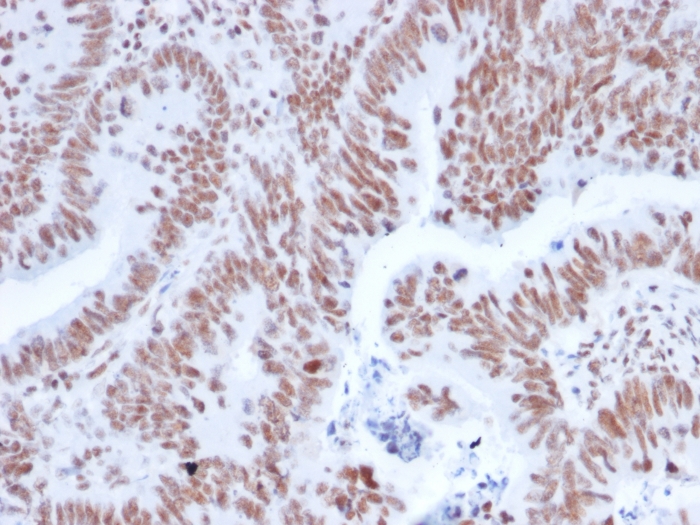
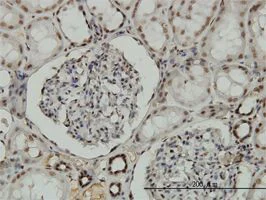
Immunohistochemistry (Formalin/PFA-fixed paraffin-embedded sections) - Anti-NRF1 antibody [2F9] (AB55744)
  • IHC-P

Unknown

Immunohistochemistry (Formalin/PFA-fixed paraffin-embedded sections) - Anti-NRF1 antibody [2F9] (AB55744)

NRF1 antibody (ab55744) used in immunohistochemistry at μg/ml on formalin fixed and paraffin embedded human kidney.

This image was generated using the ascites version of the product.
Western blot - Anti-NRF1 antibody [2F9] (AB55744)
  • WB

Unknown

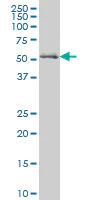
Western blot - Anti-NRF1 antibody [2F9] (AB55744)

This image was generated using the ascites version of the product.

All lanes:

Western blot - Anti-NRF1 antibody [2F9] (ab55744) at 1 µg/mL

All lanes:

Human skeletal muscle lysate

Secondary

All lanes:

Goat Anti-Mouse IgG (H&L)-HRP Conjugate

Predicted band size: 54 kDa

false

Key facts

Host species

Mouse

Clonality

Monoclonal

Clone number

2F9

Isotype

IgG1

Light chain type

kappa

Carrier free

No

Reacts with

Human

Applications

IHC-P, WB

applications

Immunogen

Recombinant Fragment Protein within Human NRF1 aa 200-300. The exact immunogen used to generate this antibody is proprietary information.

Q16656

Reactivity data

{ "title": "Reactivity Data", "filters": { "stats": ["", "Species", "Dilution Info", "Notes"], "tabs": { "all-applications": {"fullname" : "All Applications", "shortname": "All Applications"}, "WB" : {"fullname" : "Western blot", "shortname":"WB"}, "IHCP" : {"fullname" : "Immunohistochemistry (Formalin/PFA-fixed paraffin-embedded sections)", "shortname":"IHC-P"} }, "product-promise": { "all": "all", "testedAndGuaranteed": "tested", "guaranteed": "expected", "predicted": "predicted", "notRecommended": "not-recommended" } }, "values": { "Human": { "WB-species-checked": "testedAndGuaranteed", "WB-species-dilution-info": "", "WB-species-notes": "<p></p>", "IHCP-species-checked": "testedAndGuaranteed", "IHCP-species-dilution-info": "", "IHCP-species-notes": "<p></p>" } } }

Product details

This product was changed from ascites to tissue culture supernatant on 15 May 2019. Please note that the dilutions may need to be adjusted accordingly. If you have any questions, please do not hesitate to contact our scientific support team.

Properties and storage information

Form
Liquid
Purity
Tissue culture supernatant
Purification notes
Purified from TCS.
Storage buffer
pH: 7.4
Shipped at conditions
Blue Ice
Appropriate short-term storage conditions
+4°C
Appropriate long-term storage conditions
-20°C
Aliquoting information
Upon delivery aliquot
Storage information
Avoid freeze / thaw cycle

Supplementary information

This supplementary information is collated from multiple sources and compiled automatically.

The nuclear respiratory factor 1 (NRF1) also known as Alpha-Pal is a transcription factor with an approximate molecular weight of 68 kDa. It plays an important role in the regulation of genes required for mitochondrial DNA transcription and replication. Researchers find NRF1 expression in various tissues including muscle brain and liver. This protein functions mechanistically by binding to specific promoter regions of target genes to control their expression making it essential for maintaining cellular energy metabolism.
Biological function summary

NRF1 influences the expression of genes involved in the mitochondrial function and is part of the transcriptional complex. This complex includes the NRF2 protein where NRF1 partners with co-activators to modulate gene transcription. NRF1 promotes the expression of components essential for mitochondrial biogenesis and cellular respiration which are vital processes for energy production in cells. Therefore NRF1 contributes to maintaining cellular energy homeostasis and overall cellular health.

Pathways

NRF1 integrates into critical regulatory pathways for mitochondrial function and metabolism. NRF1 links closely to the PGC-1α pathway which is instrumental in the regulation of energy metabolism and mitochondrial biogenesis. Additionally NRF1 works in conjunction with NRF2 to regulate oxidative stress responses. These interactions ensure a coordinated cellular response to energy demands and help protect the cell from oxidative damage.

NRF1 associates with neurodegenerative diseases and metabolic syndromes. Altered NRF1 regulation can impact diseases such as Alzheimer's disease where it may contribute to neurodegeneration through impaired mitochondrial function. Moreover the dysfunction of NRF1 might relate to metabolic disorders like diabetes as energy metabolism and mitochondrial health are disrupted. NRF1 connects with proteins like SIRT1 in these contexts further implicating NRF1 in these pathological states through its role in energy homeostasis and stress response.

Product protocols

For this product, it's our understanding that no specific protocols are required. You can visit:

Target data

Transcription factor that activates the expression of the EIF2S1 (EIF2-alpha) gene. Links the transcriptional modulation of key metabolic genes to cellular growth and development. Implicated in the control of nuclear genes required for respiration, heme biosynthesis, and mitochondrial DNA transcription and replication.
See full target information NRF1

Alternative Names

Nuclear respiratory factor 1, NRF-1, Alpha palindromic-binding protein, Alpha-pal, NRF1

Publications (38)

Recent publications for all applications. Explore the full list and refine your search

BMC medicine 22:543 PubMed39558356

2024

Gain of bipolar disorder-related lncRNA AP1AR-DT in mice induces depressive and anxiety-like behaviors by reducing Negr1-mediated excitatory synaptic transmission.

Applications

Unspecified application

Species

Unspecified reactive species

Shufen Li,Hongyu Ni,Yaping Wang,Xiaohui Wu,Jianqiang Bi,Haiyan Ou,Zhongwei Li,Junjiao Ping,Zhongju Wang,Renhao Chen,Qiong Yang,Meijun Jiang,Liping Cao,Tingyun Jiang,Siqiang Ren,Cunyou Zhao

Nature 631:891-898 PubMed39020164

2024

Position-dependent function of human sequence-specific transcription factors.

Applications

Unspecified application

Species

Unspecified reactive species

Sascha H Duttke,Carlos Guzman,Max Chang,Nathaniel P Delos Santos,Bayley R McDonald,Jialei Xie,Aaron F Carlin,Sven Heinz,Christopher Benner

Nature communications 15:3563 PubMed38670969

2024

LSD1 inhibition circumvents glucocorticoid-induced muscle wasting of male mice.

Applications

Unspecified application

Species

Unspecified reactive species

Qingshuang Cai,Rajesh Sahu,Vanessa Ueberschlag-Pitiot,Sirine Souali-Crespo,Céline Charvet,Ilyes Silem,Félicie Cottard,Tao Ye,Fatima Taleb,Eric Metzger,Roland Schuele,Isabelle M L Billas,Gilles Laverny,Daniel Metzger,Delphine Duteil

Nature communications 14:405 PubMed36697417

2023

Epigenetic and transcriptional regulations prime cell fate before division during human pluripotent stem cell differentiation.

Applications

Unspecified application

Species

Unspecified reactive species

Pedro Madrigal,Siwei Deng,Yuliang Feng,Stefania Militi,Kim Jee Goh,Reshma Nibhani,Rodrigo Grandy,Anna Osnato,Daniel Ortmann,Stephanie Brown,Siim Pauklin

Redox biology 58:102537 PubMed36436456

2022

Ablation of Shank3 alleviates cardiac dysfunction in aging mice by promoting CaMKII activation and Parkin-mediated mitophagy.

Applications

Unspecified application

Species

Unspecified reactive species

Ying Wang,Yuerong Xu,Wangang Guo,Yexian Fang,Lang Hu,Runze Wang,Ran Zhao,Dong Guo,Bingchao Qi,Gaotong Ren,Jun Ren,Yan Li,Mingming Zhang

Aging cell 21:e13665 PubMed36111352

2022

Age alters the oncogenic trajectory toward luminal mammary tumors that activate unfolded proteins responses.

Applications

Unspecified application

Species

Unspecified reactive species

Edmund Charles Jenkins,Mrittika Chattopadhyay,Maria Gomez,Denis Torre,Avi Ma'ayan,Miguel Torres-Martin,Daniela Sia,Doris Germain

Nature genetics 54:1238-1247 PubMed35864192

2022

Hijacking of transcriptional condensates by endogenous retroviruses.

Applications

Unspecified application

Species

Unspecified reactive species

Vahid Asimi,Abhishek Sampath Kumar,Henri Niskanen,Christina Riemenschneider,Sara Hetzel,Julian Naderi,Nina Fasching,Niko Popitsch,Manyu Du,Helene Kretzmer,Zachary D Smith,Raha Weigert,Maria Walther,Sainath Mamde,David Meierhofer,Lars Wittler,René Buschow,Bernd Timmermann,Ibrahim I Cisse,Stefan L Ameres,Alexander Meissner,Denes Hnisz

Cell reports 38:110254 PubMed35045282

2022

The portrait of liver cancer is shaped by mitochondrial genetics.

Applications

Unspecified application

Species

Unspecified reactive species

Mrittika Chattopadhyay,Edmund Charles Jenkins,Ana Victoria Lechuga-Vieco,Kai Nie,Maria Isabel Fiel,Alexander Rialdi,Ernesto Guccione,Jose Antonio Enriquez,Daniela Sia,Amaia Lujambio,Doris Germain

Journal of inflammation (London, England) 18:31 PubMed34930287

2021

Ginsenoside Rg3 alleviates septic liver injury by regulating the lncRNA TUG1/miR-200c-3p/SIRT1 axis.

Applications

Unspecified application

Species

Unspecified reactive species

Pan Wu,Xiao Yu,Yue Peng,Qian-Lu Wang,Long-Tian Deng,Wei Xing

Molecular cell 81:4663-4676.e8 PubMed34637754

2021

NRF1 association with AUTS2-Polycomb mediates specific gene activation in the brain.

Applications

Unspecified application

Species

Unspecified reactive species

Sanxiong Liu,Kimberly A Aldinger,Chi Vicky Cheng,Takae Kiyama,Mitali Dave,Hanna K McNamara,Wukui Zhao,James M Stafford,Nicolas Descostes,Pedro Lee,Stefano G Caraffi,Ivan Ivanovski,Edoardo Errichiello,Christiane Zweier,Orsetta Zuffardi,Michael Schneider,Antigone S Papavasiliou,M Scott Perry,Jennifer Humberson,Megan T Cho,Astrid Weber,Andrew Swale,Tudor C Badea,Chai-An Mao,Livia Garavelli,William B Dobyns,Danny Reinberg
View all publications

Product promise

We are committed to supporting your work with high-quality reagents, and we're here for you every step of the way. In the unlikely event that one of our products does not perform as expected, you're protected by our Product Promise.
For full details, please see our Terms & Conditions

Please note: All products are 'FOR RESEARCH USE ONLY. NOT FOR USE IN DIAGNOSTIC OR THERAPEUTIC PROCEDURES'.

For licensing inquiries, please contact partnerships@abcam.com