JavaScript is disabled in your browser. Please enable JavaScript to view this website.
AB264242

Anti-Optineurin antibody

Be the first to review this product! Submit a review

|

(0 Publication)

Rabbit Polyclonal Optineurin antibody. Suitable for IP, WB and reacts with Human samples. Immunogen corresponding to Synthetic Peptide within Human OPTN aa 500 to C-terminus.
2 Images
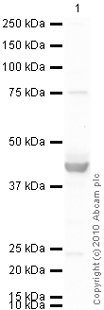
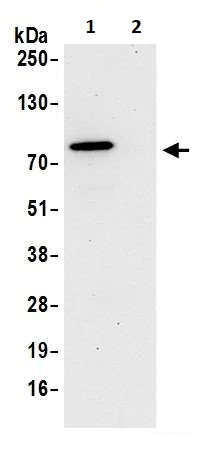
Immunoprecipitation - Anti-Optineurin antibody (AB264242)
  • IP

Supplier Data

Immunoprecipitation - Anti-Optineurin antibody (AB264242)

Optineurin was immunoprecipitated from HeLa (human epithelial cell line from cervix adenocarcinoma) whole cell lysate (0.5 or 1.0 mg per IP reaction; 20% of IP loaded) using ab264242 at 6 μg per reaction. Western blot was performed on the immunoprecipitates using ab264242 at 1 μg/ml.

Lane 1 : ab264242 IP in HeLa whole cell lysate.

Lane 2 : Control IgG IP in Hela whole cell lysate.

Exposure time : 30 seconds.

Lysates prepared in NETN buffer.

All lanes:

Immunoprecipitation - Anti-Optineurin antibody (ab264242)

Predicted band size: 66 kDa

false
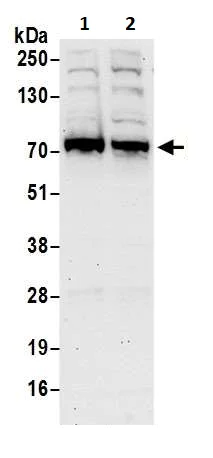
Western blot - Anti-Optineurin antibody (AB264242)
  • WB

Supplier Data

Western blot - Anti-Optineurin antibody (AB264242)

Lysates prepared using NETN buffer.

All lanes:

Western blot - Anti-Optineurin antibody (ab264242) at 0.4 µg/mL

Lane 1:

HeLa human epithelial cell line from cervix adenocarcinoma) whole cell lysate at 50 µg

Lane 2:

HEK-293T (human epithelial cell line from embryonic kidney transformed with large T antigen) whole cell lysate at 50 µg

Predicted band size: 66 kDa

true

Exposure time: 30s

Key facts

Host species

Rabbit

Clonality

Polyclonal

Isotype

IgG

Carrier free

No

Reacts with

Human

Applications

WB, IP

applications

Immunogen

Synthetic Peptide within Human OPTN aa 500 to C-terminus. The exact immunogen used to generate this antibody is proprietary information.

Q96CV9

Reactivity data

{ "title": "Reactivity Data", "filters": { "stats": ["", "Species", "Dilution Info", "Notes"], "tabs": { "all-applications": {"fullname" : "All Applications", "shortname": "All Applications"}, "IP" : {"fullname" : "Immunoprecipitation", "shortname":"IP"}, "WB" : {"fullname" : "Western blot", "shortname":"WB"} }, "product-promise": { "all": "all", "testedAndGuaranteed": "tested", "guaranteed": "expected", "predicted": "predicted", "notRecommended": "not-recommended" } }, "values": { "Human": { "IP-species-checked": "testedAndGuaranteed", "IP-species-dilution-info": "2-5 µg/mg of lysate", "IP-species-notes": "<p></p>", "WB-species-checked": "testedAndGuaranteed", "WB-species-dilution-info": "1/2000 - 1/10000", "WB-species-notes": "<p></p>" }, "Orangutan": { "IP-species-checked": "predicted", "IP-species-dilution-info": "", "IP-species-notes": "", "WB-species-checked": "predicted", "WB-species-dilution-info": "", "WB-species-notes": "" } } }

Properties and storage information

Form
Liquid
Purification technique
Affinity purification Immunogen
Storage buffer
pH: 7 - 8 Preservative: 0.09% Sodium azide Constituents: Tris citrate/phosphate
Shipped at conditions
Blue Ice
Appropriate short-term storage duration
1-2 weeks
Appropriate short-term storage conditions
+4°C
Appropriate long-term storage conditions
+4°C
Aliquoting information
Upon delivery aliquot
Storage information
Avoid freeze / thaw cycle

Supplementary information

This supplementary information is collated from multiple sources and compiled automatically.

Optineurin also known as OPTN is a multifunctional protein of approximately 67 kDa. It is expressed in various tissues including the retina where it plays a role in maintaining cellular functions. Optineurin interacts with several binding partners to execute its roles within the cell. It is involved in intracellular trafficking signaling and inflammation processes. As an essential component of the cellular machinery optineurin aids in proper cellular communication and responses.
Biological function summary

Optineurin influences different cellular processes notably autophagy and regulation of inflammation. It participates in forming a complex with other proteins to facilitate cargo transport and degradation via the autophagy-lysosome pathway. This function is important for removing damaged proteins and organelles ensuring cellular homeostasis. Inflammation regulation occurs through optineurin's ability to inhibit certain signaling pathways therefore modulating immune responses and preventing excessive inflammation.

Pathways

Optineurin plays a role in the NF-kB signaling pathway and the autophagic process. In NF-kB signaling it acts as a negative regulator by degrading specific signaling molecules. This regulation is necessary to prevent chronic inflammation and maintain immune balance. Within autophagy optineurin collaborates with other autophagy-related proteins like LC3 to facilitate the sequestration and clearance of cellular components preventing accumulation of damaged cellular materials.

Optineurin connects to conditions like glaucoma and amyotrophic lateral sclerosis (ALS). Mutations in the optineurin gene link to glaucoma as they can impair autophagy and lead to optic nerve damage. In the context of ALS optineurin mutations disrupt normal cellular functions contributing to motor neuron degeneration. The protein TDP-43 is often associated with ALS and interacts with optineurin in pathological processes affecting disease progression.

Product protocols

For this product, it's our understanding that no specific protocols are required. You can visit:

Target data

Plays an important role in the maintenance of the Golgi complex, in membrane trafficking, in exocytosis, through its interaction with myosin VI and Rab8 (PubMed : 27534431). Links myosin VI to the Golgi complex and plays an important role in Golgi ribbon formation (PubMed : 27534431). Plays a role in the activation of innate immune response during viral infection. Mechanistically, recruits TBK1 at the Golgi apparatus, promoting its trans-phosphorylation after RLR or TLR3 stimulation (PubMed : 27538435). In turn, activated TBK1 phosphorylates its downstream partner IRF3 to produce IFN-beta/IFNB1. Plays a neuroprotective role in the eye and optic nerve. May act by regulating membrane trafficking and cellular morphogenesis via a complex that contains Rab8 and huntingtin (HD). Mediates the interaction of Rab8 with the probable GTPase-activating protein TBC1D17 during Rab8-mediated endocytic trafficking, such as that of transferrin receptor (TFRC/TfR); regulates Rab8 recruitment to tubules emanating from the endocytic recycling compartment (PubMed : 22854040). Autophagy receptor that interacts directly with both the cargo to become degraded and an autophagy modifier of the MAP1 LC3 family; targets ubiquitin-coated bacteria (xenophagy), such as cytoplasmic Salmonella enterica, and appears to function in the same pathway as SQSTM1 and CALCOCO2/NDP52.. (Microbial infection) May constitute a cellular target for various viruses, such as adenovirus E3 14.7 or Bluetongue virus, to inhibit innate immune response (PubMed : 27538435, PubMed : 9488477). During RNA virus infection, such as that of Sendai virus, negatively regulates the induction of IFNB1 (PubMed : 20174559).
See full target information OPTN

Alternative Names

FIP2, GLC1E, HIP7, HYPL, NRP, OPTN, Optineurin, E3-14.7K-interacting protein, Huntingtin yeast partner L, Huntingtin-interacting protein 7, Huntingtin-interacting protein L, NEMO-related protein, Optic neuropathy-inducing protein, Transcription factor IIIA-interacting protein, FIP-2, HIP-7, TFIIIA-IntP

Product promise

We are committed to supporting your work with high-quality reagents, and we're here for you every step of the way. In the unlikely event that one of our products does not perform as expected, you're protected by our Product Promise.
For full details, please see our Terms & Conditions

Please note: All products are 'FOR RESEARCH USE ONLY. NOT FOR USE IN DIAGNOSTIC OR THERAPEUTIC PROCEDURES'.

For licensing inquiries, please contact partnerships@abcam.com