JavaScript is disabled in your browser. Please enable JavaScript to view this website.
AB99277

Anti-ORC2 antibody

Be the first to review this product! Submit a review

|

(2 Publications )

Rabbit Polyclonal ORC2L antibody. Suitable for IHC-P, IP, WB and reacts with Human samples. Cited in 2 publications. Immunogen corresponding to Synthetic Peptide within Human ORC2 aa 1-50.
3 Images
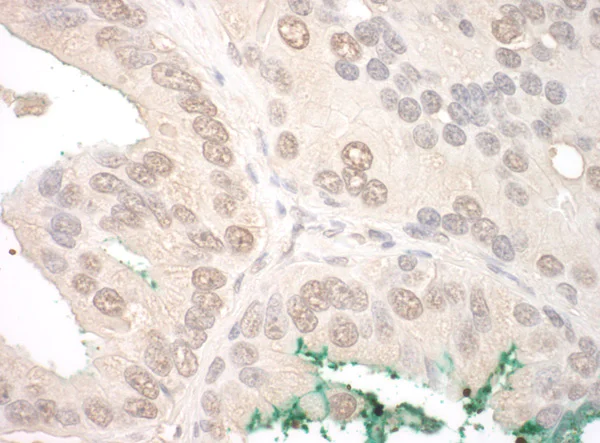
Immunohistochemistry (Formalin/PFA-fixed paraffin-embedded sections) - Anti-ORC2 antibody (AB99277)
  • IHC-P

Unknown

Immunohistochemistry (Formalin/PFA-fixed paraffin-embedded sections) - Anti-ORC2 antibody (AB99277)

Immunohistochemistry (Formalin/PFA-fixed paraffin-embedded sections) analysis of human prostate carcinoma tissue labelling ORC2 with ab99277 at 1/1000 (0.2µg/mg). Detection : DAB.
Immunoprecipitation - Anti-ORC2 antibody (AB99277)
  • IP

Unknown

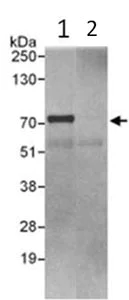
Immunoprecipitation - Anti-ORC2 antibody (AB99277)

Detection of ORC2 in Immunoprecipitates of HeLa whole cell lysates (1 mg for IP, 20% of IP loaded) using ab99277 at 3 µg/mg lysate for IP (Lane 1) and at 0.4 µg/ml for subsequent Western blot detection. Lane 2 represents control IgG IP. Detection : Chemiluminescence with an exposure time of 10 seconds.

All lanes:

Immunoprecipitation - Anti-ORC2 antibody (ab99277)

Predicted band size: 66 kDa

false
Western blot - Anti-ORC2 antibody (AB99277)
  • WB

Unknown

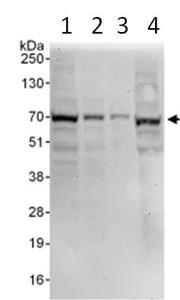
Western blot - Anti-ORC2 antibody (AB99277)

All lanes:

Western blot - Anti-ORC2 antibody (ab99277) at 0.04 µg/mL

Lane 1:

HeLa whole cell lysate at 50 µg

Lane 2:

HeLa whole cell lysate at 15 µg

Lane 3:

HeLa whole cell lysate at 5 µg

Lane 4:

293T whole cell lysate at 50 µg

Predicted band size: 66 kDa

true

Exposure time: 30s

Key facts

Host species

Rabbit

Clonality

Polyclonal

Isotype

IgG

Carrier free

No

Reacts with

Human

Applications

IHC-P, WB, IP

applications

Immunogen

Synthetic Peptide within Human ORC2 aa 1-50. The exact immunogen used to generate this antibody is proprietary information.

Q13416

Reactivity data

{ "title": "Reactivity Data", "filters": { "stats": ["", "Species", "Dilution Info", "Notes"], "tabs": { "all-applications": {"fullname" : "All Applications", "shortname": "All Applications"}, "IHCP" : {"fullname" : "Immunohistochemistry (Formalin/PFA-fixed paraffin-embedded sections)", "shortname":"IHC-P"}, "IP" : {"fullname" : "Immunoprecipitation", "shortname":"IP"}, "WB" : {"fullname" : "Western blot", "shortname":"WB"} }, "product-promise": { "all": "all", "testedAndGuaranteed": "tested", "guaranteed": "expected", "predicted": "predicted", "notRecommended": "not-recommended" } }, "values": { "Human": { "IHCP-species-checked": "testedAndGuaranteed", "IHCP-species-dilution-info": "1/200 - 1/1000", "IHCP-species-notes": "<p></p> Perform heat-mediated antigen retrieval with citrate buffer pH 6 before commencing with IHC staining protocol.", "IP-species-checked": "testedAndGuaranteed", "IP-species-dilution-info": "2-5 µg/mg of lysate", "IP-species-notes": "<p></p>", "WB-species-checked": "testedAndGuaranteed", "WB-species-dilution-info": "1/2000 - 1/10000", "WB-species-notes": "<p></p>" }, "Chimpanzee": { "IHCP-species-checked": "predicted", "IHCP-species-dilution-info": "", "IHCP-species-notes": "", "IP-species-checked": "predicted", "IP-species-dilution-info": "", "IP-species-notes": "", "WB-species-checked": "predicted", "WB-species-dilution-info": "", "WB-species-notes": "" }, "Gorilla": { "IHCP-species-checked": "predicted", "IHCP-species-dilution-info": "", "IHCP-species-notes": "", "IP-species-checked": "predicted", "IP-species-dilution-info": "", "IP-species-notes": "", "WB-species-checked": "predicted", "WB-species-dilution-info": "", "WB-species-notes": "" }, "Horse": { "IHCP-species-checked": "predicted", "IHCP-species-dilution-info": "", "IHCP-species-notes": "", "IP-species-checked": "predicted", "IP-species-dilution-info": "", "IP-species-notes": "", "WB-species-checked": "predicted", "WB-species-dilution-info": "", "WB-species-notes": "" }, "Orangutan": { "IHCP-species-checked": "predicted", "IHCP-species-dilution-info": "", "IHCP-species-notes": "", "IP-species-checked": "predicted", "IP-species-dilution-info": "", "IP-species-notes": "", "WB-species-checked": "predicted", "WB-species-dilution-info": "", "WB-species-notes": "" }, "Rhesus monkey": { "IHCP-species-checked": "predicted", "IHCP-species-dilution-info": "", "IHCP-species-notes": "", "IP-species-checked": "predicted", "IP-species-dilution-info": "", "IP-species-notes": "", "WB-species-checked": "predicted", "WB-species-dilution-info": "", "WB-species-notes": "" } } }

Properties and storage information

Form
Liquid
Purification technique
Affinity purification Immunogen
Storage buffer
pH: 6.8 - 7.4 Preservative: 0.09% Sodium azide Constituents: Tris buffered saline, 0.1% BSA
Shipped at conditions
Blue Ice
Appropriate short-term storage conditions
+4°C
Appropriate long-term storage conditions
+4°C
Aliquoting information
Upon delivery aliquot
Storage information
Avoid freeze / thaw cycle

Supplementary information

This supplementary information is collated from multiple sources and compiled automatically.

The Origin Recognition Complex Subunit 2 also known as ORC2 is a protein that forms an important part of the origin recognition complex (ORC). ORC2 helps initiate DNA replication by identifying and binding to origins of replication in the DNA. It is a protein weighing approximately 62 kDa and is ubiquitously expressed in various tissues. As a central component of the ORC ORC2 collaborates with other components including ORC1 ORC3 ORC4 ORC5 and ORC6 to establish the loading of the pre-replicative complex essential for the initiation of DNA replication.
Biological function summary

ORC2 significantly contributes to the maintenance of genomic stability by participating in DNA replication origins' identification. As part of the origin recognition complex ORC2 operates in the S phase of the cell cycle to ensure that DNA replicates once and only once per cycle. By binding to replication origins ORC2 plays a pivotal role in the formation and stability of the pre-replication complex. The function of ORC2 is therefore important for the precise timing of replication and avoidance of re-replication within the cell cycle.

Pathways

ORC2 predominantly functions within the DNA replication pathway. ORC2 works alongside other proteins such as Minichromosome Maintenance Complex (MCM) proteins to facilitate the progression and completion of DNA replication. Furthermore ORC2 has connections to the cell cycle regulation pathway coordinating with proteins like Cyclin-Dependent Kinases (CDKs) which ensure that replication is synchronized with other cell-cycle events. This cooperation enables the precise orchestration of replication with cell division.

ORC2 has potential links to certain cancers and developmental disorders. Dysregulation or mutation of ORC2 can lead to genomic instability contributing to the onset of cancers. Additionally its malfunction has associations with Meier-Gorlin syndrome a rare genetic disorder caused by defects in genes associated with ORC. This ties ORC2 to other cancers and developmental disorders-related proteins such as ORC4 and ORC6 which also play significant roles in these processes. Understanding ORC2's function and regulation offers important insights into these diseases' mechanisms and potential therapeutic targets.

Product protocols

For this product, it's our understanding that no specific protocols are required. You can visit:

Target data

Component of the origin recognition complex (ORC) that binds origins of replication. DNA-binding is ATP-dependent. The specific DNA sequences that define origins of replication have not been identified yet. ORC is required to assemble the pre-replication complex necessary to initiate DNA replication. Binds histone H3 and H4 trimethylation marks H3K9me3, H3K20me3 and H4K27me3. Stabilizes LRWD1, by protecting it from ubiquitin-mediated proteasomal degradation. Also stabilizes ORC3.
See full target information ORC2

Alternative Names

ORC2L, ORC2, Origin recognition complex subunit 2

Publications (2)

Recent publications for all applications. Explore the full list and refine your search

Cancer medicine 12:5035-5054 PubMed36205357

2022

Systemic analysis of the DNA replication regulator origin recognition complex in lung adenocarcinomas identifies prognostic and expression significance.

Applications

Unspecified application

Species

Unspecified reactive species

Min Tang,Juan Chen,Tian Zeng,Dong-Mei Ye,Yu-Kun Li,Juan Zou,Yu-Ping Zhang

Journal of virology 91: PubMed28701406

2017

Structural and Functional Basis for an EBNA1 Hexameric Ring in Epstein-Barr Virus Episome Maintenance.

Applications

Unspecified application

Species

Unspecified reactive species

Julianna S Deakyne,Kimberly A Malecka,Troy E Messick,Paul M Lieberman
View all publications

Product promise

We are committed to supporting your work with high-quality reagents, and we're here for you every step of the way. In the unlikely event that one of our products does not perform as expected, you're protected by our Product Promise.
For full details, please see our Terms & Conditions

Please note: All products are 'FOR RESEARCH USE ONLY. NOT FOR USE IN DIAGNOSTIC OR THERAPEUTIC PROCEDURES'.

For licensing inquiries, please contact partnerships@abcam.com