JavaScript is disabled in your browser. Please enable JavaScript to view this website.
AB47300

Anti-p21 (phospho T145) antibody

4

(1 Review)

|

(20 Publications )

Rabbit Polyclonal p21 phospho T145 antibody. Suitable for WB, IHC-P, ICC/IF and reacts with Human samples. Cited in 20 publications. Immunogen corresponding to Synthetic Peptide within Human CDKN1A pT145 aa 100 to C-terminus.
3 Images
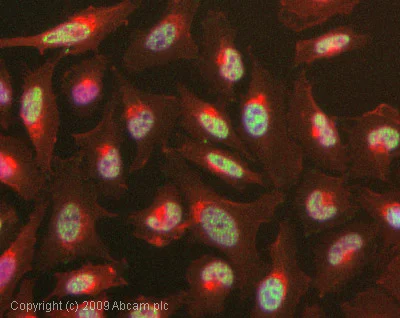
Immunocytochemistry/ Immunofluorescence - Anti-p21 (phospho T145) antibody (AB47300)
  • ICC/IF

Unknown

Immunocytochemistry/ Immunofluorescence - Anti-p21 (phospho T145) antibody (AB47300)

ICC/IF image of ab47300 stained HeLa cells. The cells were 4% PFA fixed (10 min) and then incubated in 1%BSA / 10% normal goat serum / 0.3M glycine in 0.1% PBS-Tween for 1h to permeabilise the cells and block non-specific protein-protein interactions. The cells were then incubated with the antibody (ab47300, 1µg/ml) overnight at +4°C. The secondary antibody (green) was Alexa Fluor® 488 goat anti-rabbit IgG (H+L) used at a 1/1000 dilution for 1h. Alexa Fluor® 594 WGA was used to label plasma membranes (red) at a 1/200 dilution for 1h. DAPI was used to stain the cell nuclei (blue) at a concentration of 1.43µM.
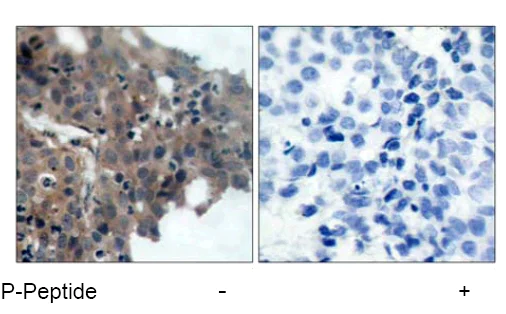
Immunohistochemistry (Formalin/PFA-fixed paraffin-embedded sections) - Anti-p21 (phospho T145) antibody (AB47300)
  • IHC-P

Supplier Data

Immunohistochemistry (Formalin/PFA-fixed paraffin-embedded sections) - Anti-p21 (phospho T145) antibody (AB47300)

ab47300 staining human breast carcinoma tissue by IHC-P (left hand panel). The right hand panel shows staining in the presence of phospho-peptide.
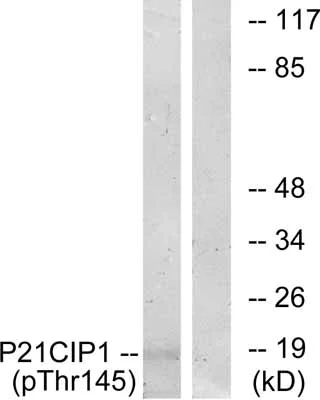
Western blot - Anti-p21 (phospho T145) antibody (AB47300)
  • WB

Unknown

Western blot - Anti-p21 (phospho T145) antibody (AB47300)

All lanes:

Western blot - Anti-p21 (phospho T145) antibody (ab47300)

Lane 1:

EGF treated HeLa cells

Lane 2:

HeLa cells

Predicted band size: 18 kDa

false

Key facts

Host species

Rabbit

Clonality

Polyclonal

Isotype

IgG

Carrier free

No

Reacts with

Human

Applications

IHC-P, ICC/IF, WB

applications

Immunogen

Synthetic Peptide within Human CDKN1A pT145 aa 100 to C-terminus. The exact immunogen used to generate this antibody is proprietary information.

P38936

Reactivity data

{ "title": "Reactivity Data", "filters": { "stats": ["", "Species", "Dilution Info", "Notes"], "tabs": { "all-applications": {"fullname" : "All Applications", "shortname": "All Applications"}, "WB" : {"fullname" : "Western blot", "shortname":"WB"}, "IHCP" : {"fullname" : "Immunohistochemistry (Formalin/PFA-fixed paraffin-embedded sections)", "shortname":"IHC-P"}, "ICCIF" : {"fullname" : "Immunocytochemistry/ Immunofluorescence", "shortname":"ICC/IF"} }, "product-promise": { "all": "all", "testedAndGuaranteed": "tested", "guaranteed": "expected", "predicted": "predicted", "notRecommended": "not-recommended" } }, "values": { "Human": { "WB-species-checked": "testedAndGuaranteed", "WB-species-dilution-info": "1/500 - 1/1000", "WB-species-notes": "<p></p>", "IHCP-species-checked": "testedAndGuaranteed", "IHCP-species-dilution-info": "", "IHCP-species-notes": "<p></p>", "ICCIF-species-checked": "testedAndGuaranteed", "ICCIF-species-dilution-info": "1 µg/mL", "ICCIF-species-notes": "<p></p>" } } }

Product details

p21Cip1 (phospho-Thr145) antibody detects endogenous levels of p21Cip1 only when phosphorylated at threonine 145.

Properties and storage information

Form
Liquid
Purification technique
Affinity purification Immunogen
Purification notes
The antibody was purified using epitope-specific phosphopeptide. The antibody against non-phosphopeptide was removed by chromatography using non-phosphopeptide corresponding to the phosphorylation site.
Storage buffer
pH: 7.4 Preservative: 0.02% Sodium azide Constituents: PBS, 50% Glycerol (glycerin, glycerine), 0.87% Sodium chloride
Shipped at conditions
Blue Ice
Appropriate short-term storage conditions
+4°C
Appropriate long-term storage conditions
-20°C
Storage information
Stable for 12 months at -20°C

Supplementary information

This supplementary information is collated from multiple sources and compiled automatically.

The p21 protein also known as CDKN1A is an important regulator of cell cycle progression. It acts as a cyclin-dependent kinase inhibitor where it binds to and inhibits the activity of cyclin-CDK2 or -CDK4 complexes. The molecular weight of p21 is approximately 21 kDa. Cellular expression of p21 is diverse; it occurs in various tissues reflecting its broad role in maintaining cell cycle control. This protein's expression level is often assessed using techniques such as p21 western blotting p21 ELISA and p21 IHC staining.
Biological function summary

P21 plays a critical role in cell cycle regulation and DNA damage response. It associates with the p53 tumor suppressor protein forming an essential part of the p53 signaling pathway under stress conditions. p21 arrests cells in G1 phase allowing DNA repair or leading to cellular senescence. Through these mechanisms p21 integrates signals from stress and damage emphasizing its importance as a mediator in cellular checkpoint control.

Pathways

P21 is closely involved in the p53 and the Transforming Growth Factor-beta (TGF-β) signaling pathways. This integration helps in transmitting growth-inhibitory signals. p21 interacts with proteins such as p53 and cyclins ensuring precise regulation of the cell cycle and growth arrest when necessary. Triggered by p53 activation p21 contributes to preventing undisturbed cell proliferation acting as a safeguard against tumor formation.

P21's deregulation associates with cancer and age-related diseases. Its impairment is a common feature in many cancers often linked with defects in the p53 pathway. Reduced p21 expression can contribute to unchecked cell division and tumor progression. Moreover in age-related diseases p21's role in promoting cellular senescence connects it with degenerative conditions. The intricate relationship between p21 and proteins such as p53 and cyclins highlights its potential as a therapeutic target for these disorders.

Product protocols

For this product, it's our understanding that no specific protocols are required. You can visit:

Target data

Plays an important role in controlling cell cycle progression and DNA damage-induced G2 arrest (PubMed : 9106657). Involved in p53/TP53 mediated inhibition of cellular proliferation in response to DNA damage. Also involved in p53-independent DNA damage-induced G2 arrest mediated by CREB3L1 in astrocytes and osteoblasts (By similarity). Binds to and inhibits cyclin-dependent kinase activity, preventing phosphorylation of critical cyclin-dependent kinase substrates and blocking cell cycle progression. Functions in the nuclear localization and assembly of cyclin D-CDK4 complex and promotes its kinase activity towards RB1. At higher stoichiometric ratios, inhibits the kinase activity of the cyclin D-CDK4 complex. Inhibits DNA synthesis by DNA polymerase delta by competing with POLD3 for PCNA binding (PubMed : 11595739). Negatively regulates the CDK4- and CDK6-driven phosphorylation of RB1 in keratinocytes, thereby resulting in the release of E2F1 and subsequent transcription of E2F1-driven G1/S phase promoting genes (By similarity).
See full target information CDKN1A pT145

Alternative Names

CAP20, CDKN1, CIP1, MDA6, PIC1, SDI1, WAF1, CDKN1A, Cyclin-dependent kinase inhibitor 1, CDK-interacting protein 1, Melanoma differentiation-associated protein 6, p21, MDA-6

Publications (20)

Recent publications for all applications. Explore the full list and refine your search

NAR cancer 7:zcaf009 PubMed40115747

2025

TRIP13 protects pancreatic cancer cells against intrinsic and therapy-induced DNA replication stress.

Applications

Unspecified application

Species

Unspecified reactive species

Jay R Anand,Gaith N Droby,Sayali Joseph,Urvi Patel,Xingyuan Zhang,Jeffrey A Klomp,Channing J Der,Jeremy E Purvis,Samuel C Wolff,Jessica L Bowser,Cyrus Vaziri

Oncology letters 28:538 PubMed39310025

2024

TREM2 promotes the proliferation and invasion of renal cell carcinoma cells by inhibiting the P53 signaling pathway.

Applications

Unspecified application

Species

Unspecified reactive species

Liang Zhang,Zhong Lv,Qin-Yu Xu,Bin Wu

iScience 27:108903 PubMed38318383

2024

Cancer selective cell death induction by a bivalent CK2 inhibitor targeting the ATP site and the allosteric αD pocket.

Applications

Unspecified application

Species

Unspecified reactive species

Alexandre Bancet,Rita Frem,Florian Jeanneret,Angélique Mularoni,Pauline Bazelle,Caroline Roelants,Jean-Guy Delcros,Jean-François Guichou,Catherine Pillet,Isabelle Coste,Toufic Renno,Christophe Battail,Claude Cochet,Thierry Lomberget,Odile Filhol,Isabelle Krimm

Cell death & disease 14:158 PubMed36841807

2023

DAPL1 prevents epithelial-mesenchymal transition in the retinal pigment epithelium and experimental proliferative vitreoretinopathy.

Applications

Unspecified application

Species

Unspecified reactive species

Xiaoyin Ma,Shuxian Han,Youjia Liu,Yu Chen,Pingping Li,Xiaoyan Liu,Lifu Chang,Ying-Ao Chen,Feng Chen,Qiang Hou,Ling Hou

Antioxidants (Basel, Switzerland) 11: PubMed36139762

2022

Exercise Improves Redox Homeostasis and Mitochondrial Function in White Adipose Tissue.

Applications

Unspecified application

Species

Unspecified reactive species

Leonardo Matta,Caroline Coelho de Faria,Dahienne F De Oliveira,Iris Soares Andrade,Niedson Correia Lima-Junior,Bianca Martins Gregório,Cristina Maeda Takiya,Andrea Claudia Freitas Ferreira,José Hamilton M Nascimento,Denise Pires de Carvalho,Alexander Bartelt,Leonardo Maciel,Rodrigo Soares Fortunato

Frontiers in oncology 12:906194 PubMed36147919

2022

The cyclin dependent kinase inhibitor p21 is a therapeutic target in high-risk neuroblastoma.

Applications

Unspecified application

Species

Unspecified reactive species

Agnes Luise Sorteberg,Vesa Halipi,Malin Wickström,Shahrzad Shirazi Fard

Frontiers in bioengineering and biotechnology 10:929979 PubMed35910032

2022

Suppression of AGTR1 Induces Cellular Senescence in Hepatocellular Carcinoma Through Inactivating ERK Signaling.

Applications

Unspecified application

Species

Unspecified reactive species

Houhong Wang,Yayun Cui,Huihui Gong,Jianguo Xu,Shuqin Huang,Amao Tang

Cell death & disease 13:599 PubMed35821021

2022

Tumor suppressive role of microRNA-139-5p in bone marrow mesenchymal stem cells-derived extracellular vesicles in bladder cancer through regulation of the KIF3A/p21 axis.

Applications

Unspecified application

Species

Unspecified reactive species

Ying Xiang,Dong Lv,Tao Song,Chao Niu,Ying Wang

International journal of oncology 60: PubMed35348189

2022

Isoforms of the orphan nuclear receptor COUP‑TFII differentially modulate pancreatic cancer progression.

Applications

Unspecified application

Species

Unspecified reactive species

Simone Polvani,Sara Pepe,Sara Tempesti,Mirko Tarocchi,Giada Marroncini,Lapo Bencini,Elisabetta Ceni,Tommaso Mello,Lucia Picariello,Irene Simeone,Cecilia Grappone,Gabriele Dragoni,Lorenzo Antonuzzo,Elisa Giommoni,Stefano Milani,Andrea Galli

The Journal of pharmacy and pharmacology 73:740-748 PubMed33793788

2021

NUPR1 participates in YAP-mediate gastric cancer malignancy and drug resistance via AKT and p21 activation.

Applications

Unspecified application

Species

Unspecified reactive species

Lei Jiang,Wenjun Wang,Zhanwu Li,Yao Zhao,Zhensheng Qin
View all publications

Product promise

We are committed to supporting your work with high-quality reagents, and we're here for you every step of the way. In the unlikely event that one of our products does not perform as expected, you're protected by our Product Promise.
For full details, please see our Terms & Conditions

Please note: All products are 'FOR RESEARCH USE ONLY. NOT FOR USE IN DIAGNOSTIC OR THERAPEUTIC PROCEDURES'.

For licensing inquiries, please contact partnerships@abcam.com