JavaScript is disabled in your browser. Please enable JavaScript to view this website.
AB231478

Anti-p27 KIP 1 antibody - C-terminal

Be the first to review this product! Submit a review

|

(2 Publications )
Rabbit Polyclonal p27 KIP 1 antibody. C-terminal Suitable for IHC-P and reacts with Human samples. Cited in 2 publications.
1 Images
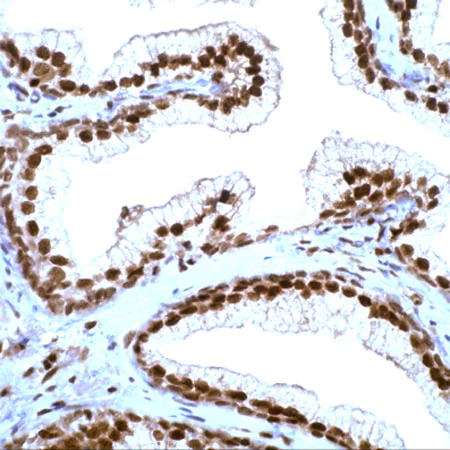
Immunohistochemistry (Formalin/PFA-fixed paraffin-embedded sections) - Anti-p27 KIP 1 antibody - C-terminal (AB231478)
  • IHC-P

Supplier Data

Immunohistochemistry (Formalin/PFA-fixed paraffin-embedded sections) - Anti-p27 KIP 1 antibody - C-terminal (AB231478)

Formalin-fixed, paraffin-embedded human prostate tissue stained for p27 KIP 1 using ab231478 at 1/100 dilution in immunohistochemical analysis.

Key facts

Host species

Rabbit

Clonality

Polyclonal

Isotype

IgG

Carrier free

No

Reacts with

Human

Applications

IHC-P

applications

Immunogen

The exact immunogen used to generate this antibody is proprietary information.

Reactivity data

{ "title": "Reactivity Data", "filters": { "stats": ["", "Species", "Dilution Info", "Notes"], "tabs": { "all-applications": {"fullname" : "All Applications", "shortname": "All Applications"}, "IHCP" : {"fullname" : "Immunohistochemistry (Formalin/PFA-fixed paraffin-embedded sections)", "shortname":"IHC-P"} }, "product-promise": { "all": "all", "testedAndGuaranteed": "tested", "guaranteed": "expected", "predicted": "predicted", "notRecommended": "not-recommended" } }, "values": { "Human": { "IHCP-species-checked": "testedAndGuaranteed", "IHCP-species-dilution-info": "1/100", "IHCP-species-notes": "<p>Boil tissue section in citrate buffer, pH 6.0 for 10 minutes followed by cooling at room temperature for 20 min. Incubate with ab231478 for 10 minutes at room temperature.</p>" }, "Mouse": { "IHCP-species-checked": "predicted", "IHCP-species-dilution-info": "", "IHCP-species-notes": "" }, "Rat": { "IHCP-species-checked": "predicted", "IHCP-species-dilution-info": "", "IHCP-species-notes": "" }, "Dog": { "IHCP-species-checked": "predicted", "IHCP-species-dilution-info": "", "IHCP-species-notes": "" }, "Hamster": { "IHCP-species-checked": "predicted", "IHCP-species-dilution-info": "", "IHCP-species-notes": "" } } }

Properties and storage information

Form
Liquid
Purification technique
Affinity purification Immunogen
Storage buffer
pH: 7.6 Preservative: 0.1% Sodium azide Constituents: PBS, 1% BSA
Shipped at conditions
Blue Ice
Appropriate short-term storage duration
1-2 weeks
Appropriate short-term storage conditions
+4°C
Appropriate long-term storage conditions
-20°C
Aliquoting information
Upon delivery aliquot
Storage information
Avoid freeze / thaw cycle

Supplementary information

This supplementary information is collated from multiple sources and compiled automatically.

The protein known as p27 KIP1 also referred to as p27 CDKN1B or KIP1 is a member of the kinase inhibitory protein family. It plays an important role in cell cycle regulation by inhibiting cyclin-dependent kinases (CDKs). p27 KIP1 weighs approximately 27 kDa and can be found in various tissues where it regulates cell proliferation. The protein functions as a suppressor by binding to cyclin-CDK complexes preventing the transition from G1 phase to S phase in the cell division cycle.
Biological function summary

The function of p27 KIP1 involves its role in controlling cell growth and division. It achieves this by becoming a part of larger protein complexes involving CDKs and cyclins. By directly interacting with these complexes p27 KIP1 modulates cell cycle progression therefore acting as a brake on cellular proliferation. The protein is important in maintaining proper cell cycle checkpoints and preventing uncontrolled cell growth which is essential for normal cellular functioning.

Pathways

The involvement of p27 KIP1 centers on cell cycle regulation and signaling pathways such as the PI3K/AKT pathway. Its interaction with CDKs and cyclins situates it within the core mechanisms that determine cell division timing. p27 KIP1 operates alongside other proteins like cyclin D and CDK4/6 fitting into the regulatory intricacies of these pathways. Proper functioning of these pathways ensures cellular homeostasis and prevents the development of oncogenic processes.

Dysfunction of p27 KIP1 has links to cancer and neurodegenerative diseases. Low levels or mutations can lead to uncontrolled cell proliferation contributing to the development and progression of cancers such as breast cancer. p27 KIP1's role in neurodegenerative diseases involves its regulation of neuronal cell cycle re-entry with abnormalities potentially exacerbating conditions like Alzheimer's disease. In these contexts its interaction with proteins such as cyclin E and CDK2 becomes particularly relevant in understanding disease mechanisms.

Product protocols

For this product, it's our understanding that no specific protocols are required. You can visit:

Target data

Important regulator of cell cycle progression. Inhibits the kinase activity of CDK2 bound to cyclin A, but has little inhibitory activity on CDK2 bound to SPDYA (PubMed : 28666995). Involved in G1 arrest. Potent inhibitor of cyclin E- and cyclin A-CDK2 complexes. Forms a complex with cyclin type D-CDK4 complexes and is involved in the assembly, stability, and modulation of CCND1-CDK4 complex activation. Acts either as an inhibitor or an activator of cyclin type D-CDK4 complexes depending on its phosphorylation state and/or stoichometry.
See full target information CDKN1B

Alternative Names

KIP1, p27, CDKN1B, Cyclin-dependent kinase inhibitor 1B, Cyclin-dependent kinase inhibitor p27, p27Kip1

Publications (2)

Recent publications for all applications. Explore the full list and refine your search

Carcinogenesis 34:858-63 PubMed23302291

2013

Prolonged survival and delayed progression of pancreatic intraepithelial neoplasia in LSL-KrasG12D/+;Pdx-1-Cre mice by vitamin E δ-tocotrienol.

Applications

Unspecified application

Species

Unspecified reactive species

Kazim Husain,Barbara A Centeno,Dung-Tsa Chen,William J Fulp,Marta Perez,Guo Zhang Lee,Noreen Luetteke,Sunil R Hingorani,Said M Sebti,Mokenge P Malafa

Genes & cancer 1:994-1007 PubMed21442024

2011

Critical role of Shp2 in tumor growth involving regulation of c-Myc.

Applications

Unspecified application

Species

Unspecified reactive species

Yuan Ren,Zhengming Chen,Liwei Chen,Bin Fang,Hla Win-Piazza,Eric Haura,John M Koomen,Jie Wu
View all publications

Product promise

We are committed to supporting your work with high-quality reagents, and we're here for you every step of the way. In the unlikely event that one of our products does not perform as expected, you're protected by our Product Promise.
For full details, please see our Terms & Conditions

Please note: All products are 'FOR RESEARCH USE ONLY. NOT FOR USE IN DIAGNOSTIC OR THERAPEUTIC PROCEDURES'.

For licensing inquiries, please contact partnerships@abcam.com