Anti-PARP4 antibody [EPR8230] - BSA and Azide free
- RabMAb
- Recombinant
- What is this?
Be the first to review this product! Submit a review
|
(0 Publication)
- WB
Unknown
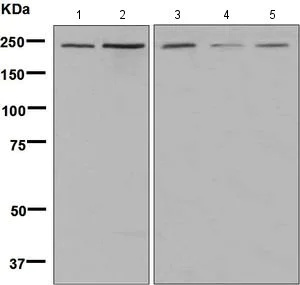
Western blot - Anti-PARP4 antibody [EPR8230] - BSA and Azide free (AB248636)
This data was developed using ab133745, the same antibody clone in a different buffer formulation.
All lanes:
Western blot - Anti-PARP4 antibody [EPR8230] (<a href='/en-us/products/primary-antibodies/parp4-antibody-epr8230-ab133745'>ab133745</a>) at 1/1000 dilution
Lane 1:
HeLa cell lysate at 10 µg
Lane 2:
HepG2 cell lysate at 10 µg
Lane 3:
Human fetal kidney tissue lysate
Lane 4:
293T cell lysate at 10 µg
Lane 5:
Human fetal liver tissue lysate
Secondary
All lanes:
Goat anti-Rabbit HRP at 1/2000 dilution
Predicted band size: 193 kDa
Observed band size: 193 kDa
false
- OI-RD Scanning
Unknown
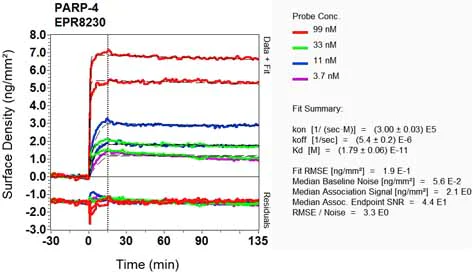
OI-RD Scanning - Anti-PARP4 antibody [EPR8230] - BSA and Azide free (AB248636)
We have systematically measured KD (the equilibrium dissociation constant between the antibody and its antigen), of more than 840 recombinant antibodies to assess not only their individual KD values but also to see the average affinity of antibody. Based on the comparison with published literature values for mouse monoclonal antibodies, Recombinant antibodies appear to be on average 1-2 order of magnitude higher affinity.
Related conjugates and formulations (1)
-
Anti-PARP4 antibody [EPR8230]
Complementary Products
Primary Antibodies
AB115777
Anti-beta Actin antibody [SP124] - Cytoskeleton Marker
20ul selling size|RabMAb|Lab Essentials|Recombinant
- 4
- 1
Reactivity data
Product details
ab248636 is the carrier-free version of ab133745.
Species reactivity
Mouse, Rat: We have preliminary internal testing data to indicate this antibody may not react with these species.
Please contact us for more information.
Patented technology
Our RabMAb® technology is a patented hybridoma-based technology for making rabbit monoclonal antibodies. For details on our patents, please refer to RabMAb® patents.
What are the advantages of a recombinant monoclonal antibody?
This product is a recombinant monoclonal antibody, which offers several advantages including:
- - High batch-to-batch consistency and reproducibility
- - Improved sensitivity and specificity
- - Long-term security of supply
- - Animal-free batch production
For more information, read more on recombinant antibodies.
Conjugation ready
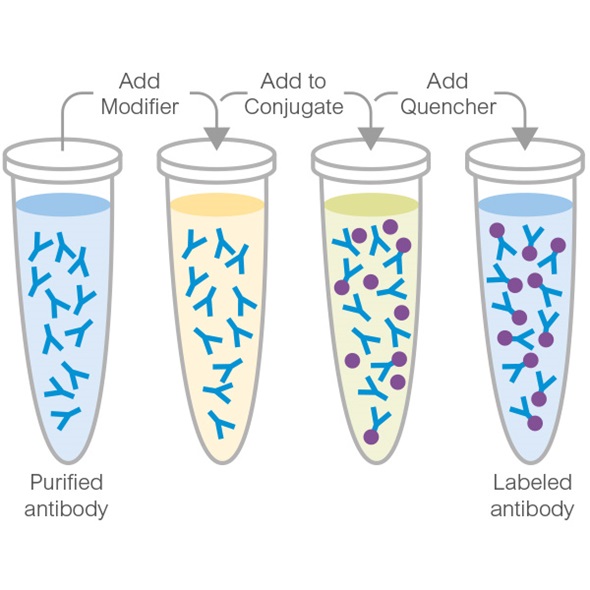
Our carrier-free antibodies are typically supplied in a PBS-only formulation, purified and free of BSA, sodium azide and glycerol. This conjugation-ready format is designed for use with fluorochromes, metal isotopes, oligonucleotides, and enzymes, which makes them ideal for antibody labelling, functional and cell-based assays, flow-based assays (e.g. mass cytometry) and Multiplex Imaging applications.
Use our conjugation kits for antibody conjugates that are ready-to-use in as little as 20 minutes with 1 minute hands-on-time and 100% antibody recovery: available for fluorescent dyes, HRP, biotin and gold.
Compatibility
This product is compatible with the Maxpar® Antibody Labeling Kit from Fluidigm, without the need for antibody preparation. Maxpar® is a trademark of Fluidigm Canada Inc.
Properties and storage information
Form
Purification technique
Storage buffer
Shipped at conditions
Appropriate short-term storage conditions
Appropriate long-term storage conditions
Storage information
Supplementary information
This supplementary information is collated from multiple sources and compiled automatically.
Biological function summary
Through its enzymatic activity involving ADP-ribosylation PARP4 plays a role in DNA repair and stress response regulation. It is part of larger structures called vault ribonucleoprotein particles which are implicated in transporting molecules across the nuclear-pore complex. The interaction of PARP4 with these vault particles suggests its involvement in intracellular transport and cellular signaling processes.
Pathways
Researchers observe PARP4's involvement in the DNA damage response and repair mechanisms. It interacts with the base excision repair (BER) pathway helping maintain genomic integrity. PARP4 also relates to proteins such as p53 which is a significant player in the regulation of cell cycle arrest and apoptosis following DNA damage indicating its regulatory importance in these pathways.
Product protocols
- Visit the General protocols
- Visit the Troubleshooting
Target data
Alternative Names
Product promise
Please note: All products are 'FOR RESEARCH USE ONLY. NOT FOR USE IN DIAGNOSTIC OR THERAPEUTIC PROCEDURES'.
For licensing inquiries, please contact partnerships@abcam.com